Rolex Chronograph 6238
- Make
- Rolex
- Reference
- 6238
- Model
- Chronograph
- Production
- 1960–1967
- Case diameter
- 36 mm
- Calibre
- 72B
- Case material
- Steel
AI-generated illustration.
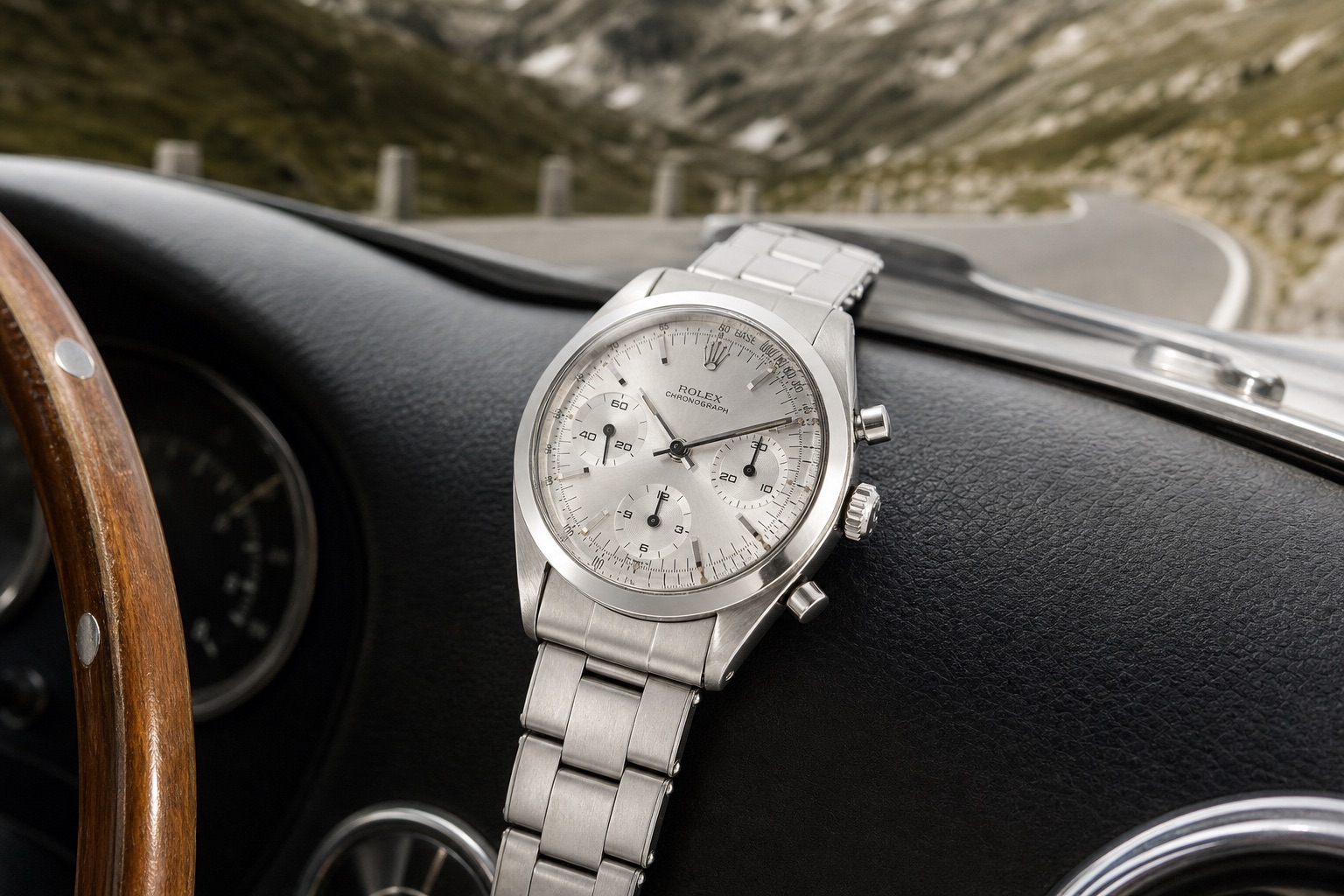
Rolex had been putting chronographs in waterproof Oyster cases since the late 1930s, when the reference 3525 became the first. For twenty-odd years those watches kept the same basic look: a plain bezel, a monochrome dial, and a tachymeter scale printed around the dial's edge. The Rolex Chronograph 6238 is the last of them. Christie's puts it plainly: "Launched in 1960, reference 6238 was the manufacturer's last traditional chronograph wristwatch with polished bezel."
It is also the first of what came next. When Rolex launched the Cosmograph 6239 in 1963, the new watch "used certain style elements of ref. 6238, notably the case, indexes, crown and chronograph pushers". Rolex moved the tachymeter onto the bezel and redesigned the dial, but the watch underneath was already there. Those shared parts are why, as Phillips puts it, collectors gave the 6238 its nickname, the "Pre-Daytona". Sotheby's calls it "the bridge between the early chronographs of the 1930s-1950s and the vintage Cosmograph Daytonas", which is the best one-line summary I've found.
It ran for about seven years, in small numbers, and for four of them it was on sale beside its own successor. Then, in 1969, it was on George Lazenby's wrist as James Bond.
I don't own one and haven't handled one. I want one, which is a good reason to be strict about what the record actually supports.
Where it came from
The 6238's direct ancestor is the 6234, which Phillips dates to 1955 and says Rolex stopped making in 1961, replacing it with the 6238. Christie's once called the 6234 "a "pre-pre-Daytona" as the imminent predecessor of reference 6238 which was the last Oyster Chronograph before the Cosmograph and Daytona era begun", which tells you how much of this family's history gets read backwards from the Daytona. Monaco Legend traces the line further, to the 3525: the 6238 "retained the utilitarian charm of its predecessors: monochromatic dials, outer tachymeter scale, and an elegant restraint in its design".
What changed was the case and the hands. The 6238 got a new 36 mm case, with an enlarged crown and round pump pushers, and from early in the run, straight baton hands. Christie's describes these as "the newly designed hands - for the first time in straight baton form", and says the 6238 was Rolex's first chronograph with a sunburst-finished silver dial, "officially referred to as "cadran soleil argenté"". The batons stayed on Daytonas, Christie's notes, until the mid-1980s.
The start date depends on whom you ask. Phillips and Christie's say 1960. Antiquorum says the 6234 "evolved into the reference 6238" in 1962, and that the watch first appeared in a Rolex catalogue, the one for the Italian market, in 1964. The earliest dated watches I found are two Antiquorum lots "Made in 1961", at serials 866302 and 866448. My read is that the reference existed by 1960 or 1961 and reached the catalogue later. The end is closer to agreed. Most houses say production stopped in 1967, Antiquorum says it left the catalogue in 1968, and a few watches are dated 1968. Shops kept selling them after that: Phillips sold a 14k example with a guarantee dated June 1969.
Phillips says the 6238 and 6239 were produced in parallel, and it calls the 6238 the brand's last classic chronograph or its first modern one. No source I read names a designer, or gives Rolex's own reason for making it. Christie's offers only "Clearly designed as a sport watch", which is a cataloguer's reading of the object.
It wasn't expensive. A Fratello reader who bought one new in 1968 paid US$215, up $10 on the price he was first quoted. That's a single invoice, and it's the best price evidence I found.
How many were made is disputed. Christie's says "approximately 3,600 examples" across steel, 14k and 18k gold, and Antiquorum gives the same figure as an estimate for 1962 to 1967. Fratello repeats 3,600 from Gisbert Brunner's Rolex, The Watch Book and notes other sources saying 2,000 to 2,500, which is the figure Bob's Watches prints. Corrado Mattarelli gives the most precise breakdown: 3,590 in steel, 150 in 18k and 225 in 14k. None of them shows its method, and the 3,600 figures may all trace back to one origin.
Bond's watch
The 6238's best-known moment is documented on paper. In December 2003, Christie's South Kensington sold "a stainless steel chronograph wristwatch, 1960s, signed Rolex, Chronograph, case no. 1206613, ref. 6238", catalogued as "purchased for and worn by George Lazenby as James Bond" in On Her Majesty's Secret Service. It came with a press still of Lazenby wearing it and an invoice from Bucherer to Eon Productions dated 23 October 1968. It made £22,912. Bob's Watches says it is the only Rolex chronograph to appear in the Bond films.
The watch came back to auction at Antiquorum in Monaco in July 2019, estimated at €300,000 to €500,000, and by then it had a red chronograph hand. Antiquorum's essay hedges the story: "History would have it that the red needle was modified at the request of Production." Christie's 2003 catalogue lists "luminous steel hands" and mentions no red. I couldn't find a result for the 2019 sale, so I can't say what it made, or whether it sold.
The watch
| Spec | Value |
|---|---|
| Case | 36 mm (auction-house figure; crown not stated), steel, 14k or 18k yellow gold |
| Thickness | 13 mm or 14 mm, depending on the Antiquorum lot; method not given |
| Bezel | Smooth, polished, no scale |
| Crystal | Domed acrylic |
| Crown and back | Screw-down crown, screw-down caseback |
| Pushers | Two round pump pushers, not screw-down |
| Dial | Monochrome: silver, grey or black; tachymeter printed on the dial |
| Movement | Valjoux 72-based, signed 72B and later 722; manual wind, 17 jewels |
| Functions | Hours, minutes, small seconds, chronograph with 30-minute and 12-hour registers |
| Bracelet | Expanding 6635 or riveted 7205 Oyster; folded 7835 from about 1968 |
The movement is the Valjoux 72, with Rolex's own finishing and a Microstella regulator. Lots list it as 72B, 722 and occasionally 72-1 or 727, which looks like chaos until you read Antiquorum's note on an 18k example: "Caliber 722 is an improved version of the caliber 72B. The caliber 722 is however still engraved 72B." A collector review by WatchProSite moderator DrStrong dates the rename to 1965. So a 72B and a 722 from the same year can be the same movement, catalogued two ways. The 727 is the calibre of the later manual Daytonas, and I'd treat a 727 in a 6238 as a question for the seller. The earliest watch I found, from 1961, has a 72A, the 6234's movement.
Whether the 6238 counts as an Oyster is a real dispute. Antiquorum wrote that it "was not yet an 'Oyster' version and did not have a screw down winding crown or screw down timing buttons". Christie's describes a "screw back, screw down crown, two round buttons in the band", and early dials say "Oyster Chronograph". My read is that the case is an Oyster and the pushers aren't sealed, which is the problem the 6240 solved with screw-down pushers in 1965. No source I found gives a water-resistance rating, and I wouldn't swim in one.
Lug width and lug-to-lug weren't stated anywhere I could check. DrStrong says the watch was sold with a 19 mm riveted bracelet, which is one collector's word, so I haven't put it in the table.
How it changed
Nobody publishes a dial-by-serial guide for the 6238 the way collectors have for some references. The table below is my own read across nearly fifty auction lots, from the four big houses plus Monaco Legend and Bonhams. Serial bands are approximate, and older catalogues often give years that don't fit the serial, so I've gone by serial.
| Years | Serials seen | Dial | Hands | Movement |
|---|---|---|---|---|
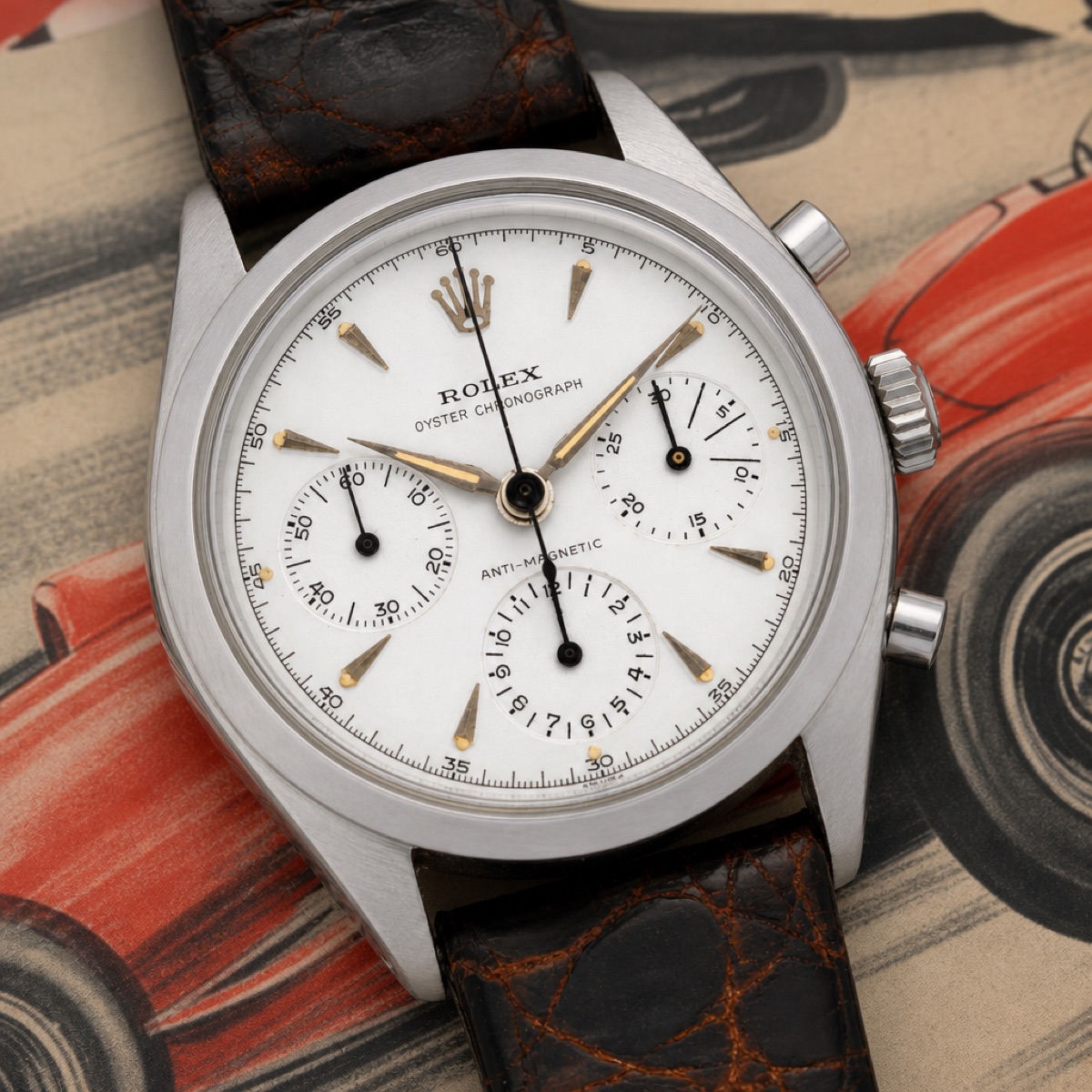
| 1961–62 | 866xxx | 6234-type: "Oyster Chronograph" and "Anti-Magnetic", dart or dagger indexes, telemeter and tachymeter, minute track only, or no scale | Dart or alpha | 72A, then 72B |
| 1963 | 907xxx–997xxx | Overlap: late 6234-type dials, underline dials, the first "Chronograph"-only dials with batons, first black dials | Batons on new dials | 72B |
| 1964 | 1.00M–1.10M | Silver sunburst is standard; black galvanic, lacquer and matte; rare pulsometer and grey | Baton | 72B, 722 |
| 1965–66 | 1.15M–1.42M | Silver sunburst, dark grey, black matte grené with silver print, black galvanic | Baton | 72B and 722 |
| 1967–68 | to 1.93M | Silver sunburst; 14k black grené | Baton | 722, 722-1 |
The early watches are the interesting ones. Antiquorum says some of the first 6238s "still had the characteristics of the earlier references as ROLEX was probably finishing up their remaining stock of parts", and the lots bear that out. A 1961 watch at serial 866448 wears the 6234's dial, reading "Oyster Chronograph" and "Anti-Magnetic", and Antiquorum notes that "the dials were changed for the 6238 to read only 'Chronograph'". Some early dials carry a telemeter as well as a tachymeter, like 866368, and one at 866211 has no tachymeter scale at all. Bob's says Rolex dropped the telemeter from the 6238 entirely, which is true of the later dials and wrong for these.
1963 is the messy year, and the most fun to read about. Lots from that year show late 6234-style dials with black and blue scales, "underline" dials, and the first "Chronograph"-only silver dials with batons, all within about 100,000 serials. By 1964 the silver sunburst dial with batons is the norm, and it stays that way to the end.
AI-generated illustration.
The variations that matter
Dials
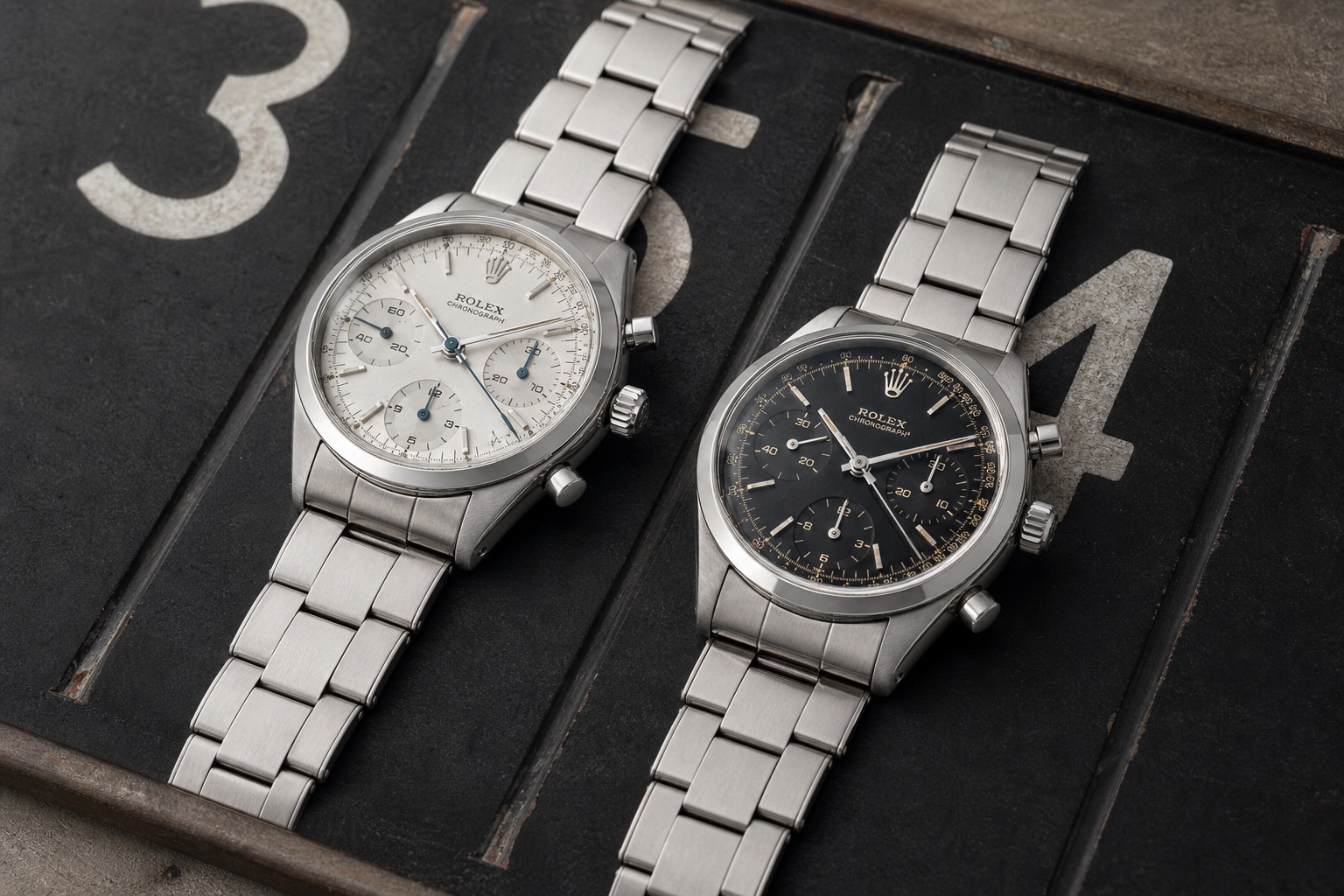
Every 6238 dial is one colour with matching registers. Phillips is explicit that the reference was only offered with a monochrome dial, so a two-tone "panda" 6238 is either a 6239 dial or a problem.
Silver sunburst is by far the most common, with a radial brushed finish that catches the light. Dark grey is the rarest standard colour: Phillips calls a 1965 example the rarest dial variant, and Le Monde Edmond's review says collectors often confuse it with silver. In a dealer photo under warm light, they can look the same.
Black is where the vocabulary gets thick. The houses describe three finishes. Galvanic black with gilt printing, glossy or lacquered black, and matte "grené" black with silver printing. Phillips calls the matte ones "the second generation 'grené' dials with silver printing", which implies gloss came first. Its own dated lots don't quite agree: a matte black dial with tritium text sits on serial 964'614 from 1963, while glossy black turns up on 1'076'844 in 1964. Le Monde Edmond's view is that glossy and matte were made in no particular order, and also that "glossy" on a 6238 just means more shine than matte. I'd go with both.
The lume text is the other dating clue. Early dials read just "Swiss" at six o'clock; tritium dials read "T Swiss T". Monaco Legend describes a 1963 black dial with a small line under the signature and explains that the underline denotes the switch from radium to tritium. Phillips describes the move to "T Swiss T" on an 18k watch from 1964. At least one black galvanic dial from 1965 has no lume plots at all.
AI-generated illustration.
Gold cases
Gold 6238s are scarce. Christie's puts them at "less than a tenth of the entire model production in gold, and particularly few watches in 18 carat", and Antiquorum estimates about 150 in 18k. The two golds went to different markets. Phillips says 14k cases were usually reserved for North America, with 18k for Europe and Asia. The lots show gold made in small batches: 18k at serials around 884xxx, 1'038'6xx and 1'422'4xx, and 14k around 997'1xx and later in 1968.
Monaco Legend's essay on an 18k watch says "the vast majority have been produced in 14 carats". That conflicts with Christie's and Phillips, and with Mattarelli's numbers, and I suspect it means most gold 6238s. Even read that way, it's one house against several.
US-market watches have a tell beyond the metal. A movement bridge stamped "ROW" marks a watch destined for the North American market, and many come on US-made C&I or Champion bracelets.
Bracelets
Sotheby's names "the tradition bracelets for the 6238 that are the expanding 6635 and the riveted 7205", with "a folded 7835 bracelet that appeared around 1968". One 1965 watch at Phillips came on a 7205 with end links stamped 71. The lots also show end links stamped 57, 60 and 61, and Jubilees, which Phillips calls rarely seen on this reference. I found no clean rule tying an end-link number to a serial band, so I'd judge a bracelet by checking its clasp date against the watch.
The same 1968 Sotheby's lot, which calls itself one of the last 6238s made, has a case that is "slightly convex to the crown, with a light hollow after the lower right lug, giving it a profile very similar to the ref. 6240". That's one example, but it suggests late cases were already shared with the Cosmograph line.
Co-branded, commissioned and unusual dials
Tiffany & Co.
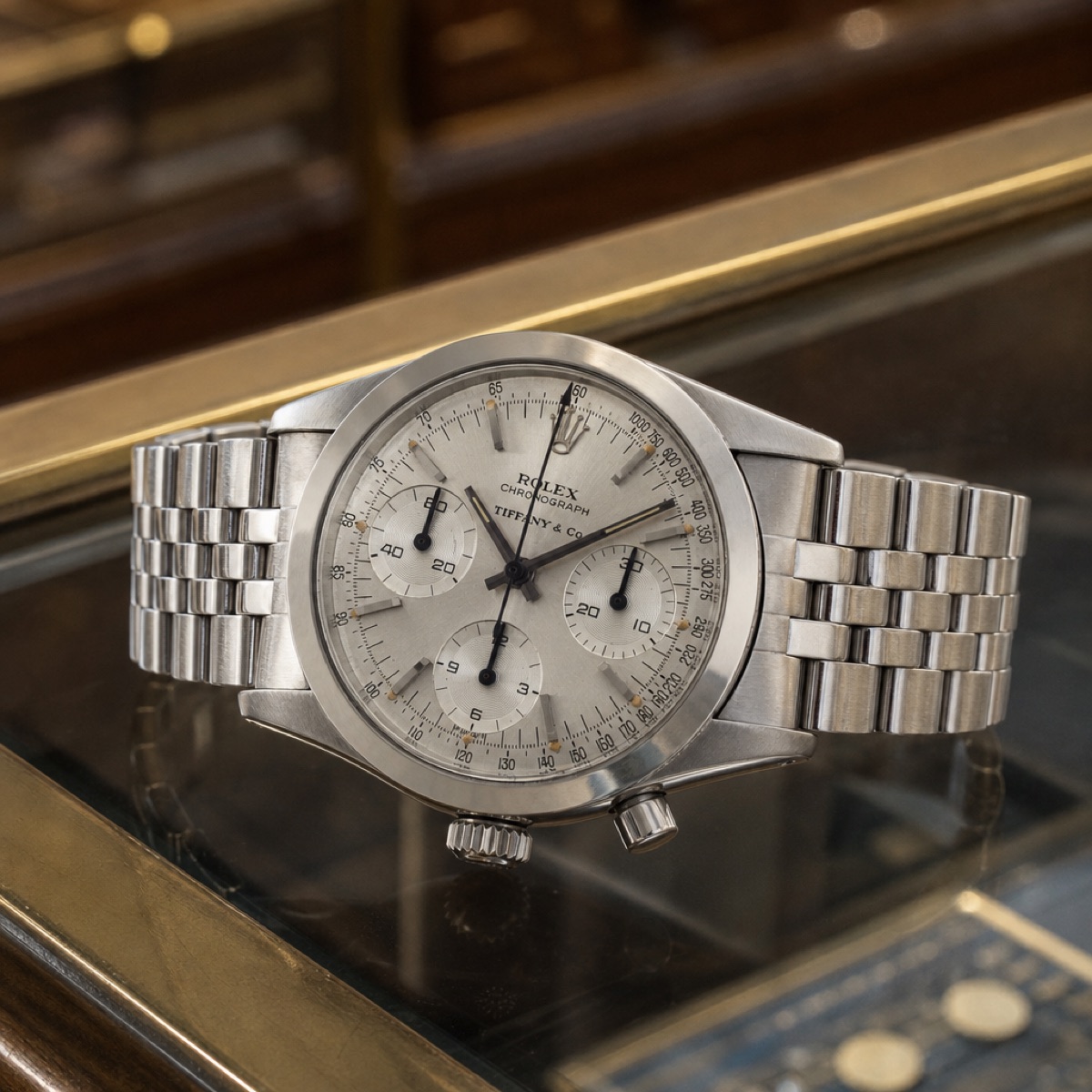
Tiffany is the only retailer signature I could document on a 6238 with an actual lot. I found four: steel examples at Phillips, Phillips Hong Kong and Antiquorum, and a 14k one at Phillips Geneva. The steel Phillips watch, a silver sunburst in unrestored condition, sold for CHF 161,000 in the 2016 Start-Stop-Reset sale against an estimate of CHF 50,000 to 100,000. The Antiquorum watch made CHF 56,250 in 2017. The Hong Kong lot carries a ROW movement, which Phillips reads as proof it was sold in the US.
Sotheby's essay on a 14k Tiffany 6238 says Rolex allowed the retailer to stamp the dials at its Fifth Avenue premises, and that the number made is unknown. That's the problem with the category. The signature was added outside the factory on at least some watches, so a Tiffany print on a 6238 dial needs the same scrutiny as any other dial print, and more, given what it adds to the price.
Plenty of Tiffany Daytonas exist, and their stories leak into 6238 listings. The Tiffany lots I checked at Phillips, Christie's and Monaco Legend that turned up in searches for this reference were all 6239s. I found one magazine line claiming an Asprey 6238 and no lot to back it, and nothing for Cartier, Beyer or Serpico y Laino on this reference.
AI-generated illustration.
The pulsometer dial
The most unusual dial I could document is a silver dial with a blue pulsometer scale, used to count a pulse. Sotheby's sold one in 2012 and called it "the fourth known to appear in the market", from a run "produced for a very short period in few examples". Another made US$175,000 at Phillips in its Game Changers sale. Hairspring says dials like this were mostly special-ordered by medical professionals, which is plausible and, as far as I can tell, unprovable.
The Peruvian Air Force
The only documented institutional 6238s carry a caseback engraved for the Fuerza Aérea del Perú. Monaco Legend sold a 1964 example in 2019 for €59,800, and its essay hedges the history: the air force "is thought" to have ordered watches for its officers in the early 1960s, mostly Daytonas but some 6238s. Antiquorum sold another in 2020. The engraving is on the back, and engravings can be added, so the paperwork matters more than the caseback.
I found no named factory error or misprint dial for the 6238.
Why it matters
The obvious objection is that the 6238 is a Daytona without the Daytona, priced on borrowed fame. Part of that is fair: "Pre-Daytona" is a collector's sales word, and the 6238's prices only make sense next to the 6239's. But the auction record shows the market valuing it in its own right. The top result I found is an 18k watch with a black lacquer dial, ex-John Goldberger, that made €825,000 at Monaco Legend in October 2021. In steel, a brown tropical "Suspended T" dial, with its tritium marks floating between the six o'clock register and the tachymeter, made CHF 492,500 at Phillips in 2018. A matte black steel watch sold at Phillips for CHF 149,000 in 2016 and again for CHF 190,500 in Phillips' Decade One sale. Ordinary watches sell for far less: a silver-dial steel example made CHF 50,000 at Phillips' Geneva SIX sale. That's still a long way from US$215.
What I like about the 6238 is that it's the moment the Daytona's parts were already designed and the dial hadn't caught up. You get the case, crown, pushers and hands that Rolex would use for the next twenty years, under the restrained dial of the 1950s. The 6239 is the more important watch. I think the 6238 is the better-looking one.
What I'd check before buying one
- The dial, first. Vintage chronograph dials are often redone. Phillips' strongest results are for watches whose essays stress an unrestored dial, and an Artcurial black 6238 with a refreshed dial and relumed dots passed unsold in 2023. Corrado Mattarelli warns of replacement dials with the wrong lettering, and of a "Daytona" dial that may have come from a 6239.
- Dial against serial. A 6234-type dial on an 866xxx serial is right; on a 1.2M serial it's a question. Lume text ("Swiss" or "T Swiss T") should fit the year.
- Monochrome only. A two-tone dial means 6239 parts.
- The bezel. It should be smooth and polished, with no scale. A sharp bezel is a good sign of an unpolished case; a 6238 with a graduated bezel has very likely borrowed a Daytona's.
- The caseback. Some correct 6238s have 6239 stamped inside, so a 6239 stamp can be fine, as long as the rest of the watch agrees.
- The movement. 72B or 722 (still engraved 72B) is right. A 727 needs an explanation, and ROW on the bridge should match a US-market history.
- Hands. Batons on later dials, alpha or dart on the first series. The registers' hands are thinner than on a 6239.
I found no guidance on outright fakes of the 6238. The risks in the record are redials, swapped Daytona parts and polished cases, so buy the seller and the paperwork as much as the watch.
Sources
- Phillips, ref. 3525, Geneva NINE, lot 55
- Phillips, ref. 6238, origin of the Pre-Daytona nickname
- Phillips, "Manual-wind Rolex Daytonas", November 2024
- Phillips, ref. 6234, yellow gold
- Phillips, ref. 6234, steel, Geneva EIGHT, lot 209
- Christie's, ref. 6234, New York, December 2012
- Christie's, ref. 6238, launched in 1960
- Christie's, ref. 6238, precursor of the 6239
- Christie's, ref. 6238 in 18k gold, sunburst dial and baton hands
- Christie's, ref. 6238, about 3,600 made
- Christie's, ref. 6238, case construction
- Christie's, ref. 6238, New York, December 2016
- Christie's South Kensington, George Lazenby's ref. 6238, December 2003, lot 164
- Sotheby's, ref. 6238, London 2016, lot 138
- Sotheby's, ref. 6238, Time Museum sale 2008, lot 96
- Sotheby's, ref. 6238, Hong Kong 2018, lot 2746
- Sotheby's, ref. 6238 from 1968, London, lot 30
- Sotheby's, ref. 6238 pulsometer dial, Geneva 2012, lot 238
- Sotheby's, ref. 6238 retailed by Tiffany & Co., 2020
- Antiquorum, ref. 6238, 6234 evolved into 6238
- Antiquorum, ref. 6238, Italian catalogue and production estimate
- Antiquorum, ref. 6238 from 1961 with cal. 72A
- Antiquorum, ref. 6238 from 1961 with a 6234 dial
- Antiquorum, ref. 6238, catalogue 1964 to 1968
- Antiquorum, ref. 6238 in 18k, cal. 722 engraved 72B
- Antiquorum, ref. 6238 in 18k, about 150 made
- Antiquorum, ref. 6238, George Lazenby, Monaco 2019, lot 103
- Antiquorum, ref. 6238 retailed by Tiffany & Co., 2017, lot 144
- Antiquorum, ref. 6238 for the Peruvian Air Force, 2020
- Phillips, ref. 6238, Geneva SIX, lot 132
- Phillips, ref. 6238, produced in parallel with the 6239
- Phillips, ref. 6238 in 14k with a 1969 guarantee
- Phillips, ref. 6238, monochrome dials
- Phillips, ref. 6238, dark grey dial
- Phillips, ref. 6238, matte black grené dial
- Phillips, ref. 6238, black and blue scales
- Phillips, ref. 6238, Start-Stop-Reset, lot 68
- Phillips, ref. 6238, Decade One, lot 77
- Phillips, ref. 6238 in 18k, Swiss to T Swiss T
- Phillips, ref. 6238 with no lume plots and a 7205 bracelet
- Phillips, ref. 6238 in 18k, 14k for North America
- Phillips, ref. 6238 on a Jubilee bracelet
- Phillips, ref. 6238 retailed by Tiffany & Co., Start-Stop-Reset, lot 14
- Phillips, ref. 6238 retailed by Tiffany & Co., Hong Kong EIGHT, lot 1152
- Phillips, ref. 6238 in 14k retailed by Tiffany & Co., lot 146
- Phillips, ref. 6238 pulsometer dial, Game Changers, lot 21
- Phillips, ref. 6238 "Suspended T", Geneva EIGHT, lot 86
- Monaco Legend, ref. 6238 black lacquer, October 2025, lot 84
- Monaco Legend, ref. 6238 black underline dial, lot 236
- Monaco Legend, ref. 6238 black galvanic with ROW movement, lot 82
- Monaco Legend, ref. 6238 in 18k ex-Goldberger, October 2021, lot 285
- Monaco Legend, ref. 6238 for the Peruvian Air Force, July 2019, lot 158
- Artcurial via Invaluable, ref. 6238 black dial, Monte-Carlo, July 2023, lot 265
- Le Monde Edmond, "In-depth review Rolex 6238 Pre-Daytona", Edmond Saran, 2016
- WatchProSite, "A review of the Pre-Daytona ref. 6238", DrStrong, 2012
- Fratello, "A $215USD Rolex 6238 from 1968", 2018
- Bob's Watches, "The Rolex 6238 Pre-Daytona Chronograph"
- Bob's Watches, George Lazenby and James Bond, 2017
- Corrado Mattarelli, "Rolex ref. 6238"
- Hairspring, pulsations dial 6238