Rolex Datejust 16234
- Make
- Rolex
- Reference
- 16234
- Model
- Datejust
- Production
- 1988–present (in production)
- Case diameter
- 36 mm
- Calibre
- 3135
- Case material
- Stainless steel and 18k white gold
AI-generated illustration.
Rolex launched the Datejust in 1945 with three things that still define it: a date in a window at three o'clock, a fluted bezel and a new five-link bracelet called the Jubilee (Rolex). The Cyclops lens over the date followed in 1953 (Rolex). For the next 35 years the formula hardly moved. The Datejusts of the late 1970s and early 1980s, the 16014 and its siblings, still wore a domed acrylic crystal.
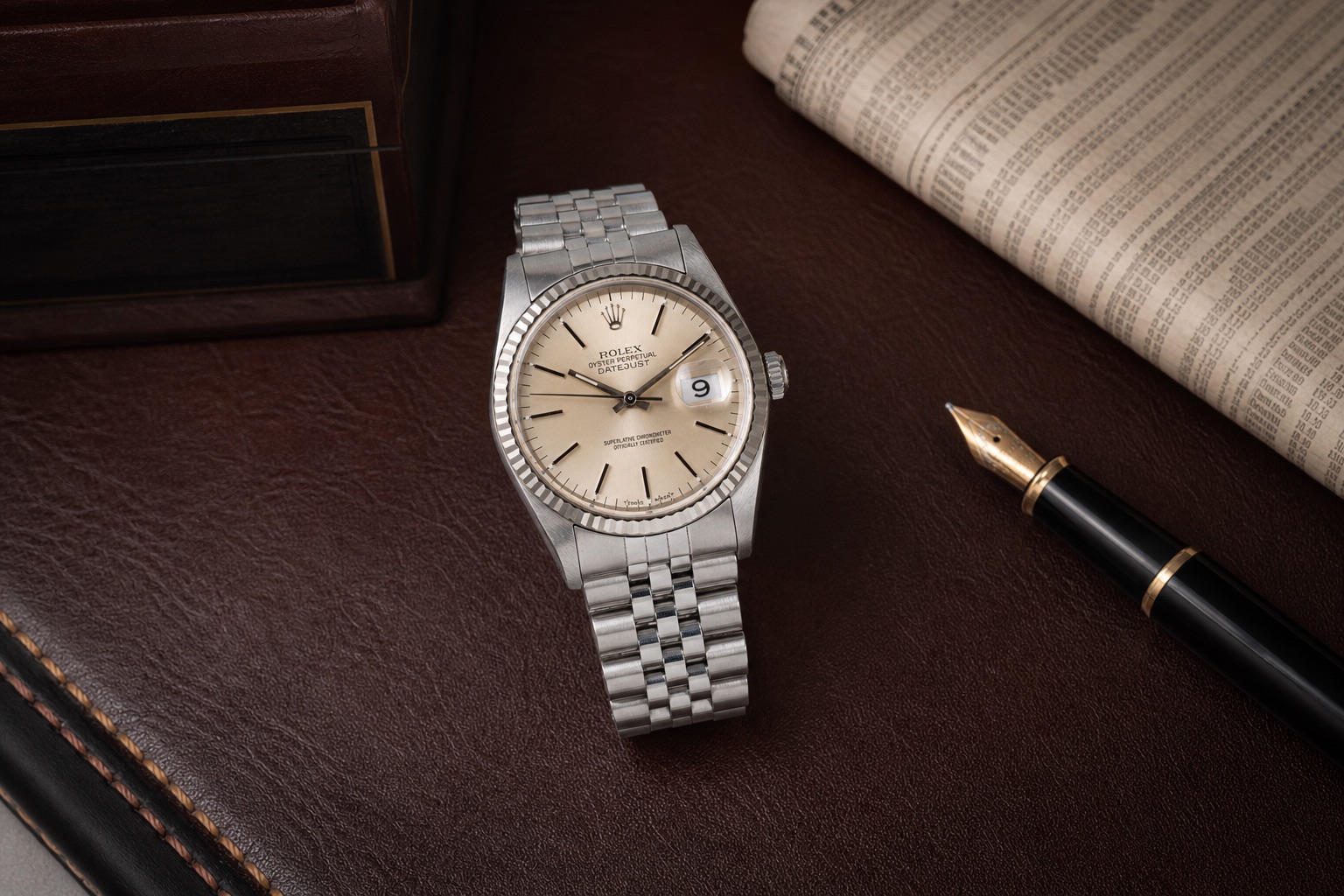
The Rolex Datejust 16234 is the watch that changed that. Phillips puts its introduction in 1988, fitted with the new calibre 3135, and says it was "the first from its model" with a sapphire crystal in place of the old Plexiglas (Phillips). It's the steel version with an 18 ct white gold fluted bezel, and it stayed in the catalogue until the mid-2000s. That makes it the bridge in the Datejust story. It has the proportions of the vintage watches and the crystal and movement Rolex would keep building on for the next three decades.
I've restored and rebuilt several of these. The parts are plentiful, so a 16234 is relatively affordable to bring back, and that same plenty is the main thing a buyer has to watch for. Most of this article is about what a correct one looks like at each point in its run.
Where it came from
The Datejust sits on two older Rolex ideas. The fluted bezel was "presented on our Oyster in 1926", and it began as a working part: its notches let it be screwed tightly to the case to complete the seal (Rolex). The Jubilee was "specifically created for the Datejust" and "launched in 1945 to celebrate 40 years of craftsmanship" (Rolex). The first reference was the 4467 (Phillips).
By the late 1970s the steel Datejust was the 160xx generation: the 16000, the 16014 with its white gold fluted bezel, and the 16030, all on calibre 3035 (BeckerTime). A lot of dealer copy credits the 16234 with a faster beat and a quickset date. It didn't bring either. The 3035 of 1977 was already Rolex's first 28,800 vph movement and already had the quickset date (BeckerTime), so the 16014 had both a decade earlier.
What arrived in 1988 was two things. The first was the crystal. Every Phillips essay on a 16234 I read treats sapphire as the headline, one calling it "perhaps the most notable and practical upgrade" (Phillips), and Sotheby's says the generation was "the first Datejust model to feature a sapphire crystal" (Sotheby's). The second was the movement. Phillips says Rolex "released the ref. 16200 series of Datejust models upgraded with the firm's new cal. 3135" that year (Phillips). The steel and white gold 16234 came with the steel 16200, the engine-turned 16220 and the steel and yellow gold 16233.
Fratello's Robert-Jan Broer makes the point I'd lead with: with the 162xx series, "the case design stayed the same as its predecessors" (Fratello). Rolex changed the inside and the glass and left the shape alone. That's why a 16234 sits so close to a 16014 on the wrist, and why so many parts cross between them.
No source I read names a designer, and I found no period advert or Rolex price list for the 16234 itself. A collector's transcription of a dealer price table puts the steel and white gold fluted Jubilee Datejust at $3,500 in February 1989 (Minus4Plus6, archived). I think that's the first 16234 price in the table, but the row doesn't name the reference and I couldn't find the original list to check it.
The famous-owner stories don't hold up either. One Japanese dealer's column puts Paul Newman in a 16234 in The Color of Money, a 1986 film made two years before the watch existed (Commit). The Datejust has plenty of famous wearers. This reference, as far as I can find, has none that anyone has documented.
The replacement
The 116234 replaced it, and sources disagree on when. Sotheby's gives 1988 to 2004 for the generation, writing about the two-tone 16233 (Sotheby's). Fratello says 2005, and BeckerTime says "around 2006" (BeckerTime). The physical evidence sits in between. Rolex's own website still listed the 16200 from this generation in November 2004 and March 2005 (Rolex, archived), and Sotheby's catalogued a 16234 with an F-prefix serial as circa 2005 (Sotheby's). I'd call it 2005 and accept a year either way. The line continued in the 2019 126234.
The watch
| Spec | Value |
|---|---|
| Official name | Oyster Perpetual Datejust |
| Dial text | Superlative Chronometer Officially Certified |
| Reference | 16234 |
| Case | Oyster, 36 mm nominal; screw-down caseback |
| Measured | 34.3–34.5 mm across the bezel, 35.4–35.7 mm case width, 43.4–43.6 mm lug to lug |
| Thickness | 11.8 mm (one measured example) |
| Lug width | 20 mm |
| Material | Stainless steel case and bracelet; 18 ct white gold fluted bezel |
| Crystal | Sapphire, Cyclops lens over the date |
| Crown | Screw-down |
| Water resistance | 100 m |
| Movement | Calibre 3135, automatic, 31 jewels |
| Frequency | 28,800 vph |
| Power reserve | About 48 hours |
| Functions | Hours, minutes, central seconds; quickset date |
| Certification | COSC chronometer |
| Bracelets | Jubilee 62510H with 555B end links; Oyster 78360 |
The measurements come from Antiquorum's catalogues of two 16234s, one c.1996 and one c.2002 (Antiquorum, Antiquorum), with thickness and lug width from a Gray & Sons listing (Gray & Sons). Water resistance is from BeckerTime, and the movement details from the auction lots and Bob's Watches.
The 3135 is the reason to care about this reference. It's 6 mm tall, thinner than the 3035, and its balance sits under a full bridge held at both ends instead of a cock held at one, which makes the balance more stable (BeckerTime). It has a Breguet overcoil and is regulated by Microstella nuts on the balance (Bob's Watches). Sources split on the reserve: BeckerTime's comparison gives 48 hours against the 3035's 42, and its own review of the 16234 says 50. I've used the majority figure. BeckerTime counts the 3135 in Rolex production until 2022 and calls its modular design "loved by watchmakers and technicians", which is the best argument for it I know.
Two claims about the steel and the hairspring need care. BeckerTime says the 16234 was "the last of the DJ family to be forged in 316L grade steel", but another BeckerTime piece has Rolex moving its whole line to 904L in 2003, which would catch the last couple of years of production (BeckerTime). I couldn't find a Rolex source for either, so I just call it stainless steel. On the hairspring, Fratello says "early 3135 movements still had the Nivarox (Swatch Group) hairspring" (Fratello). Bob's 2024 review says the 16234 has a Parachrom hairspring, and I found nothing to support that. A blue Parachrom in a 16234 today is most likely a service part.
Collectors read the reference number as a code: 162 for a Datejust with the 3135, 3 for the fluted bezel, and the last digit for the metals (BeckerTime). I couldn't find Rolex publishing a key, but it's a useful way to keep the siblings apart. Antiquorum muddies it slightly: some of its lots are catalogued as "16234 / 16200" and one as "16234 / 2080", with no explanation on the page (Antiquorum). Phillips records the number 2080 stamped inside the caseback of another 16234, so my guess is that it's a case code, but I haven't seen anyone confirm it.
How it changed
| Years | Serial prefixes | Case | Dial lume | Bracelet seen on dated examples |
|---|---|---|---|---|
| 1988–1990 | R, L, E | Drilled lug holes | Tritium | Jubilee 62510H, 555B |
| 1991–1994 | X, N, C, S | Lug holes dropped somewhere in this stretch or the next | Tritium | Jubilee 62510H, 555B |
| 1995–1998 | W, T, U | No lug holes | Tritium; "tritinova" transitional dials late | Jubilee 62510H, 555B; Oyster |
| 1999–2001 | A, P, K | No lug holes | Luminova, then Super-LumiNova | Oyster 78360, 558B |
| 2002–2005 | K, Y, F | No lug holes | Super-LumiNova | Jubilee 62510H, 555B |
The serial years follow Bob's Watches' chart (Bob's), which admits there's no official Rolex list. Every date in this table is approximate. The bracelet and case columns come from 16234s catalogued with a serial and a year by Antiquorum, Sotheby's and Phillips, plus a handful of dealer pieces.
Read as a story, the table shows a watch that never had a redesign. Rolex kept the case, the bezel and the movement and changed the small things around them, and those are what date a 16234 today.
The lug holes went first. Early cases are drilled through the lugs for the spring bars, and later ones are solid. Nobody agrees on the year. A Dutch dealer says "around 1993", BeckerTime says the mid-1990s, and the dealer examples I could check put a drilled case on a 1991 X serial (Craft & Tailored) and a solid one on a 1996 T serial (Craft & Tailored). "Early to mid 1990s" is as precise as the evidence goes.
The lume changed next, and you can read it at six o'clock. Tritium dials carry a "T" in their bottom text, as "T Swiss T", "T Swiss Made T" or "Swiss - T < 25". Around 1998 Rolex switched to Luminova and printed just "Swiss", then "Swiss Made" with Super-LumiNova from about 1999 or 2000 (WatchProSite). That evidence comes from the sports models, and the Datejust doesn't follow it neatly. Craft & Tailored sold a 1997 16234 with a T-marked dial filled with Luminova, which collectors call "tritinova" (Craft & Tailored). Sotheby's listed a c.2000 16234 with a tritium dial (Sotheby's). Leftover dial stock is the likely explanation, but nobody has shown it. Expect overlap at the edges.
The variations that matter
Dials
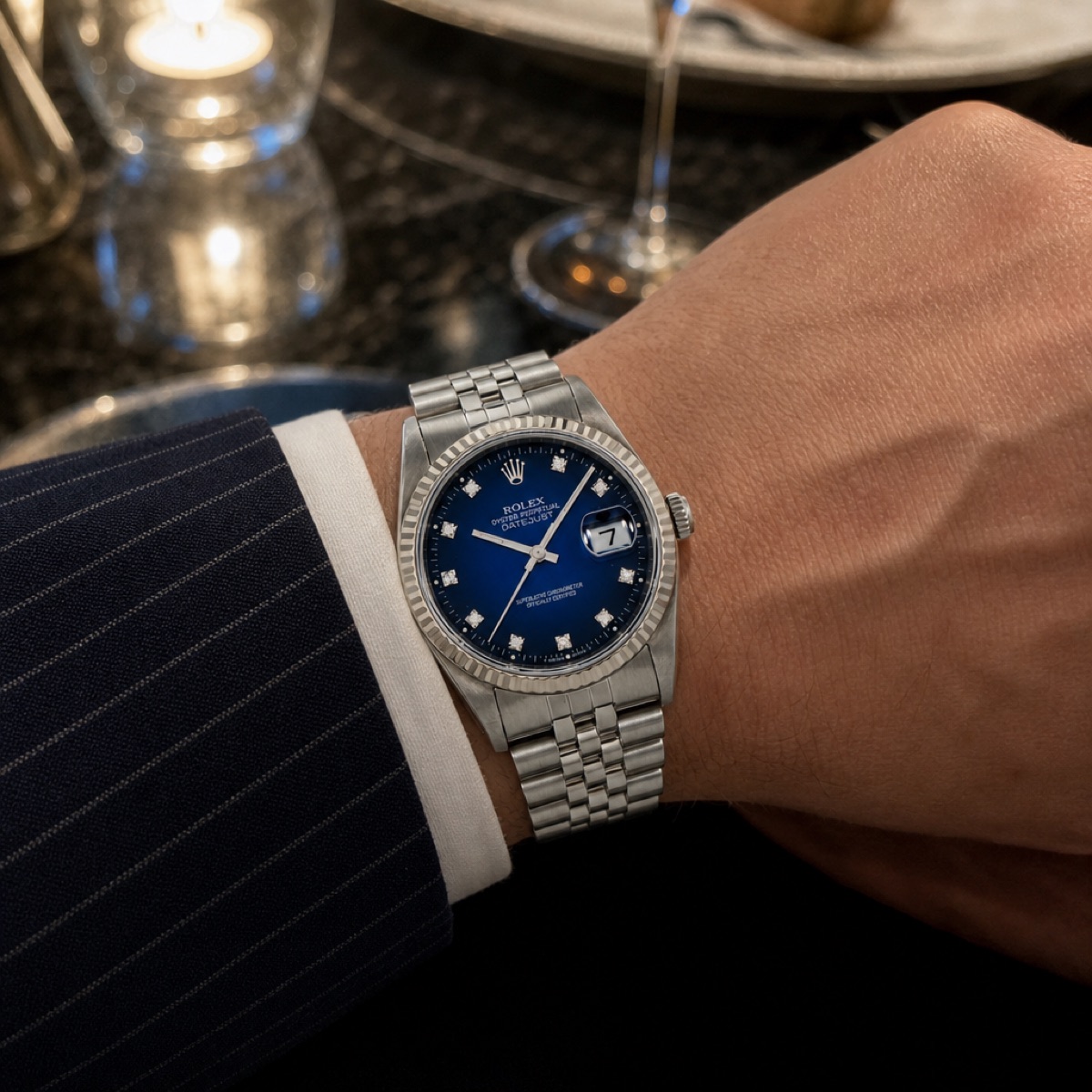
Rolex offered the 16234 with a wide spread of dials, and I couldn't find a period catalogue that lists them, so the best evidence is what auction houses have catalogued with a serial attached. That covers silver baton dials, black and blue dials with diamond hour markers, a textured anthracite dial with applied Arabic numerals, and blue sodalite stone with diamonds, all on 16234s dated from about 1989 to 2005 (Sotheby's, Sotheby's, Antiquorum). Dealers add white and silver "Jubilee" dials (Analog/Shift) and a c.1990 blue tritium dial with factory diamonds that Analog/Shift calls "vignette" without saying what it means (Analog/Shift).
AI-generated illustration.
Silver tritium dials are the ones to watch as they age. Some have turned towards cream and orange, which collectors call tropical. Bulang & Sons described one as going "orange to creme brûlée" (Bulang & Sons). My read is that it's a nice accident on a 16234 and not worth paying a premium for. It's fragile evidence of originality, and a redial can fake the colour.
Hands should match the dial. Tritium hands on a tritium dial age to the same tone, and Antiquorum grades the hands as original on the lots that have them (Antiquorum). Bright white hands over a dial with a T at six usually mean a service has been through, and that's fine as long as it's priced as one.
Bracelets
The Jubilee is reference 62510H with 555B end links, and it's the most consistent part of the whole record. Antiquorum and Phillips catalogue it on 16234s from about 1990 through to 2003 (Antiquorum, Phillips). The Oyster option is reference 78360, which Antiquorum names on a 1999 16234 (Antiquorum) and Rolex listed for the 16200 in the same case (Rolex, archived). Bulang & Sons records 558B end links and a DE-coded clasp on a 2000 example (Bulang & Sons).
All of this generation's bracelets have hollow end links and a flip-lock clasp (BeckerTime). They stretch, and they rattle a little. Solid end links came with the 116234. The clasp carries a date code. HQ Milton sold a 1994 16234 on a clasp coded 1995 (HQ Milton), which is normal, but a bracelet years newer than the case is one I'd ask about. Check the end-link stamp too: the two-tone 16233 uses 455B (Phillips).
Co-branded, commissioned and error dials
Sodalite
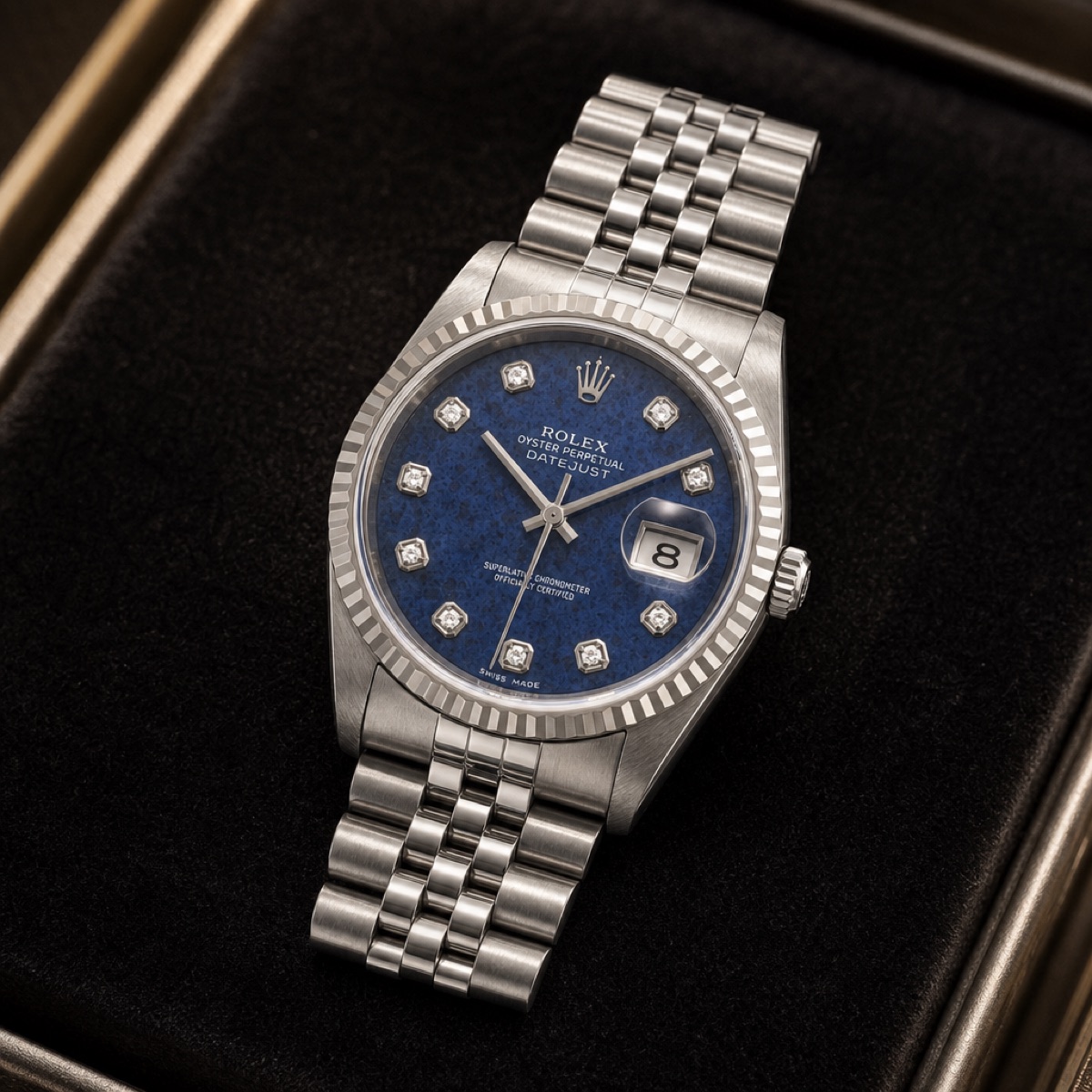
The stone dial is the 16234 with an auction record of its own: blue sodalite, set with diamond hour markers. Phillips called one "highly uncommon" and sold it at its Geneva Watch Auction XIV for CHF 20,160, against an estimate of CHF 6,000 to 12,000 (Phillips). In Hong Kong, Phillips sold sodalite 16234s for HK$119,700 at Watch Auction XIII (Phillips), HK$201,600 at Watch Auction XII (Phillips) and HK$228,600 at its spring 2023 online sale, the second unworn with its factory sticker (Phillips). Antiquorum's Geneva results were lower: CHF 10,000 in November 2024 (Antiquorum) and CHF 11,250 in November 2025 (Antiquorum). I couldn't find the Phillips sale dates on their lot pages.
For comparison, an ordinary c.1996 16234 with an anthracite dial sold at Antiquorum in Hong Kong in March 2022 for HK$55,000 (Antiquorum). The sodalite dial took the same reference to roughly four times that, which is exactly why you check the papers. The dated sodalite examples run from a 1997 sale through to about 2002, on both Jubilee and Oyster.
AI-generated illustration.
Tiffany & Co.
Tiffany-signed 16234 dials exist, but on dealer evidence only. Two dealer listings offer black-dial 16234s from 1990 with "Tiffany & Co." printed at six. One describes the watch as "one of the latest Tiffany-signed Rolex models before the two brands parted ways in the early 1990s" (Loupe This, Oliver & Clarke). That fits the history. Bob's says that "in the early 1990s, Rolex decided to stop supplying co-branded watches", and names the 16220 as one of the last references to carry the stamp (Bob's Watches). I couldn't find a Tiffany 16234 catalogued by an auction house. Bob's also says Tiffany dials "are some of the most counterfeited dials in the vintage watch world". On a 16234, I'd want provenance before I believed one, and I'd expect a 1990 or 1991 serial.
What isn't there
The Middle Eastern logo dials, such as the Khanjar, the UAE hawk and the Qatar emblem, are documented on the older 16013, 16014 and 16030 (Sotheby's, Hairspring), and I found none on a 16234. I found no named factory error dial either. I'd treat a "Khanjar 16234" as a transplanted dial or a fake until someone shows otherwise.
Why it matters
The case against the 16234 is that it's everywhere. Rolex made it for about 17 years, it was never rare, and its price as an ordinary used watch reflects that. It has no famous owner and no designer story. Even the upgrade it's known for, the sapphire crystal, makes it look less vintage than the 16014 it replaced.
My read is that its plainness is the point. The 16234 is the earliest Datejust you can wear every day without worrying about the crystal, and the 3135 inside it is one of the best-understood movements Rolex ever made. Fratello's headline says it ticks all the boxes, and I agree. The plentiful parts that make it easy to fake are the same parts that make it cheap to keep running, and that's why I keep coming back to them. If I were choosing one, I'd take an early drilled-lug case with a silver tritium baton dial on the Jubilee, because it's the closest a sapphire Datejust gets to the old ones.
What I'd check before buying one
- The serial between the lugs, against the dial. A T at six on the dial means tritium and roughly pre-1998. "Swiss Made" with bright lume on a 1990 serial points to a service dial.
- Lug holes against the serial. Drilled holes on a late F serial, or solid lugs on a 1989 L serial, need an explanation.
- A plain rehaut. The engraved inner bezel ring came with later references, so a 16234 shouldn't have one.
- The bracelet code and clasp date: 62510H with 555B end links, or 78360 with 558B. 455B end links belong to the two-tone 16233.
- Diamond dials and diamond bezels. Rolex made diamond dials for this reference, which gives aftermarket ones cover, so ask for paperwork that names the dial. Rolex can refuse to service a watch with suspect parts until they're replaced (Monochrome).
- The parts in general. A watch built from genuine Rolex parts that never met at the factory is, as Monochrome puts it, "100% Rolex parts – but it isn't quite 100% a Rolex". That's fine if you're buying a project and pay project money. It isn't fine at full-set money.
Sources
- Rolex — Datejust collection
- Rolex — Jubilee bracelet
- Rolex — Cyclops lens
- Rolex — Datejust 36 mm 16200 spec sheet, November 2004 (archived)
- Phillips — 16234 sodalite, HK spring 2023 lot 8088
- Phillips — 16234 sodalite, Geneva Watch Auction XIV lot 132
- Phillips — 16234 sodalite, HK Watch Auction XIII lot 1091
- Phillips — 16234 sodalite, HK Watch Auction XII lot 893
- Phillips — 16234, Intersect lot 67
- Phillips — 16234 c.2003, HK lot 860
- Phillips — 16233 c.1991, HK Watch Auction XII
- Sotheby's — 16233 pyramid dial, Fine Watches 2022
- Sotheby's — 16234 c.1989, Hong Kong 2007 lot 1837
- Sotheby's — 16234 c.2003, Geneva 2014 lot 137
- Sotheby's — 16234 c.2005, London 2017 lot 51
- Sotheby's — 16234 blue dial c.2000
- Sotheby's — 16013 Khanjar, 2019 lot 76
- Antiquorum — 16234 c.1996, lot 348-208
- Antiquorum — 16234 c.1996, lot 353-151
- Antiquorum — 16234 c.1990, lot 356-346
- Antiquorum — 16234 c.2002, lot 351-138
- Antiquorum — 16234 1999, lot 291-138
- Antiquorum — 16234 sodalite, lot 372-293
- Antiquorum — 16234 sodalite, lot 381-512
- Fratello — Here's why the Rolex Datejust 16234 ticks all the boxes
- BeckerTime — Rolex 16234 review
- BeckerTime — Datejust 16000/16014/16030 vs 16200/16234/16220
- BeckerTime — Datejust 162xx vs 1162xx
- BeckerTime — The Rolex calibre 3135
- Bob's Watches — Calibre 3135
- Bob's Watches — Rolex serial numbers
- Bob's Watches — Tiffany & Co. Rolex dials
- Monochrome — Re-dialed and customised Rolex watches
- WatchProSite — Rolex "Swiss" only dial guide
- Hairspring — State of Qatar 16014
- BeckerTime — Rolex metals: stainless steel
- HQ Milton — 1994 16234 tropical silver dial
- Gray & Sons — 16234 W523031
- Craft & Tailored — 1991 16234
- Craft & Tailored — 1996 16234
- Craft & Tailored — 1997 16234 tritinova
- Analog/Shift — 16234 blue vignette
- Analog/Shift — 16234 Jubilee dial
- Bulang & Sons — 16234 tropical dial
- Loupe This — 16234 retailed by Tiffany & Co.
- Oliver & Clarke — 16234 Tiffany & Co.
- Minus4Plus6 — Rolex price evolution (archived)
- Commit — Rolex in film