Rolex Oyster Perpetual 6062
- Make
- Rolex
- Reference
- 6062
- Model
- Oyster Perpetual
- Production
- 1950–1953
- Case diameter
- 36 mm
- Calibre
- 655
- Case material
- 18k yellow gold
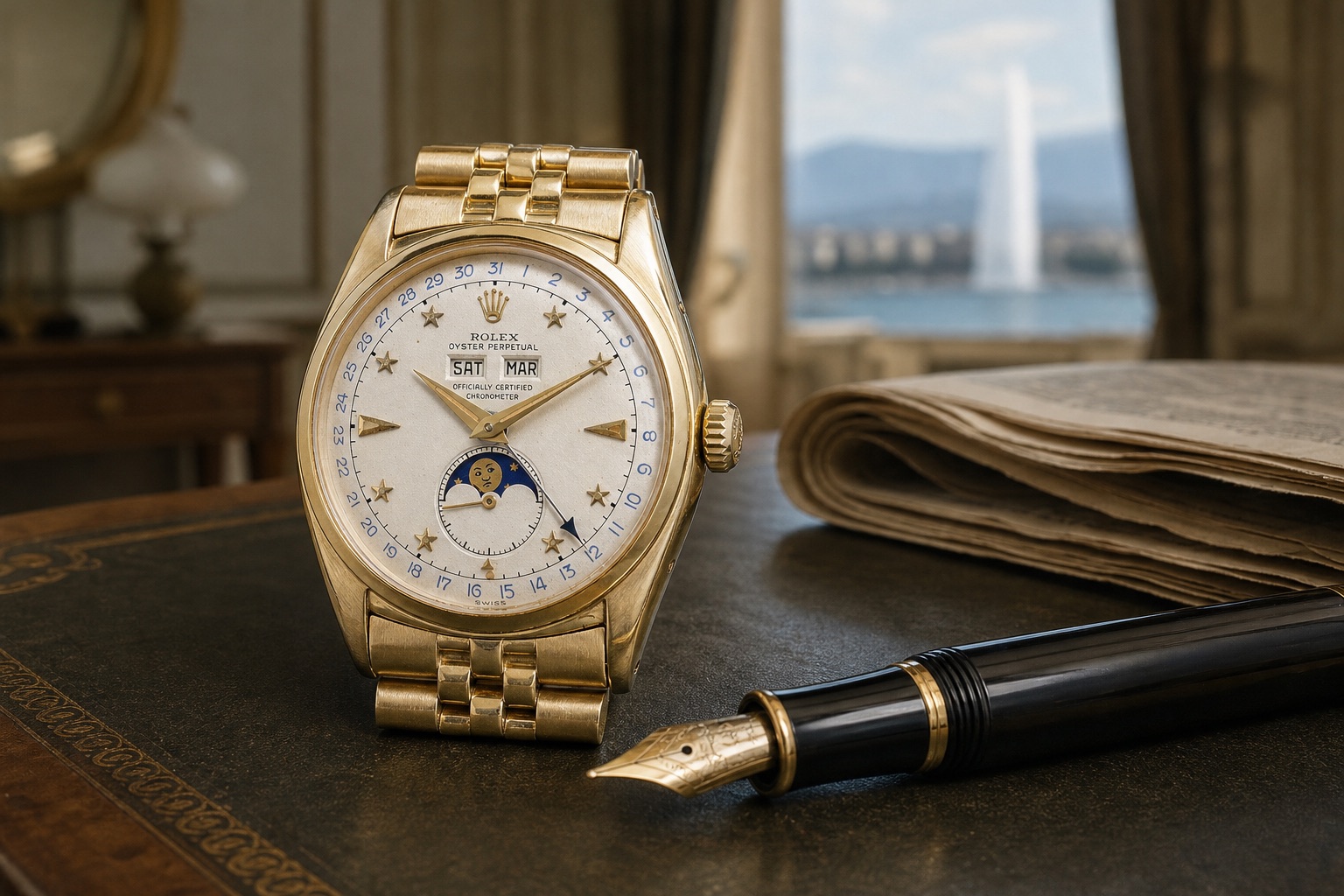
AI-generated illustration.
In 1950 Rolex took a full calendar with the phases of the moon and sealed it inside a waterproof Oyster case. The result was the Rolex Oyster Perpetual 6062, launched at the Basel Fair that year. Phillips describes it as "the first automatic wristwatch with date and moonphases to be housed in a waterproof case made by Rolex". Its sibling, the 8171, did the same job in a plain snap-back case, and between them they are, in Phillips' words, "the only two vintage Rolex models with moonphases".
It didn't sell. Rolex made the 6062 for about three years, kept it in the catalogue for most of the decade, and let the simpler Day-Date take its place. The day window it introduced lived on in that Day-Date; the moonphase didn't return to a Rolex until 2017. Collectors have spent the decades since making up for the cool reception. The 6062 owned by Bao Dai, the last Emperor of Vietnam, made CHF 5,066,000 in 2017, then a record for any Rolex at auction. The version I picture when someone says "6062" is the stelline, with small gold stars for hour markers, and stelline examples have sold for anything from CHF 187,500 to CHF 1,940,000.
I don't own one and have never handled one. What follows comes from the auction record, which for this reference is unusually deep and unusually contradictory.
Where it came from
Rolex already had a calendar watch. In 1947 it launched the 4767, which Phillips calls "Rolex's first triple calendar chronograph wristwatch", in an Oyster case. What it hadn't done was pair a full calendar with a moonphase. The 8171 got there first, "in approximately 1949, using a non-Oyster case", according to Phillips' guide to the reference, although Phillips' own 8171 lot essays date it to the early 1950s. The 6062 was the waterproof version: screw-down caseback, screw-down crown, and a self-winding movement, the calibre 655, that Christie's says was "especially developed for the model". The same guide calls it "the only example of Rolex placing a complicated self-winding movement inside its original Oyster case design".
Rolex never called it a triple calendar. Antiquorum notes that "in period advertising, this watch was referred to as the Oyster Perpetual COSMOGRAPH", and Christie's quotes its listing in the 1959 catalogue as a Cosmograph Oyster Perpetual with calendar and moonphase. Rolex later gave the Cosmograph name to its chronograph, the watch that became the Cosmograph Daytona. The dial says only "Oyster Perpetual" and "Officially Certified Chronometer". No source I read names a designer or gives a launch price.
The same Christie's essay says the 6062 "introduced two new features". One was the Super Oyster crown, which "proved to be one of the company's rare failures". The other was the day of the week in a window, which "proved to be a major success when transferred to the Day-Date in 1956". That's the irony at the centre of this watch. The Day-Date took its best idea, dropped the month and the moon, and outlived it. Christie's is blunt about the cause: "It was the success of the Day-Date that proved to be the nail in the coffin of the Cosmograph." Phillips puts it down to timing, saying "the watch-buying public wasn't quite prepared for a truly high-end Rolex".
When production ended is less clear than it should be. Phillips gives "approximately 1950 to 1953", and the latest dated examples I found in catalogues are from 1953. The watch stayed on sale long after. Christie's says the 1959 catalogue was "the last one it appeared in", and Antiquorum says the yellow gold 6062 "remained in the Rolex catalogue until 1960". Phillips has sold one of three identical 6062s that three brothers bought new at Gübelin in 1964. My read is that Rolex made the watch for three or four years and spent the rest of the decade selling the stock. A few catalogues give 1948 or 1949 as the start, and two Christie's lots say it was made for "approximately 10 years", but none of the dated examples support either.
How many were made is anyone's guess, and the auction houses guess differently. Antiquorum has printed 350 in yellow gold and 50 in pink gold. Christie's has printed about 670 in yellow gold. Monaco Legend has printed both 670 and 300 for yellow gold, in the same sentence on two different lots, and 350 for the whole run on a third. Phillips' guide gives a total "from under 450 examples to a number in the ballpark of 1,000". None of them cites Rolex. Counting what has surfaced is a little firmer: Phillips says about 110 have appeared on the market, and Sotheby's says about 225 have been identified. Either way, the watches anyone has actually seen number in the low hundreds.
The watch
| Spec | Value |
|---|---|
| Case | 18k yellow gold, 18k pink gold or stainless steel; Oyster, with screw-down caseback and crown |
| Diameter | 36 mm in most catalogues; 35, 35.5 and 37 mm also printed |
| Thickness | 13 to 15 mm, as catalogued |
| Movement | Rolex calibre 655, 9¾ lignes, self-winding |
| Jewels | 17, 18 or 19, depending on the catalogue |
| Functions | Hours, minutes, small seconds; day and month in windows; date by central hand; moonphase |
| Dial text | "Rolex Oyster Perpetual", "Officially Certified Chronometer" |
| Case makers | Genex (gold), Spillman (steel) |
| Bracelet | Gold Jubilee on many gold watches; steel Jubilee on steel; leather with a Rolex buckle |
The layout is easy to read once you know it. Day and month sit in two windows under the coronet. A long central hand with a blued spear tip points to a date ring printed around the edge of the dial, in what Phillips calls "inky blue" numerals on the silvered dials. A subdial at 6 combines the running seconds with the moon. Sotheby's describes the moon disc as "blue champlevé enamel on a gold disc", with a face on the moon, and Monaco Legend credits it to Stern Frères. On black dials the sky behind the moon is black as well.
The figures in the table come from auction catalogues, since Rolex's site doesn't carry discontinued references, and the catalogues disagree. One watch, case 916'321, is 36 mm in one Christie's catalogue and 35 mm in another. The jewel counts follow no pattern by serial number, and Christie's adds a fourth answer: "25 or 26 jewels, depending if the movement base was 17 or 18 jewels", apparently counting the calendar works. I'd treat any single figure as a catalogue convention. I found no catalogue that gives a water resistance rating, a lug width or a beat rate, so they're left out.
The cases came from outside makers. Phillips says the precious-metal cases "were built for Rolex by Genex S.A." and the steel ones by Spillman, "the firm that was behind the original development of the Oyster case for Rolex". Genex's mark, "a number 12 inside a key", is punched inside the gold casebacks.
How it changed
| Serial block | Years, as catalogued | Metals seen | Dials seen |
|---|---|---|---|
| 690'xxx | 1950–51 | Yellow and pink gold | Stelline, silvered and black |
| 788'xxx | 1951–53 | Yellow and pink gold | Stelline; pink gold with Arabic numerals and lozenge markers |
| 911'xxx | c. 1952 | Yellow gold | Stelline |
| 916'xxx | 1952–53 | Yellow gold; one steel | Stelline; black with diamonds; steel with darts and Arabic quarters |
| 942'xxx | 1953 | Yellow gold, steel | Stelline; pyramid; dagger; black with diamonds; steel semi-Explorer |
The table is built from about two dozen catalogued watches, so treat it as a sketch. Christie's says "the majority of recorded examples have serial numbers in the upper 700'000s up to the late 900'000s", and the lots I read fall into those five blocks. What the blocks don't do is sort the watches. The Phillips guide offers shortcuts: pink gold from 788'5xx, steel from 942'59x, black dials from about 916'2xx, stellines in the 690s. Every one of them has an exception. A 788 watch has sold as yellow gold, a pink gold one carries 690'042, a black stelline carries 690'035 and is dated 1950, and stellines turn up in every block. Antiquorum even sold a steel 6062 numbered 916621.
The run was short, so the changes are small. The chronometer text moved: Phillips says earlier stelline dials print it "below the in-line calendar apertures" and later ones put it in the small seconds. Sotheby's says the improved, more water-resistant crown Rolex introduced in 1953 was added on the last few 6062s. And two pink gold watches, 690'042 and 788'652, have "6063" stamped inside the caseback and struck through by Rolex. No source I read explains why.
Bracelets help date a watch more than they change it. Phillips has sold gold 6062s on gold Jubilee bracelets with deployant clasps stamped from "1 50" to "1. 53", one of them made by Gay Frères, and steel ones on Rolex USA Jubilees. Many 6062s now sell on leather with a signed Rolex buckle. Gold watches usually wear gold dauphine hands in the catalogues; Phillips says steel ones have "either non-luminous feuille-type hands or lume-filled alpha hands".
The variations that matter
Dials
Christie's and Phillips agree that there are six dial variants, and neither names them the same way. Phillips' lot essays list star, triangle, "Explorer" (Arabic 3 and 9), pyramid ("Egyptian") and "Dagger" (or "Lys", or "Drop"). Its guide lists stelline, pyramids, spades, diamonds and explorer. I suspect spade and dagger are the same marker under two names, but no source says so.
The ranking is clearer. Phillips writes that "the most common one, found in about half of the known examples, is the one with star indexes". Triangle and Explorer dials sit in a second tier, and "the ultimate echelon of rarity is attained with the dials featuring pyramid markers", along with the dagger, with fewer than ten of each known. Older catalogues put it the other way round. Antiquorum said the rarest were "the diamond indexes and then the star indexes", and in 2016 Phillips itself described star markers as appearing "very rarely". The newer count is the only one that shows its basis, so I'd go with it.
Pink gold narrows the field further. Phillips says "only approximately one dozen different pink-gold 6062s" have surfaced at auction, and that only two dials are known on them: the stelline, and one with Arabic numerals and faceted lozenge markers. Sotheby's puts the pink gold figure much higher, at about 50 sold.
The stelline
Stelline is Italian for "little stars", and the name comes from collectors. Phillips says they "were so taken with the model they nicknamed it 'Stelline'", and nobody seems to know who said it first. Phillips now uses the word for the reference as a whole: it has titled a soleil dial, a dagger dial and a steel semi-Explorer "Stelline". A lot title proves nothing; read the description.
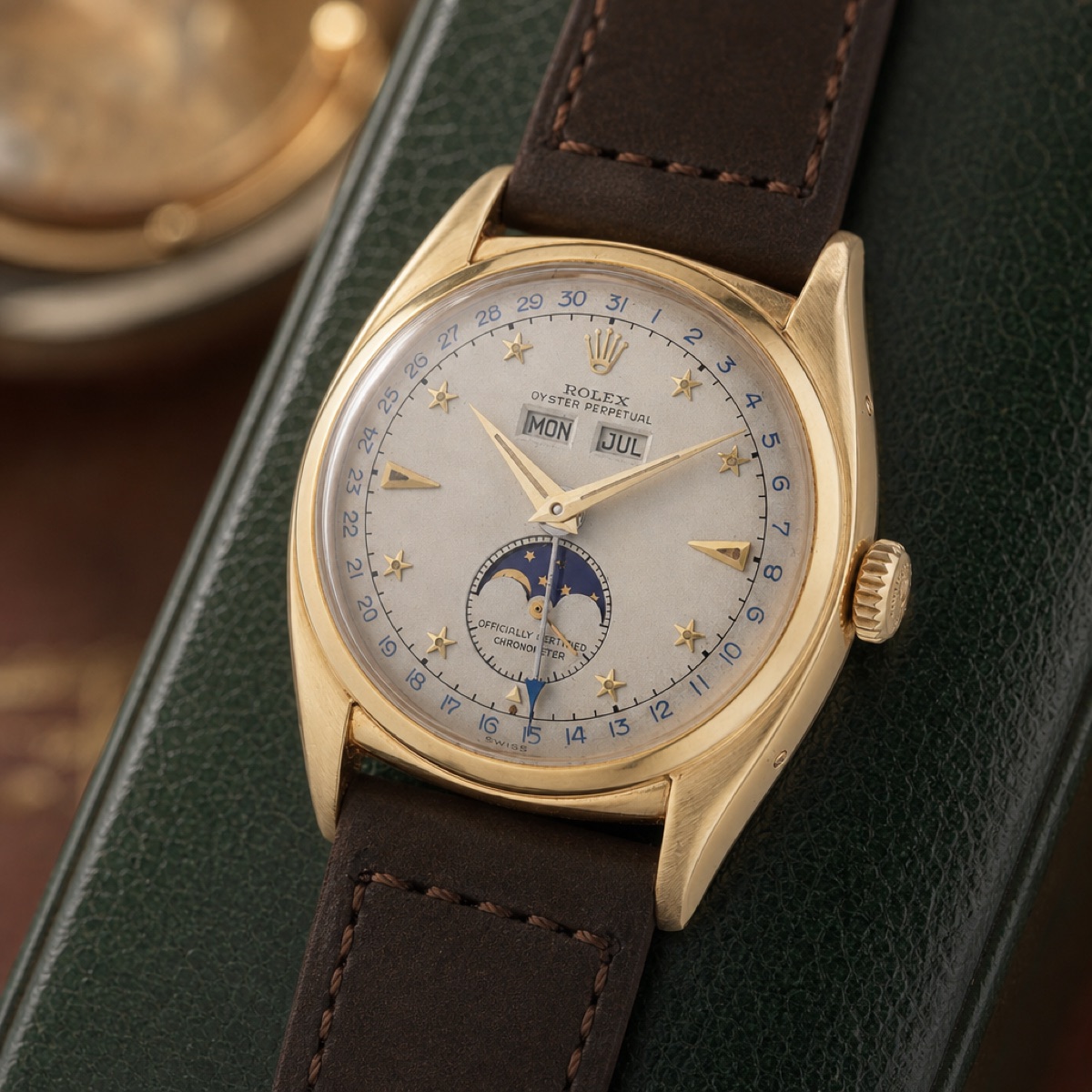
AI-generated illustration.
The dial itself has eight applied, faceted, five-pointed gold stars in place of hour markers. Christie's places faceted daggers at 3, 6 and 9, and the Phillips lot photographs show the Rolex coronet at 12, so the stars take the other eight hours. Most stellines are silvered with a grained finish and a blue date scale. A few are black: in 2016 Phillips said "only four examples are known to scholars" of the black lacquer stelline, and the one it sold that May had the matching black sky on the moon disc. They're documented in yellow and pink gold; I found no steel stelline, which fits Phillips' observation that steel 6062s all carry the semi-Explorer dial.
There are two generations, and they're easy to tell apart once you know where to look. Phillips: "Earlier dials placed a dot of lume on the dials directly next to the hour markers, while later dial versions incorporated the luminescent material directly to the center of each applied star index." The chronometer text moves with them, from under the calendar windows on the earlier dials to inside the small seconds on the later ones. Christie's has its own names for the two, Dial Type 453 for the lume-beside version and "Mark 1, Dial Type 755" for the lume-centred one. Phillips adds that the pink gold stellines "all seem to be fitted with the earlier dial generation". Sotheby's says the star dial was the first version Rolex made in 1950, and Phillips ties the early stellines to serials in the 690s, but they kept coming through the 942 block.
Who made them rests on attribution. Phillips writes that "it's believed that Stern Frères was the sole producer of "star"-type dials for Rolex"; Christie's says the dials were "probably made by Beyeler and delivered and mounted by Stern Frères". Rolex didn't save the stars for the 6062 either. Phillips lists star dials on the time-only references 6024, 6088, 6090, 6098 and 6244 from 1946, with the 2705 believed to be the first. I found nothing documenting a star dial on the 8171.
The objection to the stelline is obvious once you've read Phillips' count: it's the common dial, and it's the most famous one. I don't think that's a problem. The prices come from how it looks, with gold stars on a grained silver dial and a blue enamel moon, and from the fact that collectors bid against each other for the clean ones. The steel watches and the diamond dials are rarer, and the market prices them that way. One small curiosity: on the yellow gold stelline Christie's sold in New York in December 2018, the 7 o'clock star was mounted at the wrong angle. Collectors call that watch the Dark Star.
Phillips will sell another one this week. Lot 129 at its Geneva Watch Auction XXIV, on 7 and 8 November 2026, is a yellow gold stelline from about 1952, "recently discovered in Japan and acquired from its original owner", estimated at CHF 600,000 to 1,200,000.
Steel
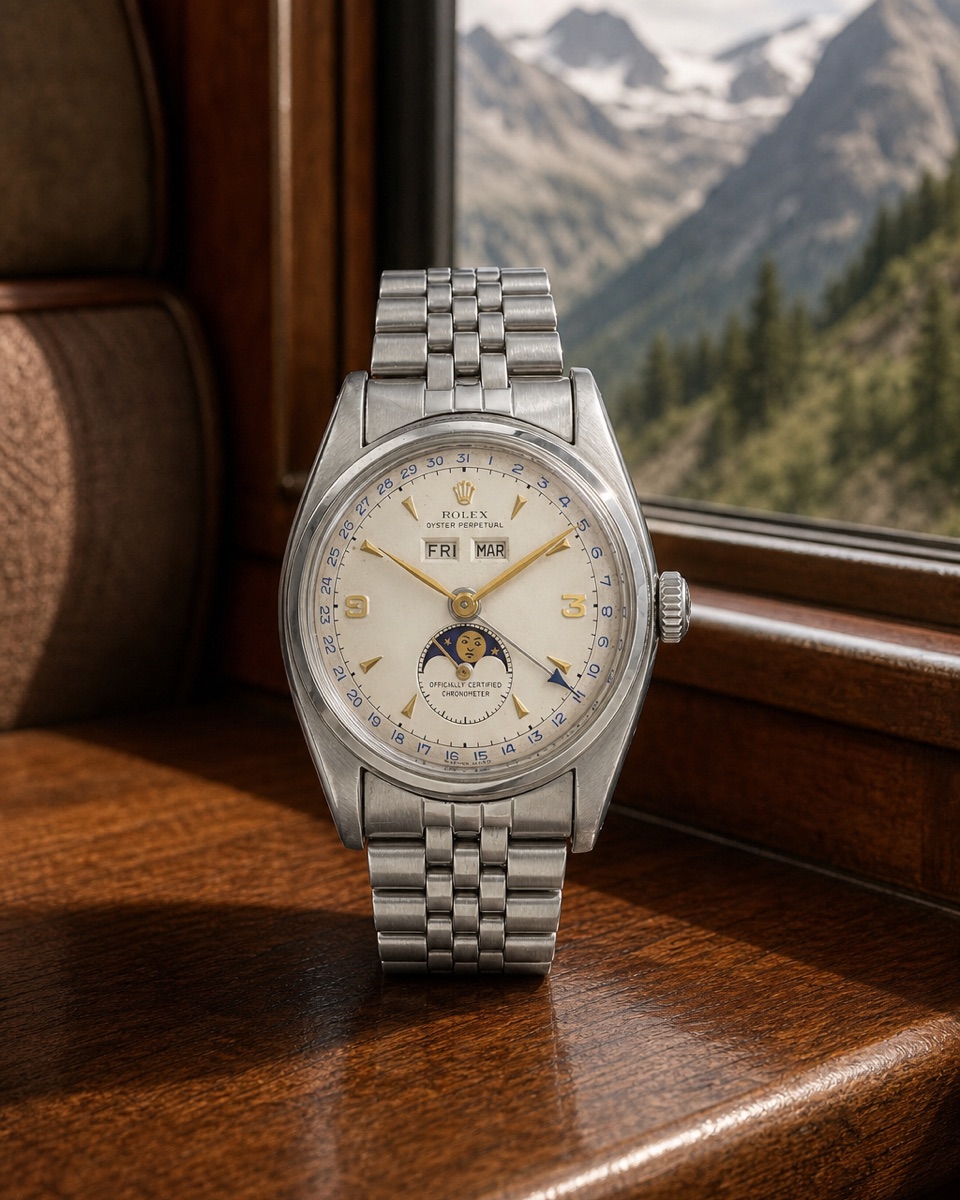
AI-generated illustration.
Steel is where the 6062 is rarest and now most expensive. Phillips says "less than 100 steel examples were originally produced", all in the last year of production, and fewer than 50 are publicly known. The steel watches share one dial, which Phillips calls "Semi-Explorer": silvered two-tone, with applied Arabic 3 and 9 and dagger markers in steel or gold tone, signed "Swiss Made" where almost every gold dial says "Swiss". The steel casebacks carry "Modèle Déposé" and "Registered Design". In November 2023 Phillips sold one for CHF 2,117,000, more than any stelline result I found.
Co-branded, commissioned and error dials
The Bao Dai
The most famous 6062 is a black dial with diamonds. The story Phillips tells, from the family's account, begins in Geneva in the spring of 1954. Bao Dai, born Nguyễn Phúc Vĩnh Thụy and the last emperor of the Nguyễn dynasty, walks into Chronométrie Philippe Beguin. "He wants the rarest and most precious Rolex ever made." After several refusals, a clerk is sent from the Rolex workshops on the outskirts of Geneva. SJX and CNBC place him in the city for the Indochina peace talks.
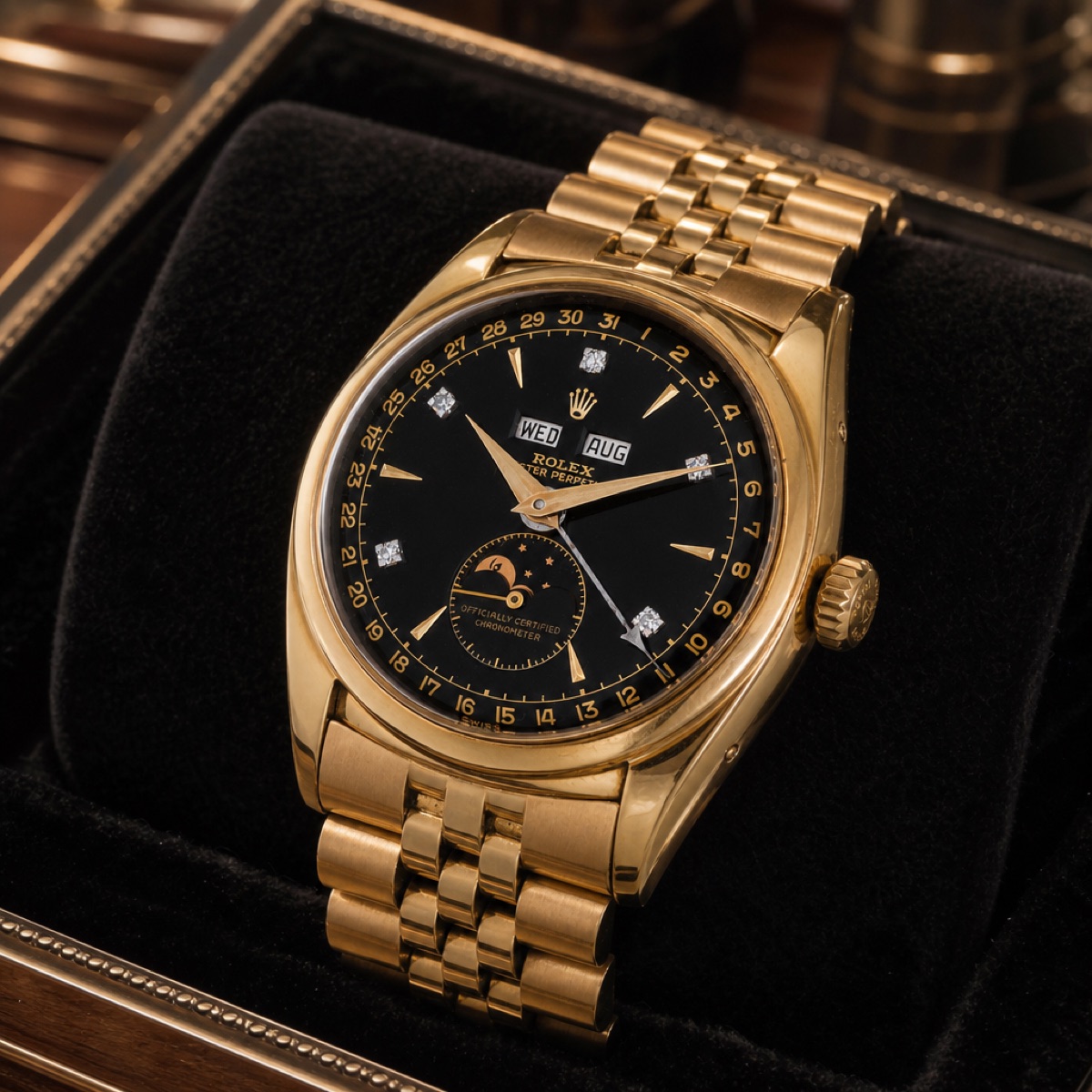
AI-generated illustration.
The watch is yellow gold, dated 1952, case 916'366. Phillips calls it "one of only three black dial models known to be set with diamond markers". The other two have six diamonds at the odd hours. The Bao Dai has five at the even hours and a different layout, because the diamond at 12 pushes the coronet down between the calendar windows. Its family consigned it to Phillips in 2002, when it made CHF 370,000, "the most expensive Rolex ever sold at the time". On 13 May 2017 it came back as lot 93 of the Geneva Watch Auction: FIVE. Bidding opened at CHF 1 million with ten bidders, and it sold for CHF 5,066,000, the Rolex auction record until a Paul Newman Daytona passed it.
One of the other two diamond dials sold in October 2025. Monaco Legend's lot 111 was a yellow gold 6062 from about 1953, case 942'536, with diamonds at 1, 3, 5, 7, 9 and 11. It had passed through Sotheby's London in 1991 and Antiquorum's Mondani sale in 2006, where it made CHF 469,700. Monaco Legend's page gives the result as €5,150,000 including premium; some press reports said €5.33 million. I'd go with the lot page.
Retailer signatures
Two 6062s are documented with a retailer attached. The first is a steel watch from 1953 with "K.W. Co." printed below the day and month windows, which Phillips sold in November 2021 for CHF 1,361,000. Phillips says the signature may be the Knickerbocker Watch Company, a US importer, or a defunct Indian retailer, and that this was the first 6062 known with it. The second is a yellow gold pyramid-dial watch retailed by Serpico y Laino, which Antiquorum sold in 2007 for CHF 192,750. The catalogue doesn't say the dial itself is signed. I found no Tiffany or Cartier 6062 in any catalogue, so I'd treat one with suspicion.
Soleil and service dials
The three brothers' watches from Gübelin carried soleil dials, and Phillips first assumed the one it sold was a service replacement. "This proved not to be the case." It made CHF 177,800. Genuine service dials do exist: Phillips says they're "typically marked "T Swiss T"", for the tritium lume, with a bolder date-ring font and slightly thicker seconds markers.
Why it matters
| Date | Sale | Watch | Result |
|---|---|---|---|
| Nov 2015 | Phillips Geneva, lot 253 | Pink gold stelline | CHF 1,265,000 |
| May 2016 | Phillips Geneva, lot 192 | Yellow gold, black stelline | CHF 905,000 |
| May 2017 | Phillips Geneva, lot 93 | Bao Dai | CHF 5,066,000 |
| Dec 2018 | Christie's New York | Yellow gold stelline, the Dark Star | USD 1,572,500 |
| Nov 2019 | Phillips Geneva, lot 249 | Pink gold stelline, ex-Gordon Bethune | CHF 1,940,000 |
| Nov 2021 | Phillips Geneva, lot 178 | Steel, K.W. Co. | CHF 1,361,000 |
| Nov 2023 | Phillips Geneva, lot 12 | Steel, semi-Explorer | CHF 2,117,000 |
| Nov 2023 | Phillips Hong Kong, lot 903 | Yellow gold stelline | HKD 7,112,000 |
| Oct 2025 | Monaco Legend, lot 111 | Yellow gold, six diamonds | €5,150,000 |
The pink gold stelline in that table belonged to Gordon Bethune, the former Continental Airlines chief executive, and it shows how fast this market moved. SJX reports that it sold at Christie's New York in 2012 for US$590,500; seven years later Phillips sold it for more than three times as much. The Dark Star followed a similar path, from US$542,500 in 2011 to the 2018 result, according to Phillips.
The prices are the visible part. I think the 6062 matters more as the road Rolex didn't take. For a few years in the early 1950s Rolex put a complicated movement in its waterproof case and sold it in gold with enamel moons and star dials. The market shrugged, and Rolex built its next half-century on simpler watches: the Day-Date that borrowed the 6062's day window, and the sports watches that followed it. Monaco Legend notes it took over 60 years for Rolex to revisit the moonphase, with the Cellini in 2017. This September Rolex went further back for the Perpetual Padellone, an annual calendar with a moonphase that Fratello reads as a nod to the 8171. The 6062 was the Oyster half of that pair, and to my eye the more interesting one.
What I'd check before buying one
The lot essays are the best guide to what an original 6062 looks like. None of the sources I read deals directly with faked or redialled stellines, so these checks come from how the auction houses argue that a watch is right.
- Read past the title. "Stelline" on a lot title doesn't mean star markers.
- The windows. Phillips and SJX both point to sharp, bevelled edges on the day and month apertures as a sign of an original dial.
- The printing. Inky blue date numerals, lume that has aged evenly with them, "Swiss" alone on a gold watch and "Swiss Made" on steel. "T Swiss T" means a service dial.
- The moon. Blue enamel on silvered dials, a black sky on black ones.
- The case. A sharp hallmark on the lug, crisp serials between the lugs, and the Genex 12-in-a-key mark inside a gold caseback.
- Expect age. Phillips notes that "most examples are spotted throughout". Hairspring puts it more sharply: "If you see a perfectly clean 6062, that's more of a red flag than note in its favor."
Restoration shows up in the price. Phillips sold a yellow gold star dial with carefully restored lume for CHF 187,500 in 2020, where untouched stellines in that period were making several times as much. Hairspring noted in January 2025 that a stelline which made about US$206,000 at Phillips in 2020 was listed by a dealer at US$425,000.
Sources
- Phillips, "The Fine Print: A Complete History of the Rolex Triple Calendar Moonphase Ref. 6062", Logan Baker, 4 October 2023
- Phillips, "Rolex star and stelline dials", Logan Baker, 30 April 2024
- Phillips, "The Bao Dai Rolex"
- Phillips lot essays: Geneva FIVE lot 93, Geneva TWO lot 253, Geneva THREE lot 192, Geneva SEVEN lot 128, Geneva SEVEN lot 180, Geneva NINE lot 71, Geneva X lot 249, Geneva XI lot 157, Geneva XIV lot 178, Geneva XVIII lot 12, Geneva XX lot 167, Geneva XXI lot 39, Hong Kong XVII lot 903, Winning Icons lot 43, The Watch Auction: ONE lot 118, ref. 8171, Geneva XIX lot 96, ref. 4767, Geneva FOUR lot 156
- Phillips, Geneva Watch Auction XXIV highlights, press release, 2026
- Christie's lot essays: lot 346, case 911072, Important Watches lot 59, Kairos Collection lot 127, Rare Watches lot 209, New York lot 160, sale 2496 lot 108
- Sotheby's lot essays: Geneva 2013 lot 316, Hong Kong 2022 lot 2293, Fine Watches 2023 lot 7
- Antiquorum lot essays: Hong Kong 2017 lot 270, Geneva 2010 lot 463, Geneva 2015 lot 415, Geneva 2011 lot 526, Geneva 2007 lot 498
- Monaco Legend Auctions: Exclusive Timepieces 38 lot 111, Exclusive Timepieces 30 lot 37, Exclusive Timepieces 32 lot 68, Exclusive Timepieces 40 lot 25
- SJX, "Hands-on with perhaps the most expensive Rolex ever", March 2017; "Rolex Unicorns, Part III", October 2019; "Hands-on: Rolex ref. 6062 in steel", November 2023
- Revolution, "Most expensive Rolex sold at auction: Phillips spring Geneva 2017"
- CNBC, "Rare Rolex sells at Phillips for world record $5 million", 19 May 2017
- Webchronos, Christie's New York December 2018 results, Davide Munari, 30 December 2018
- Hairspring, "Stelline Dial 6062", Erik Gustafson, 31 January 2025
- Fratello, "Rolex's Perpetual Padellone annual calendar takes a nod from the past", 15 September 2026