Rolex GMT-Master II 116710
- Make
- Rolex
- Reference
- 116710
- Model
- GMT-Master II
- Variants
- 116710LN, 116710BLNR
- Production
- 2007–2019
- Case diameter
- 40 mm
- Calibre
- 3186
- Case material
- 904L steel
- Water resistance
- 100 m (328 ft)
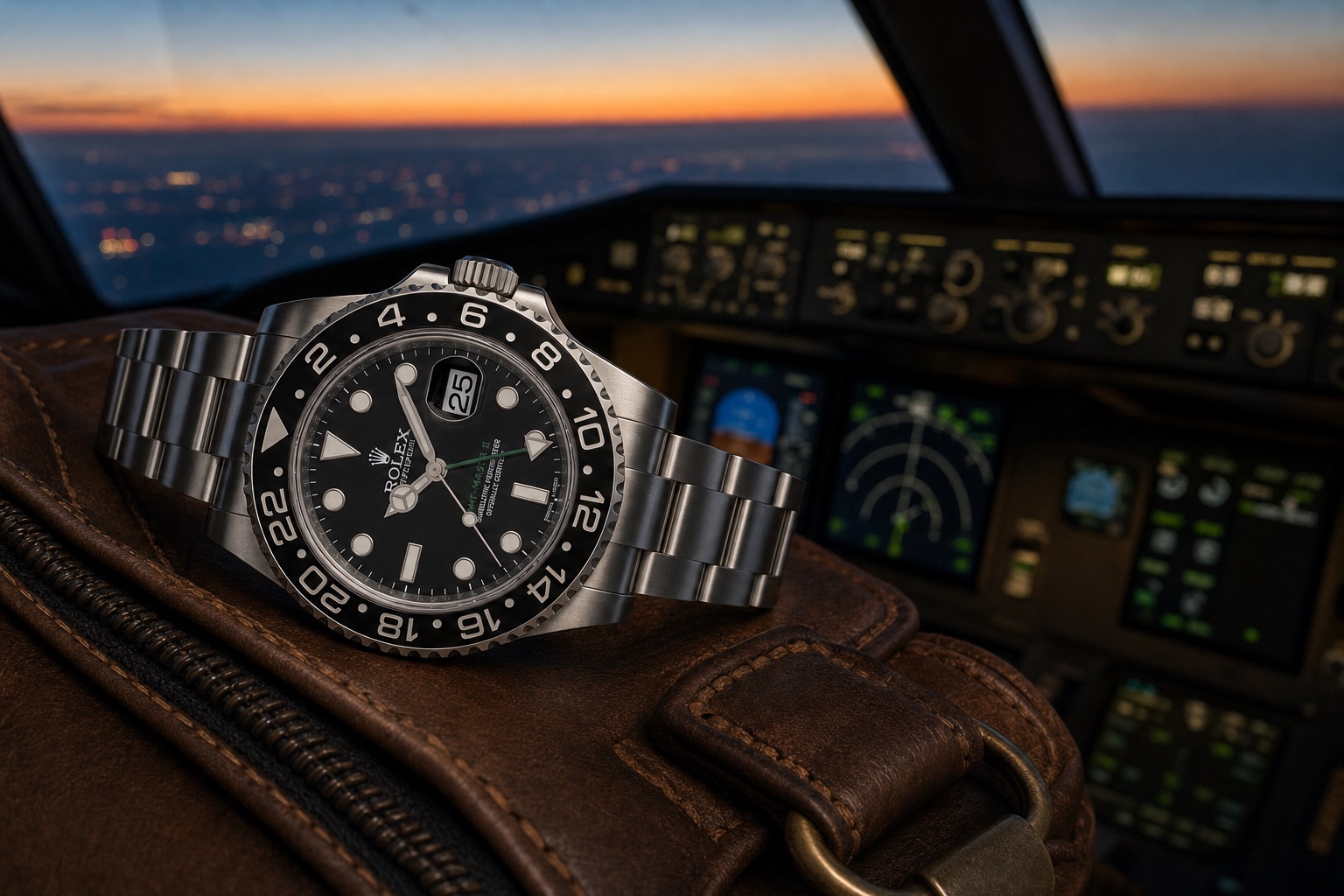
AI-generated illustration.
The GMT-Master spent most of its first fifty years with the same weak spot. The bezel is the part of the watch that does the second-time-zone work, and from 1959 it was an anodised aluminium insert (SJX) that faded in sunlight and scratched easily. In 2005, for the model's fiftieth anniversary, Rolex fixed it in 18 ct yellow gold: the 116718LN carried a new ceramic insert the company called Cerachrom (Phillips). Two years later, at Baselworld 2007, the fix came to steel (Phillips).
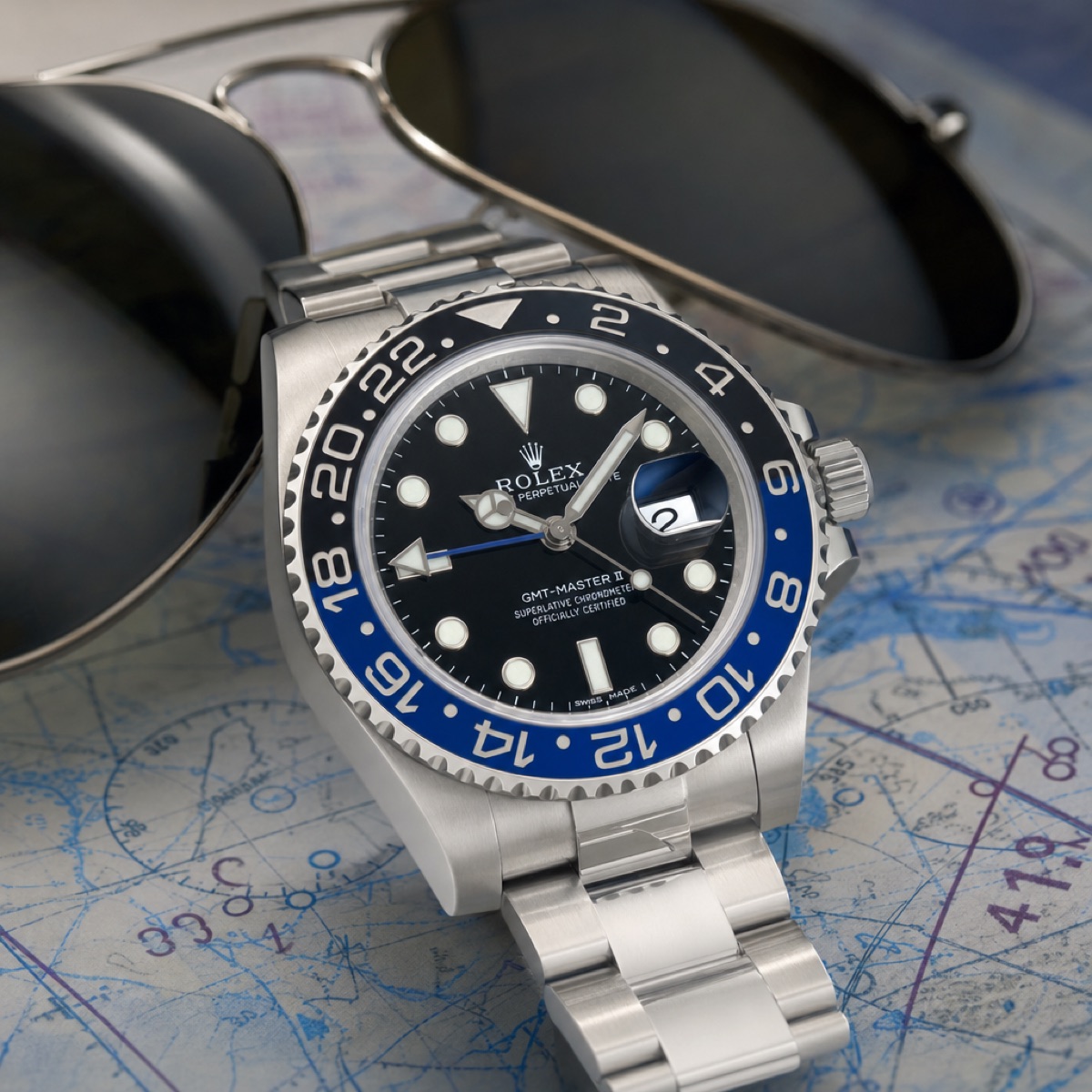
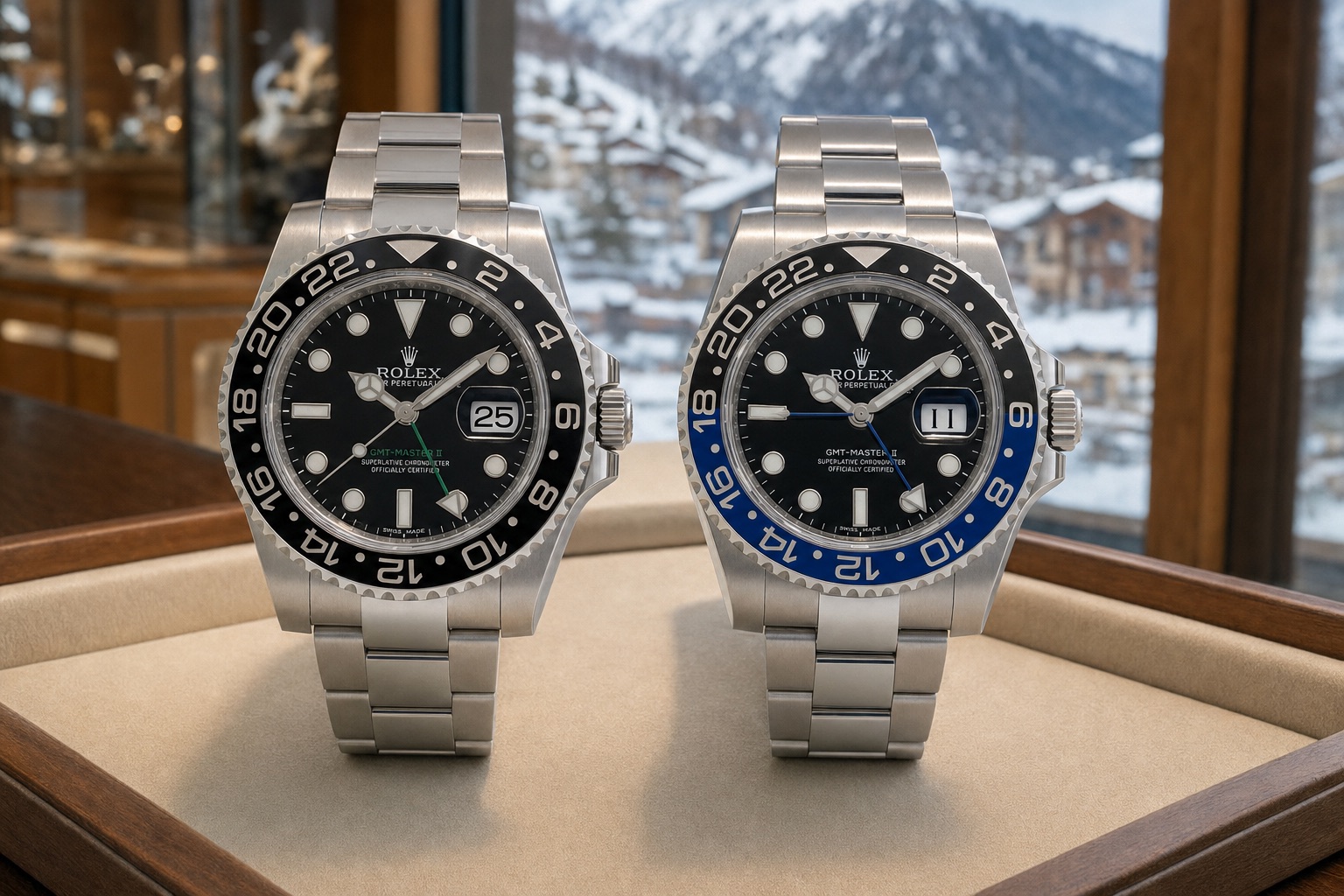
That steel watch is the Rolex Oyster Perpetual GMT-Master II, reference 116710. It's the first six-digit steel GMT-Master II, and the reference that took the steel GMT from aluminium to ceramic. It came in two versions. The 116710LN, for lunette noir, has the all-black bezel and a green 24-hour hand. The 116710BLNR arrived in 2013 with a bezel in blue and black, the first two-colour ceramic insert Rolex put on a GMT-Master II, and collectors named it the Batman. Both were replaced by the 126710 series between 2018 and 2019.
I own both, bought on the same afternoon in 2018. They mean more to me than every other watch I have put together, and I'll get to why at the end. First, the watch.
Where it came from
The GMT-Master was a pilot's watch from the start, and the early story, from the Pan Am brief to the Bakelite bezel, is in my article on the GMT-Master 1675. What matters for the 116710 is the line it inherited. Its direct predecessor was the 16710, sold from 1989 to 2007 with an aluminium bezel insert (Fratello, Monochrome). It was a good watch with an old problem. Aluminium colours fade under UV light, and the soft inserts mark easily (Senatus).
Rolex's answer was ceramic, and it rolled it out from the top of the range down. SJX puts it simply: "In 2005, Rolex unveiled its first-ever ceramic bezel insert on the GMT-Master II, but in a single colour of black" (SJX). That was the yellow gold 116718LN. Monochrome says a steel-and-gold 116713LN followed in 2006, and that "the steel-only GMT-Master II was released in 2007" (Monochrome).
You'll often read that the 116710LN was the first GMT-Master II with a ceramic bezel. Phillips' own lot essays say it was "the first GMT-Master II to be fitted with a ceramic bezel and the newly designed case and bracelet" (Phillips). That's true of steel and wrong as a general claim, because the gold watch got there two years earlier. The 116710LN is the first steel one, and Fratello calls it "the first stainless GMT model with a Cerachrom bezel" (Fratello).
The movement came from the gold watch too. SJX says the calibre 3186 was introduced with that 2005 GMT-Master II (SJX), and Sotheby's lists a 3186 in a 116718LN (Sotheby's). Rolex also fitted it to the last of the 16710s in 2007, and Fratello says those short-run late 16710s now fetch high prices (Fratello). No source I read names a designer for the 116710, and I found no dated launch price for the black watch in a source I could open.
The Batman
Six years later Rolex did something it hadn't done before. At Baselworld 2013 it showed the 116710BLNR, "the first GMT-Master to be crafted with the blue and black color combination on its bezel," in Christie's words (Christie's). The colours weren't new to the GMT world. Two colours in one piece of ceramic were. SJX: "It was only in 2013 that the two-colour, monobloc ceramic insert arrived on the GMT-Master II" (SJX).
How Rolex makes it is partly on the record. Christie's says "the creation process for this Cerachrom bezel is patented and results from a singular piece of blue ceramic," with the black added afterwards (Christie's). SJX describes the pigment being infused "into the porous surface of the untreated alumina-based ceramic," and points to a European patent, EP2746243B1, filed by Rolex in 2013 (SJX). I haven't read the patent itself, so I can't tell you how much of the two-colour process it covers. The practical reason for doing it in one piece is the obvious one: two ceramic halves joined together would leave a seam, and a seam is a weak point (Senatus).
The price at launch was CHF 8,500, or €6,050 before VAT (Fratello), "about USD9000" by SJX's conversion (SJX). The nickname came from the bezel, and Sotheby's says the colour pairing "quickly earned the watch its unofficial 'Batman' nickname" (Sotheby's). Who said it first, I couldn't find.
Apart from the bezel and the hand, it was the same watch. SJX: "It is otherwise the identical to the earlier all black version with the same 40 mm case and bracelet" (SJX). Fratello's 2013 launch report still made the case for the material against "the old pre-2007 models with aluminum inserts": the new "CERACHROM bezels won't scratch or discolor due to ultraviolet rays" (Fratello). Six years into the 116710's run, that was still the selling point.
The red and blue "Pepsi" came back a year later, at Baselworld 2014, as the 116719BLRO, and only in 18 ct white gold (Watch Collecting Lifestyle). For the next four years, if you wanted a two-colour ceramic GMT in steel, the Batman was the only one Rolex made. I found no source that explains why the Batman went to steel and the Pepsi to gold, and I'd treat any confident answer with suspicion.
The watch
Rolex's own pages for the two references, as archived in 2014, 2015 and late 2018, are the source for this table unless a row says otherwise (116710LN, 2014; 116710BLNR, 2015; 116710LN, Nov 2018; 116710BLNR, Dec 2018).
| Spec | Value |
|---|---|
| Official name | Oyster Perpetual GMT-Master II |
| References | 116710LN (black bezel), 116710BLNR (blue and black bezel) |
| Case | Oyster, 40 mm; monobloc middle case, screw-down case back and crown |
| Material | 904L steel; Rolex's late-2018 pages call it Oystersteel |
| Crystal | Sapphire, Cyclops lens (2.5×) over the date |
| Bezel | Bidirectional, 24-hour graduated, Cerachrom ceramic insert; BLNR "two-colour blue and black" |
| Crown | Screw-down, Triplock |
| Water resistance | 100 m / 330 ft |
| Movement | Calibre 3186, self-winding, 31 jewels (Phillips) |
| Hairspring | Paramagnetic blue Parachrom |
| Functions | Hours, minutes, seconds; 24-hour hand; independently set local hour hand; instant date; stop-seconds |
| Power reserve | About 48 hours |
| Certification | COSC chronometer on the 2014–15 pages; Superlative Chronometer, −2/+2 sec/day after casing, on the 2018 pages |
| Bracelet | Oyster, flat three-piece links; BLNR offered on Oyster only |
| Clasp | Oysterlock folding safety clasp with 5 mm Easylink extension |
| Launch price | 116710BLNR: CHF 8,500 / €6,050 ex VAT, 2013 (Fratello) |
Rolex doesn't say whether its 40 mm includes the crown, and it doesn't publish thickness or lug-to-lug. Dealers quote 12.1 to 12.2 mm thick, which I'd treat as a ballpark.
The bezel is the headline, but the case changed nearly as much. The 116710 kept the 16710's 40 mm and fattened everything around it: broader lugs, bigger crown guards, a bigger Triplock crown in place of the old Twinlock. Collectors call it the Super Case, which is Fratello's phrase for it as much as anyone's (Fratello). Rolex never used the name in anything I read. The dial got larger hour markers and wider hands to match (Fratello).
The bracelet is where a 16710 owner would feel the difference first. The links are solid, the clasp is a proper Oysterlock, and the Easylink lets you add 5 mm in the afternoon when your wrist swells. Fratello calls this the first generation of Rolex bracelets without the old rattle (Fratello).
The movement does what the GMT-Master II has always done: Rolex lists a "second time zone with independent rapid-setting of the hour hand" (Rolex), so you move the local hour hand on its own while the 24-hour hand stays on home time. Step off a long flight and you set the watch to where you've landed without stopping it. Rolex fitted it with the blue Parachrom hairspring, which Fratello calls the 3186's most important change (Fratello). Fratello also notes that the bezel's numerals and graduations are coated in platinum by PVD (Fratello), which is why they stay bright against the ceramic.
AI-generated illustration.
How it changed
The 116710 ran for about twelve years, and the changes are small, so the table is short. Rolex doesn't publish serial ranges, so the letters below are the dealer consensus and approximate (Bob's Watches).
| Years | Serials | Version | What changed |
|---|---|---|---|
| 2007 | M, Z | 116710LN | Launch at Baselworld: Cerachrom black bezel, green 24-hour hand, calibre 3186, Triplock crown, Oysterlock bracelet |
| 2008 | M, V | 116710LN | Serial engraved on the rehaut only, lugs blank (a Rolex-wide change) |
| 2009 | V | 116710LN | "Stick dial" variant reported on V-serial watches (Sotheby's) |
| 2010–2011 | G, then random | 116710LN | Rolex moves to random serials |
| 2013 | Random | 116710BLNR added | Two-colour blue and black bezel, blue 24-hour hand, Oyster bracelet only |
| by 2016 | Random | Both | Precision spec tightened to Rolex's −2/+2 Superlative Chronometer standard (Fratello) |
| 2018 | Random | Both | Rolex's pages relabel the steel as Oystersteel; steel 126710BLRO launched |
| 2018–2019 | Random | Both | End of production; 126710BLNR replaces the Batman in 2019 |
What the table shows is a reference Rolex barely touched once it was right. There's no case revision, no movement swap and no bracelet change I could document across the whole run. The only real event was the Batman, which added a second model six years in, and the paperwork changes that came with Rolex's wider updates.
The end is less clear than it should be. Phillips says the black watch "enjoyed a successful 10-year production run before being discontinued in 2018" (Phillips), while Monochrome and Fratello's history run the 116710LN to 2019 (Monochrome, Fratello). The Batman's end is better agreed: Sotheby's says it "remained in production until 2019" (Sotheby's), and Phillips says it was replaced that year by the 126710BLNR (Phillips). Rolex was still listing both 116710s on its site at the end of 2018 (Rolex). Fratello treats the 2024 126710GRNR as the black watch's real successor (Fratello).
The variations that matter
Dials
The black watch is the green one: Phillips points out that both the model name on the dial and the 24-hour hand are green (Phillips). Fratello traces the green hand to the 2005 gold watch (Fratello). The Batman drops the green: "To match the bezel, the GMT hand is in blue, whereas it was green in the previous version" (SJX).
The one dial variant with a name is the stick dial. A Sotheby's Hong Kong catalogue note says the 116710LN "saw three dial variations" in how the "II" of "GMT-Master II" is printed. Most have Roman numerals with large serifs. Some have serifs so small the "II" looks almost rectangular. A few have no serifs at all, so the two strokes "appear to be stick-like, hence the nickname 'stick dial'." The same note says these "are only found on the V series of the 116710LN watches which were only made during the year 2009" (Sotheby's). That's one auction house's account, it gives no count, and the 16710 had stick dials of its own, so check that the watch you're looking at is the right reference before paying a premium for it.
Lume is murkier. A dealer listing for a 2007 watch describes its "green-glowing Luminova dial," and says it was "only in production for a few years before Rolex switched to blue Chromalight" (Watchclub). I couldn't find a year or a serial for the switch from a source I'd stand behind, so treat green lume on a 116710LN as a sign of an early watch, and confirm it against the papers.
AI-generated illustration.
Bezels
There are two bezels and they're easy to tell apart. The black watch's insert is a plain black ceramic disc with engraved numerals (Haute Time), and with the black dial and that one green hand, I think it's the purer design of the two: the closest the 116710 gets to an old tool-watch GMT. The Batman's insert is one piece of ceramic, so my read is that the line where blue meets black should be clean, with no step or seam. Rolex's 2015 page describes "engraved numerals and graduations" (Rolex), platinum-coated by Fratello's account, so they should look like metal set into the ceramic. I found no documented shade variants for the BLNR insert, early or late, and I'd be wary of anyone selling one on that basis.
Bracelets
The 116710 came on one bracelet, the Oyster with polished centre links, Oysterlock clasp and Easylink. The Batman was never offered on a Jubilee: that came with the 126710BLNR in 2019, which collectors call the "Batgirl" to tell the two apart (Bob's Watches). Sources disagree on the bracelet reference number, so I've left it out.
Co-branded, commissioned and error dials
None are documented. I found no Tiffany, retailer, military or company dial on the 116710 in any auction or specialist source, and no factory error dial with a collector name. Aftermarket dials and refinished cases exist, as they do for every modern steel Rolex, and they're not Rolex's work. The stick dial above is the closest the reference gets to a named variant.
Why it matters
The 116710 is the watch that made the modern steel GMT-Master II. Ceramic, the heavier case and a solid bracelet with a proper clasp all arrived in steel with this reference, and the Batman's two-colour insert is the process behind every two-colour GMT bezel Rolex has made since.
It's also the reference that was caught in the steel Rolex shortage. One owner who bought a Batman at its $8,950 US retail in October 2013 wrote in 2018 that the retail price hadn't changed in five years, and that new ones were "being resold online for over $11,000" (ocabj.net). When the steel Pepsi arrived at Baselworld 2018, StockX reported that "wait lists at ADs around the world quickly filled" (StockX). The black watch has held up at auction too: an unworn, full-set 116710LN sold at Phillips in Geneva in autumn 2022 for CHF 20,160 (Phillips), and another made CHF 10,795 there in spring 2026 (Phillips). My read is that the spread says more about the market cooling than about the two watches.
Those waitlists are where my two come from. The first Rolex I ever bought was a 116710LN in 2018, for my dad's retirement. John Lasley flew F-15s out of Elmendorf in Alaska and F-5s out of Nellis for the US Air Force, then spent thirty years at Delta, retiring as a Boeing 777 captain. I had a hell of a time finding an authorised dealer who was interested in selling to me, until Meridian Jewelers in Aspen, Colorado found me the watch, and they were incredible about it. When I went to collect it, they surprised me with a Batman as well, and I bought that one for myself.
Those two GMTs mean more to me than all my other watches combined. My son is named after my dad, and the Batman stays with me until he's ready to take ownership of it.
What I'd check before buying one
- The reference on the papers and the rehaut. Make sure the serial on the rehaut matches the card, and that the reference is 116710LN or 116710BLNR. Late 16710s with a 3186 are a different watch with a different price.
- The bezel. On a Batman, a clean one-piece blue-to-black transition and engraved, metallic numerals. I'd walk away from a seam, a step or numerals that look painted.
- Lume and dial. Green lume points to an early LN; a stick dial should come with a V serial if you're paying for one.
- The bracelet. Oyster with Oysterlock and Easylink. A Jubilee on a 116710BLNR isn't original to the reference.
- Box and papers. Late full sets turn up: Sotheby's offered an unworn 116710LN with its stickers and a guarantee card dated February 2017 (Sotheby's).
Sources
- Rolex, GMT-Master II 116710LN, archived Dec 2014
- Rolex, GMT-Master II 116710BLNR, archived Jan 2015
- Rolex, GMT-Master II 116710LN, archived Nov 2018
- Rolex, GMT-Master II 116710BLNR, archived Dec 2018
- Phillips, 116710LN, Geneva Sessions Fall 2022, lot 53
- Phillips, 116710LN, Geneva Sessions Spring 2026, lot 51
- Phillips, 116718LN
- Phillips, 116710BLNR, New York 2021
- Christie's, 116710BLNR, Live Auction 23206
- Sotheby's, 116710LN stick dial, Hong Kong, lot 2002
- Sotheby's, 116710BLNR, Important Watches I, 2023
- Sotheby's, 116718LN, Fine Watches 2024
- Sotheby's, 116710LN, Fine Watches 2025
- Sotheby's, A Closer Look at the Rolex GMT-Master II Batman
- SJX, In-Depth: Rolex GMT-Master II, 2024
- SJX, Baselworld 2013: GMT-Master II 116710BLNR
- Fratello, Baselworld 2013: GMT-Master II 116710BLNR
- Fratello, 126710GRNR vs 116710LN, 2025
- Fratello, Rolex GMT-Master history
- Monochrome, An early retrospective: GMT-Master II Lunette Noire ceramic, 2013
- Monochrome, History of the GMT-Master and GMT-Master II
- Senatus, Rolex Cerachrom, 2018
- Watch Collecting Lifestyle, Baselworld 2014: GMT-Master II Pepsi in white gold
- StockX, In-depth: GMT-Master II 126710BLRO, 2018
- ocabj.net, 116710BLNR five years later, 2018
- Bob's Watches, Serial and model numbers
- Bob's Watches, History of the Rolex Batman
- Haute Time, My Rolex: GMT-Master II 116710LN
- Watchclub, 116710LN, 2007