Rolex Day-Date II 218238
- Make
- Rolex
- Reference
- 218238
- Model
- Day-Date II
- Variants
- 218235, 218239, 218206
- Production
- 2008–2015
- Case diameter
- 41 mm
- Calibre
- 3156
- Case material
- 18k yellow gold
- Water resistance
- 100 m (328 ft)
AI-generated illustration.
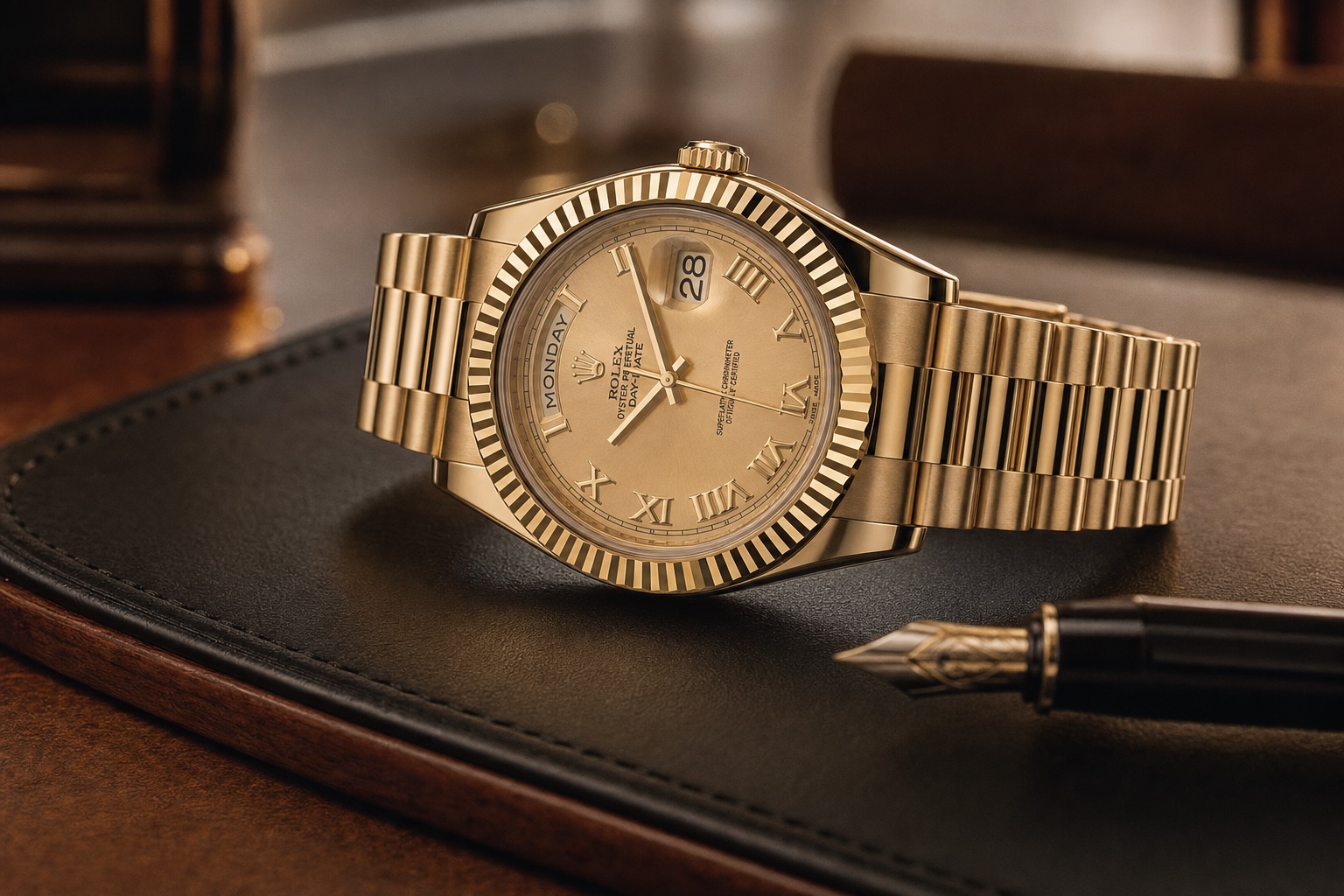
For its first fifty-two years the Day-Date came in one size. Rolex launched it in 1956 as the first wristwatch with the day of the week written out in full, in precious metal only, on a bracelet Rolex called the President (Monochrome, Phillips). The case was 36 mm, and it stayed 36 mm through every reference that followed. Then, in 2008, Rolex made it bigger. The Rolex Day-Date II 218238 was the yellow gold version of a 41 mm Day-Date that Phillips says "stood in stark contrast to the original Day-Date launched in 1956".
It lasted seven years. In 2015 Rolex replaced it with the Day-Date 40, a millimetre smaller and noticeably slimmer in the bezel and lugs (Phillips, Revolution). That makes the Day-Date II the one time Rolex took its flagship in a direction and then walked it back. Fratello's Robert-Jan Broer called it "out of balance", and Monochrome says plainly that "it proved to be a disappointing seller" (Fratello, Monochrome). I think it's worth a proper look anyway, because it's the biggest Day-Date Rolex ever sold and its short run makes it a clean, well-bounded thing to collect.
Where it came from
The Day-Date started with two references in 1956, the 6510 with a smooth bezel and the 6511 with a fluted one. Revolution's Wei Koh notes they "lasted only a year before being replaced" (Revolution, Monochrome). Phillips says the President bracelet was introduced alongside it, and that the 6611 of 1957 brought an improved calibre 1055 (Phillips). From the start, then, the Day-Date was a precious-metal watch with its own bracelet and its own movement development, and every later reference kept that arrangement. The nickname that followed is harder to pin down. Revolution credits Lyndon B. Johnson, captioning him as "the first US President to wear the Day-Date in office", and quotes an early Rolex advert selling it as "the watch you so often see on the wrists of presidents everywhere" (Revolution). Haute Time says experts "are still divided" on where the name came from (Haute Time). Sources disagree about which other presidents wore one, so I'll leave it at Johnson.
For half a century that formula didn't move: 36 mm, gold or platinum, day in an arc at twelve, date at three. Revolution puts the 2008 change simply. Rolex "introduced the Day-Date II, which featured the largest case yet for this model, at 41mm in diameter" (Revolution). Fratello gives the yellow gold 218238 as the reference Rolex introduced, and the line came in four metals: yellow gold (218238), Everose (218235), white gold (218239) and platinum (218206) (Fratello, Phillips, Phillips). There was no steel or two-tone version.
Why 41 mm, and why 2008? Rolex doesn't explain its design decisions, and I couldn't reach a Rolex press release from the launch. Monochrome's Erik Slaven says the Day-Date II debuted "to celebrate Rolex's centennial anniversary" (Monochrome). That's the only reason I found in a source I'd trust, and I haven't seen Rolex say it. Nobody I read names a designer either.
The reception was mixed from the start, and the criticism was about proportion. When SJX covered the Day-Date 40 at Baselworld 2015, JX Su described it as replacing "the oversized Day-Date II", whose day and date windows "seemed too small relative to the case" (SJX). Broer wrote that Rolex "seemed to have some issues with maintaining that perfect profile" at 41 mm (Fratello). Slaven is kinder about the presence, saying it "certainly had the most wrist presence of any Day-Date model", but agrees that the bezel and lugs were heavier than what came next (Monochrome).
It did get one memorable outing. At the Cleveland Cavaliers' 2016 championship parade, Hodinkee spotted LeBron James wearing "what sure appears to be the now-discontinued 41 mm Rolex Day-Date II", in yellow gold with a fluted bezel, black dial and Roman numerals (Hodinkee). That description matches a 218238 with a black Roman dial. Hodinkee's own interest was that he wasn't wearing an Audemars Piguet, the brand he represents.
The watch
| Spec | Value |
|---|---|
| Case | 18k yellow gold, fluted 18k gold bezel |
| Diameter | 41 mm (Phillips; Bonhams catalogued a 218239 at 41.5 mm) |
| Lug width | 21 mm |
| Crystal | Sapphire, Cyclops over the date |
| Movement | Calibre 3156, self-winding, 31 jewels, 28,800 vph, about 48 hours |
| Oscillator | Parachrom hairspring, Paraflex shock absorbers |
| Certification | COSC chronometer |
| Functions | Hours, minutes, seconds; day spelled out in an arc at 12, date at 3, both changing instantly at midnight |
| Water resistance | 100 m |
| Bracelet | President, three-piece links, concealed folding clasp |
| Production | 2008 to 2015 |
Movement and diameter are from Phillips; lug width, crystal, water resistance and the day-date change from Watchbase; oscillator from Monochrome; frequency, reserve and certification from Bob's Watches.
The two numbers I couldn't settle are thickness and lug-to-lug. Dealer measurements range from 11.8 to 12.1 mm thick, and one reviewer's 53 mm lug-to-lug looks high for a 41 mm Rolex. None of those sources is good enough to print as fact, so I've left both out of the table. If you're worried about wrist fit, that's a reason to try one on.
The movement is the part of the spec that matters. The calibre 3156 was new for the Day-Date II. Monochrome describes it as a small step from the 3155 used in the 36 mm Day-Date, with a Parachrom hairspring and Paraflex shock protection added (Monochrome). The 3155 shows up in some dealer listings for the 218238, and that's a mix-up with the older 36 mm watch: three Phillips lots across the family all give the 3156 (Phillips, Phillips, Phillips). It's a good movement, but it's the last of an older generation. The Day-Date 40 brought the calibre 3255, with about 70 hours of reserve against the 3156's 48 (Bob's Watches). That's the single biggest practical difference between the two watches.
The four metals deserve a word. Yellow and white gold are 18k. Everose is Rolex's own pink gold, first introduced in 2005, which Phillips describes as a ratio of gold, copper and palladium (Phillips). Platinum is 950 (Phillips). Otherwise they share the calibre, case size and President bracelet.
The rest is standard Day-Date. The day sits in its arc under twelve and the date under a Cyclops at three. Both change instantly at midnight. The day wheel came in a wide choice of languages, which the Rolex-style copy on Watchbase mentions without listing them.
How it changed
The Day-Date II was one generation with one movement, and I found nothing that documents a change to case, dial printing, hands or calibre during its seven years. The more useful comparison is with what came before and after it:
| Day-Date, 1956 on | Day-Date II, 2008–2015 | Day-Date 40, 2015 on | |
|---|---|---|---|
| Diameter | 36 mm | 41 mm | 40 mm |
| Movement | Calibre 3155 in the 18xxx generation (a 1990 example) | Calibre 3156 | Calibre 3255, about 70 hours |
| Bezel and lugs | Classic fluted or smooth | Broad bezel, heavy lugs | Slimmer bezel, narrower lugs |
Sources: Phillips, Phillips, 18238, Monochrome, Bob's Watches.
Read the table right to left and you can see what Rolex thought it got wrong. The Day-Date 40 lost only one millimetre of diameter, but Monochrome says Rolex used the change to "address the Day-Date II shortcomings", with a slimmer bezel and narrower lugs. The result was "basically a larger 36mm model", where the Day-Date II had "a beefier, sportier look" (Monochrome). Broer found the 40 "much more elegant" (Fratello). SJX gave its launch prices as CHF 33,200 in yellow gold, CHF 35,800 in white gold or Everose and CHF 59,500 in platinum (SJX), which is the nearest thing I have to a list price for the watch it replaced. I agree with him on looks. The Day-Date II's case looks like a 36 mm design scaled up, where the 40 was drawn again at its new size.
One loose end on the dates. Phillips sold a platinum 218206 whose Rolex guarantee is dated 18 March 2021, six years after the same essay says the reference was discontinued (Phillips). My read is a late sale of old stock, but I haven't seen anyone explain it. Production ended in 2015. The last new ones may have been sold later.
The variations that matter
Dials
AI-generated illustration.
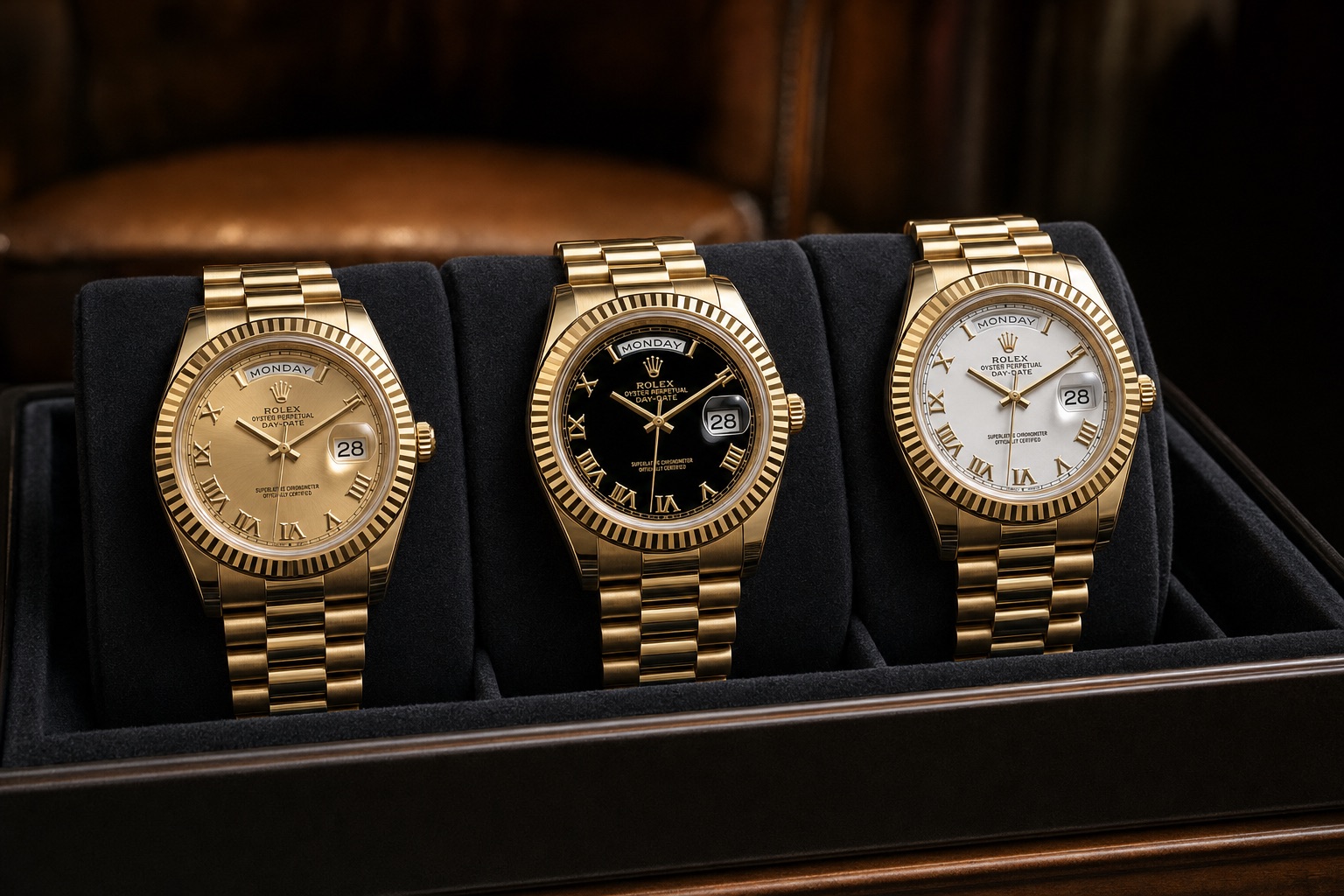
The yellow gold 218238's core catalogue in Watchbase's database is three Roman-numeral dials: white (-0037), champagne (-0038) and black (-0041), all with stick hands. Dealer listings also show champagne dials with stick markers and diamond-set versions, but I couldn't confirm those against a catalogue, so treat them as listings, not a complete list. Uhren-Muser sold a champagne Roman 218238 in May 2023 for €40,000, at the top of its estimate (Uhren-Muser).
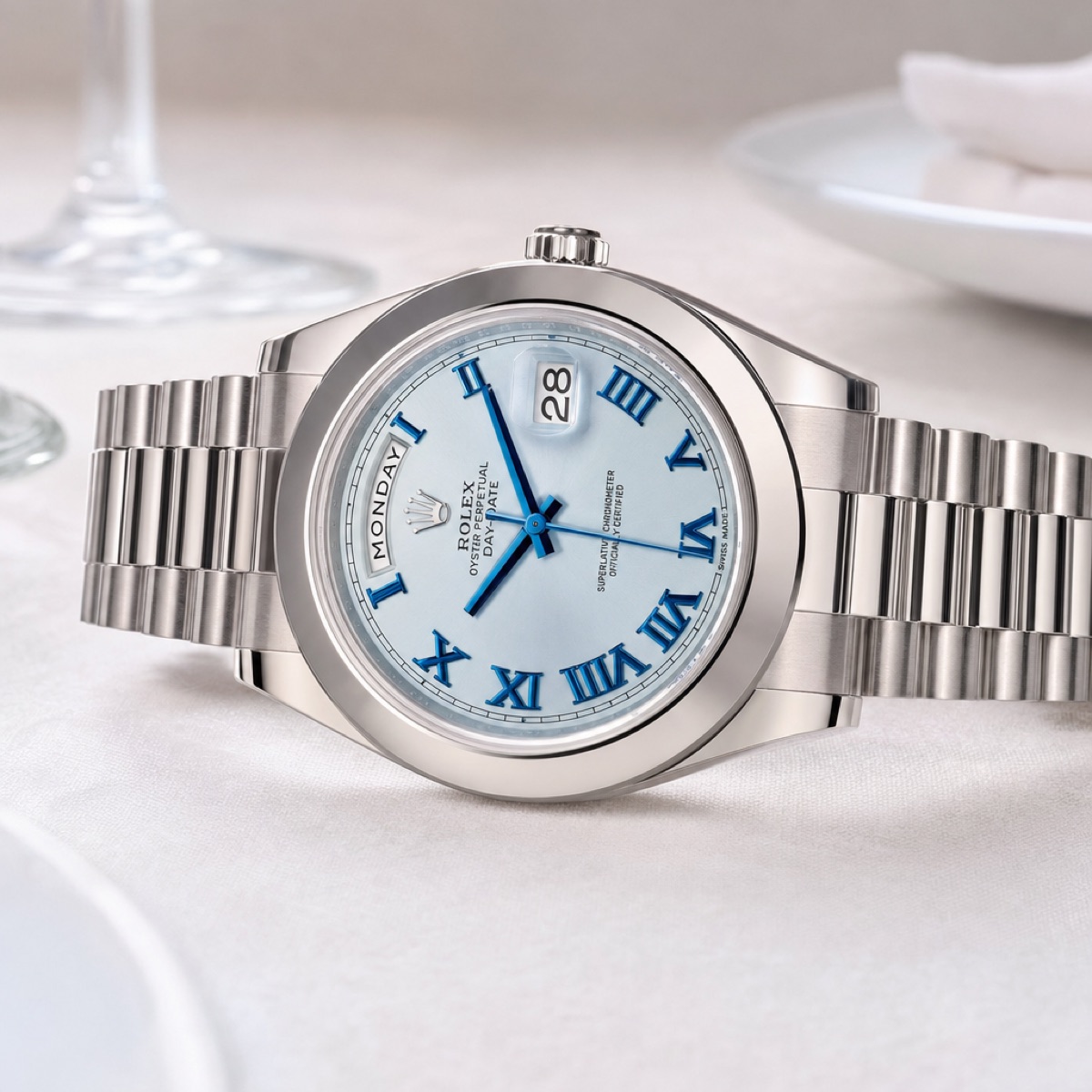
The other metals had their own dials, and this is how you tell a sibling from a 218238 at a glance. Watchbase lists Everose 218235s in black, ivory and chocolate Roman and a pink diamond dial; white gold 218239s in white and chocolate Roman and silver with diamonds; and platinum 218206s in Ice Blue Roman and Arabic, black Arabic and several diamond dials (Watchbase). The Ice Blue dial belongs to platinum. Phillips describes it as "only ever fitted to solid platinum Rolex models" (Phillips). A gold Day-Date II with an Ice Blue dial is a swapped or fake dial. Bonhams calls the white gold watch's rhodium charcoal dial a "rarity among rarities", made in very small numbers, though it gives no figure (Bonhams).
Bezels
AI-generated illustration.
The bezel tells you the metal. Every gold Day-Date II has the fluted gold bezel, and platinum has a smooth polished one. Monochrome called the smooth bezel "a platinum exclusive" in 2011 (Monochrome, Phillips). Diamond-set bezels appear in dealer stock. I found no reliable reference numbers for those gem-set versions, so they're out of scope here.
Bracelets
Every Day-Date II I found is on a President bracelet with a concealed folding clasp. I found no Oyster bracelet or leather strap fitted from the factory. Platinum bracelets have ceramic inserts between the links to stop them stretching, and Monochrome notes this "was only available for platinum bracelets on the Day-Date II" (Monochrome). On the gold watches, bracelet stretch is a real wear item. The heft is part of the appeal and part of the problem: Bonhams weighed a white gold 218239 at about 218 g, with a bracelet of about 173 mm and four spare links of about 24 mm (Bonhams). My guess is that all that gold is what wears the pins.
The clasp carries a stamped code, and Phillips records it. A 218235 with a guarantee dated November 2011 has a clasp stamped LT7, and the platinum 218206 with the 2021 card has P4V (Phillips, Phillips). I can't give you a sourced table decoding those codes for this family, but a clasp code that's wildly out of step with the papers is worth a question. My own notes list bracelet references for the family, but I couldn't confirm them against a Rolex source, so I won't print them.
Co-branded, commissioned and error dials
I couldn't find a documented Tiffany, Gulf-crest or factory error dial on the 218238. Collectors talk about Omani and UAE crest dials on older Day-Dates, but I only saw those in search results for other references, and none on this one.
The one Day-Date II commission I found is on the platinum watch, and the crest isn't on the dial. In February 2025 Sotheby's offered a 218206 from around 2012, with an ice-blue diamond dial and the Royal Khanjar of Oman engraved on the caseback (Sotheby's). The catalogue says the Muscat retailer Khimji Ramdas reported it was delivered to the Diwan of the Royal Court, and it was estimated at US$60,000 to 90,000. That's the auction house's account, and I haven't seen it confirmed independently. It does suggest where to look on a 218238, though: turn the watch over before you rule out a commission.
Why it matters
The honest case against the Day-Date II is the one Rolex made itself. It replaced the watch after seven years with one that fixed its proportions and gained a better movement. If you want a modern big Day-Date to wear, the Day-Date 40 is the better watch, and the 3255 alone settles it for me.
The case for it is that it's a finished story. A seven-year run with one movement and four metals is a small field you can learn completely. It's the largest Day-Date Rolex has made, and the only one with the "beefier, sportier look" Monochrome describes. Prices back that up only loosely. Uhren-Muser's €40,000 for a champagne 218238 in 2023, and CHF 27,940 for a white gold 218239 at Phillips, sit a long way above the £17,500 to 22,500 Sotheby's estimated for a platinum one in 2011, when Monochrome noted a new one cost over £30,000 at a dealer (Uhren-Muser, Phillips, Monochrome). Those are a handful of lots and they go stale fast. Treat them as an outline of the market, and get current numbers before you buy.
I haven't owned one. From what I've read, I'd buy one only if I wanted that particular look, a gold Day-Date with real presence, and I'd go in knowing that Rolex itself decided the look was too much.
What I'd check before buying one
- Movement: Calibre 3156. A 218238 described as having a 3155 is either a listing error or a watch with the wrong movement.
- Dial for the metal: Ice Blue only on platinum; champagne, white and black Roman are the core yellow gold dials. A mismatch is a swapped dial.
- Bezel for the metal: Fluted on gold, smooth on platinum.
- Bracelet stretch: Gold President bracelets have no ceramic inserts, so look at the slack between links and ask for any spare links.
- Caseback: Check for a crest or engraving before assuming the watch is standard.
- Papers: A guarantee dated 2008 to 2015 is normal. A later card on new old stock is possible, as the Phillips platinum watch shows, but it needs an explanation.
Sources
- Phillips: 218239, Geneva Watch Auction XIX, lot 123; Daytona 116505, on Everose; 218235, Hong Kong Watch Auction XII, lot 1000; 218235, c. 2011; 218206; 18238, 1990; Day-Date history, Geneva Watch Auction EIGHT, lot 25
- Sotheby's, Origins, 218206 with Royal Khanjar caseback, February 2025
- Bonhams, 218239, Hong Kong, March 2026, lot 1013
- Uhren-Muser, 108th auction, lot 246, May 2023
- Monochrome: Erik Slaven, the history of the Day-Date, December 2024; Martin Green, platinum Day-Date II at Sotheby's, July 2011
- Fratello, Robert-Jan Broer, Day-Date historical overview, November 2019
- Revolution, Wei Koh, Presidents' Choice, February 2019
- SJX, JX Su, Day-Date 40, March 2015
- Hodinkee, LeBron James at the 2016 Cavaliers parade, June 2016
- Haute Time, Martin Green, 2017
- Watchbase: Day-Date II catalogue; 218238-0037
- Bob's Watches: Day-Date II vs Day-Date 40; Everose Day-Date II
- Research dossier:
~/Projects/notebook/personal/research/watches/2026-10-29-rolex-day-date-ii-218238-dossier.md