Rolex Submariner 5508
- Make
- Rolex
- Reference
- 5508
- Model
- Submariner
- Production
- 1958–1962
- Calibre
- 1530
- Case material
- Steel
- Water resistance
- 100 m (328 ft)
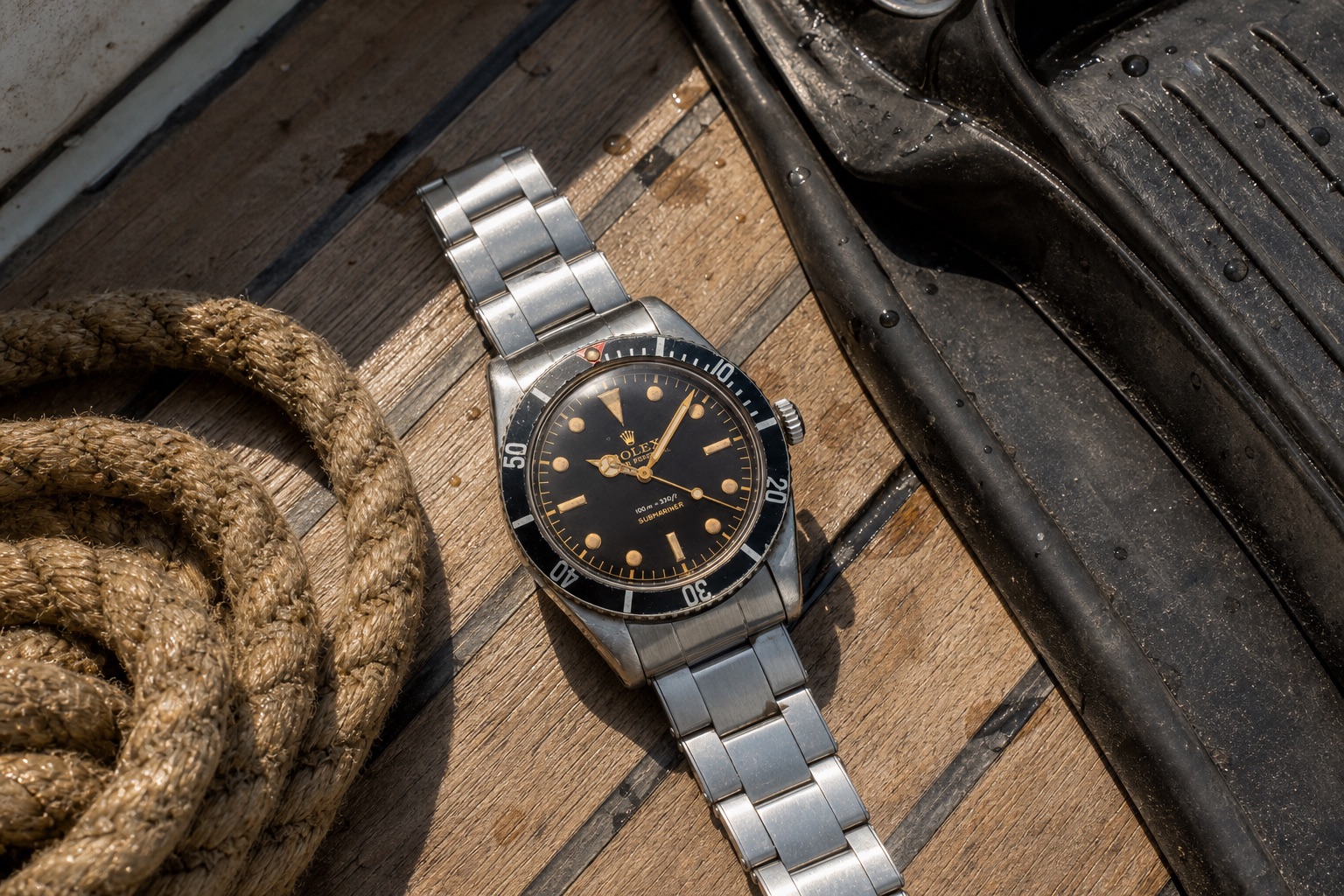
AI-generated illustration.
The Rolex Submariner 5508 is the last of the first Submariners. Every Submariner since 1962 has had a pair of guards on the right side of the case, protecting the crown. Before that, from the first 6204 of 1953 to the end of the 1950s, the crown sat out on its own at three o'clock, and the 5508 was the last watch built that way. Phillips calls it "the last one to carry a 100m depth rating and no crown guards", and Monochrome puts it more bluntly: it is "the last Submariner ever produced without crown guards".
It was also the small one. In the late 1950s Rolex ran two Submariner lines side by side: big-crown watches rated to 200 metres, and slimmer small-crown watches rated to 100. The 5508 was the final small-crown model, an update of the 6536/1 with Rolex's newer calibre 1530. It is about 37.5 mm across and 12.6 mm thick by Fratello's measurements, which makes it smaller than any Submariner Rolex has made since. For most of its run it overlapped with the watch that replaced it, the guarded 5512, so the 5508 spent most of its life as a holdover. That's a large part of why collectors care about it now.
Where it came from
The Submariner started in 1953 as the 6204, and within a few years Rolex had split it in two. The 6538 carried an 8 mm "big crown" and a 200-metre rating. Its sibling, the 6536 and then the 6536/1, was the 100-metre watch with a 6 mm crown. Both ran on the calibre 1030.
In 1958 Rolex updated both lines at once. Fratello notes that "the 5508 and 5510 both came out in 1958": the 5510 took over from the 6538 as what Monochrome calls "the last of the 'Big Crown' Rolex Submariner watches", and the 5508 took over from the 6536/1. Christie's describes the 5508 as "the upgraded version of reference 6536/1". The upgrade was mostly inside. Edmond Saran of Le Monde Edmond put a 6536/1 and a 5508 side by side and found the cases "exactly the same height and exactly the same length", both with 6 mm crowns and no guards. The difference was the movement: the 5508 carries the calibre 1530, which Saran calls "a more modern and reliable movement than the 1030".
Then the line moved on without it. The 5512 arrived in 1959 with a case of about 40 mm and, in Monochrome's words, a crown "now 7mm" and "protected for the first time by crown guards". The 5512 set the shape every Submariner has had since, but Rolex didn't drop the older watches straight away. The 5510 and the 5508 both stayed in the catalogue alongside it. Bob's Watches has the 5508 in production until 1962, and the latest one I found at auction has a caseback stamped II.62.
The dates aren't settled. Phillips gives 1958 to 1962 in most of its essays, and Sotheby's agrees. Christie's says "in production from 1957 until circa 1961", and one Phillips essay says the reference "launched in 1957". Antiquorum stretches it to 1965. I've used 1958 to 1962 here, because it's what most of the auction houses say and it fits the dated watches.
How many were made is a harder question. One Phillips essay says the 5508 "was produced in only 9,000 pieces as confirmed by Rolex". That's a striking number and it may be right, but it's the only place I found it, and the same essay calls the 5508 the last watch of its kind "before the ref. 5513", which mixes it up with a neighbour. I'd treat the figure as Phillips' and wait for a second source.
The sources are silent on a designer, a launch price and who Rolex had in mind for the slimmer 100-metre watch, and I found no documented expedition or famous owner. The 5508's history is the history of its case and dial.
The James Bond nickname
Collectors call the 5508 the "James Bond" Submariner. Phillips uses the name in its catalogues, calling the 5508 "the model affectionately called by collectors as the 'James Bond'" and, in another essay, "small James Bond". The nickname is real. The film connection behind it is thin.
The Submariner Sean Connery wore in Dr. No is usually identified as a 6538, the big-crown watch. My 6538 article goes through the evidence. Saran writes that "many experts believe only the 6538 was indeed worn in the Bond Films" and allows that it might have been a 5510. Monochrome's Alistair Gibbons is direct: the watch Connery wore "was not a 5508". My read is that the 5508 picked up the name because it looks like the watch in the early films (an unguarded Submariner of the right years) and because "small James Bond" was a convenient way to sell it next to the 6538.
The Royal Navy watch that wasn't
The 5508 has a military story too, and it doesn't hold up. In November 2007 Antiquorum offered a 1962 5508 in Geneva as a "British Royal Navy Issue" watch, estimated at CHF 48,000 to 58,000. The catalogue said a Royal Navy commander "would have been issued just such a watch", and it brought in Bond as well.
Gibbons went looking for the man behind the service number engraved on the watch. The archive he asked had a record of the number, which belonged to a man stationed at Portsmouth, and a retired Royal Navy clearance diver confirmed that the number marked him as a clearance diver. The same diver told Gibbons the man would have had to have the watch engraved with his details himself. That's what you'd do to a watch you'd bought. Gibbons's conclusion: the watch "was not issued by the Royal Navy but was a personal watch". It went unsold. The Submariners that really were British military issue are the later 5513 and 5517 "Milsubs", and I found no documented issued 5508. A working diver's own 5508 is a good story in its own right, but it isn't the one the catalogue told.
At auction
The 5508's record belongs to a very early watch. At Phillips' Geneva Watch Auction NINE, on 11 and 12 May 2019, a 1958 example with a red-triangle bezel and its bracelet stamped 1.58, "directly coming from the family of the original owner", sold for CHF 500,000 against an estimate of CHF 80,000 to 160,000. Watch Collecting Lifestyle called it "a brand new record and benchmark for this reference 5508".
Late watches with the "exclamation" dial (below) have done well too. A II.62 example made CHF 125,000 at Phillips in November 2018, and a 1962 watch made CHF 132,300 at Phillips in May 2022. Both are well above the CHF 25,000 to 30,000 that plainer 1958 and 1959 examples have fetched at the same house, which shows what the market will pay for the late dial in good condition.
The watch
| Spec | Value |
|---|---|
| Case | Stainless steel Oyster case, no crown guards |
| Diameter | 37 to 38 mm depending on source; Fratello measures 37.5 mm |
| Lug to lug | 46.9 mm (Fratello) |
| Thickness | 12.6 mm (Fratello); 12.8 mm (Le Monde Edmond) |
| Crown | 6 mm screw-down, unguarded |
| Crystal | Domed acrylic |
| Bezel | Bidirectional, black 60-minute insert, minute hashes for the first 15 minutes |
| Movement | Rolex calibre 1530, automatic; 25 or 26 jewels depending on the catalogue |
| Depth rating | 100 m, printed "100m=330ft" |
| Dial | Glossy black with gilt print, chapter ring, Mercedes hands |
| Bracelet | Riveted Oyster; 7206 and 6636 both recorded on auction lots |
Sources split on the case size, and the split is wider than it should be. Phillips alone has catalogued 5508s at 37, 37.5 and 38 mm. Saran measured his unpolished case at "38mm from end to end", and Fratello gives "37.5mm × 46.9mm × 12.6mm". All of them leave out whether the crown is included. My guess is that 37.5 mm without the crown is closest, and that the rest is rounding and polish. Fratello points out that those numbers are "within spitting distance of a Tudor Black Bay 54".
The crown is the detail that names the watch. Bob's gives it as "a 6mm crown (for comparison, the 'Big Crown' Submariners included 8mm crowns)". Together with the thinner case, that's why Rolex rated the 5508 to 100 metres when the big-crown 5510 beside it was rated to 200. Phillips notes that it was "the last Submariner to carry the '100m=330ft' depth rating". From the 5512 on, every Submariner was rated to at least 200 metres.
The calibre 1530 is the other half of the upgrade. Bob's describes it as a nickel-finished automatic, "more modern and reliable than its predecessor", the 1030. The catalogues can't agree on the jewel count: Phillips lists 25 jewels on some 5508s and 26 on others. It isn't a useful way to date a watch. You'll also read that the 5508 was the first chronometer Submariner. None of the auction lots I read describes a chronometer dial on a 5508, and Phillips has sold a 6538 with an "Officially Certified Chronometer" dial and a caseback stamped IV.1958, so I wouldn't repeat the claim.
How it changed
| Years | Case numbers seen | Dial | Lume | Movement |
|---|---|---|---|---|
| 1958 | 361'xxx, 400'xxx, 489'xxx to 490'xxx (all stamped III.1958) | Glossy gilt, chapter ring; depth in silver or white | Radium | Cal. 1530 |
| 1959 | 489'xxx to 490'xxx | Glossy gilt, chapter ring; "double silver" print on some | Radium (tritium from 1959 by one account) | Cal. 1530 |
| 1961 to 1962 | 762'xxx to 764'xxx (II.62 on one) | Glossy gilt with "exclamation" dot at 6 | Diluted radium or tritium; sources disagree | Cal. 1530; one 1962 watch with a 1560 |
Treat every line of that table as approximate. It's built from individual auction lots, and the serials fall out of order: Phillips and Sotheby's have catalogued watches numbered 400'096, 400'307 and 489'985, all with casebacks stamped III.1958. Read the serial together with the caseback stamp, and expect 1958 and 1959 to blur.
The 5508 changed less than most Submariners because it was only made for four years. What did change was the lume. In 1958 the dial was painted with radium. By 1962 Rolex was using either a weaker radium mix or tritium, and the sources don't agree on which. Fratello says the dials "still featured radium lume, although the compound was diluted towards the end of the production run in 1962". Monochrome calls the 5508 "the first reference of the Submariner to start using tritium paint". Rolexhaven, a collector's site with detailed pages on single 5508 dials, says Rolex started using tritium in 1959 "there were no markings or distinction" from radium dials, and standardised on the "Swiss T<25" marking about a year later. The exclamation dial sits at the end of that change.
The variations that matter
Dials
AI-generated illustration.
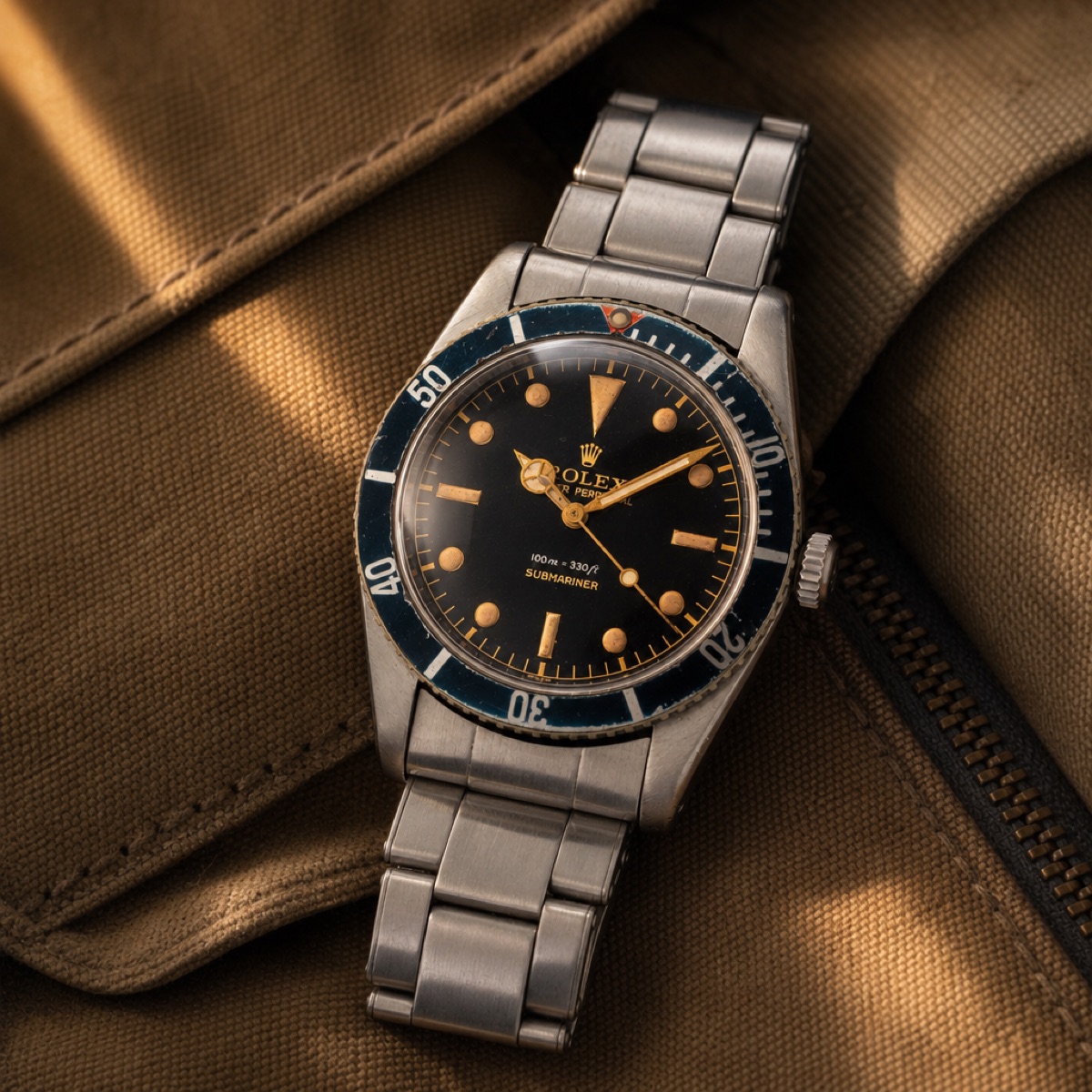
Every original 5508 dial I found at auction is the same basic type: glossy black lacquer with gilt print, which Bob's describes as "a glossy black background punctuated with gold-colored text". It has a printed minute track around the edge, the chapter ring, and the depth rating "100m=330ft" in two lines with "Submariner". A Phillips lot from 1961 describes "a gilt chapter ring, Mercedes hands, and a glossy lacquer dial", and calls the combination "correct". The matte dials came later, during the 5512's run.
The variations within that type are in the print. On a 1958 watch Phillips sold, the coronet, "Rolex", "Oyster Perpetual" and "Submariner" are gilt but the depth rating is "silver printed". Rolexhaven argues that the very first batch printed the depth rating in gold ink and that silver came later in 1958. That's a single collector's reading, but it's a careful one. A 1959 watch at Phillips went further, a "double silver" dial with both the depth rating and the model name in silver, "whereas normally only the depth rating on this model is printed" that way.
Then there are the dials that have changed colour. Gilt dials can turn brown as the black lacquer breaks down, and collectors call the result "tropical". Sotheby's offered a 1958 5508 in June 2026 with a "glossy tropical gilt" dial, found in a family home in Egypt in 2017, at USD 100,000 to 200,000. A tropical dial is the work of age and climate, and two "tropical" dials can look completely different.
The exclamation dial
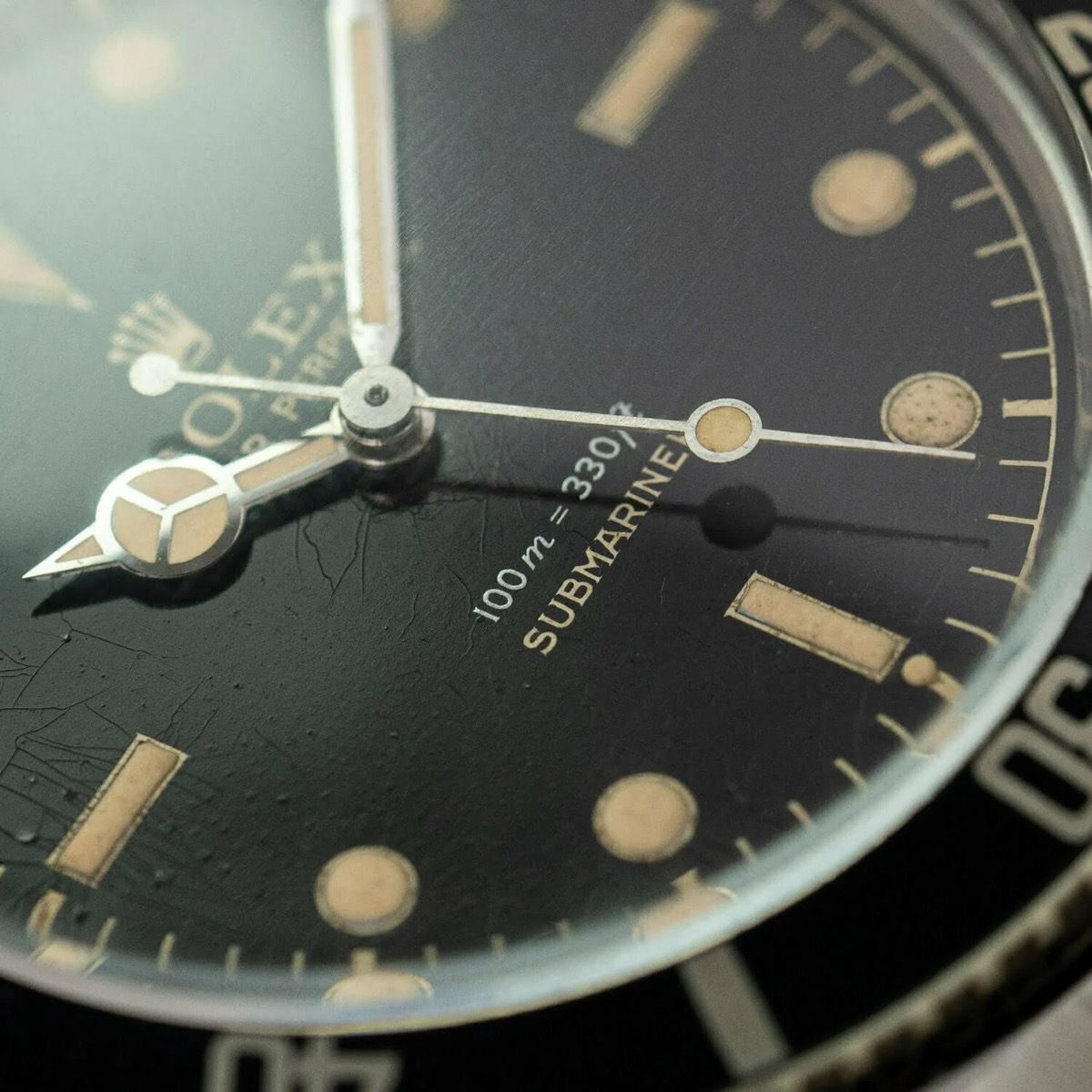
Photo: Amsterdam Vintage Watches.
Late 5508s carry a small round dot of lume just below the six o'clock marker, which makes the marker and dot read like an exclamation mark. Rolexhaven describes it as "a small dollop of luminous material below the 6:00 marker". Every exclamation 5508 I found in Phillips' catalogues is dated 1961 or 1962.
What the dot meant is still argued over, and Phillips has taken both sides. One Phillips essay says the dot is one "which collectors identify as signifying a lower radium amount". Another says "it is believed a small dot placed at six o'clock confirms the use of tritium". Rolexhaven sides with tritium and "less radiation". The collector Nicolas ("amanico") summed it up on WatchProSite in 2012: "a pity that Rolex doesn't communicate on those details". He had seen the dot on watches from 1958 and 1959, though "most often in the 60 / 62 range".
My read is that the dot marked the change to a less radioactive lume, whatever the mix, during the year or two before Rolex printed "T<25" on its dials. It's a transitional detail, which is exactly what makes it collectable, and the auction results above show what the market pays for it.
Bezels
The 5508's bezel insert has minute hashes for the first 15 minutes, then numbers and markers at five-minute steps. Saran points out that this is one way to tell it from a 6536/1, whose early inserts were marked at ten-minute intervals. Phillips calls the 15-minute insert the "correct bezel with the individual first 15 minute markers".
The marker at zero changed during the run. Bob's says "the earliest versions included a red triangle" and later watches had a silver one, and Fratello says you'll find both. The red-triangle inserts turn up on 1958 watches: the CHF 500,000 Phillips record, the Sotheby's tropical watch with its "pristine red triangle and original pearl", and an Antiquorum watch numbered 361'450. The pearl is the small lume pip inside the triangle, and an original one survives less often than the insert.
Bracelets
The 5508 came on a riveted Oyster bracelet, and the references on the clasps don't line up with the tidy tables you'll find online. Auction lots record a 7206 with end links stamped 58 on a III.1958 watch, a 7206 with end links 80 on a 1959 watch, end links 75 on another 1958 watch, and the 6636 with end links 80 on a fourth. Rolexhaven says the 7206 number was first stamped on a link in 1962, which doesn't sit easily with Phillips cataloguing 1958 bracelets as 7206s. Either way, several bracelets are correct for a 5508. What matters more is that the clasp date suits the watch: the record-setting 1958 example's bracelet was stamped 1.58.
Co-branded, commissioned and error dials
Serpico y Laino
I found no Tiffany & Co. 5508. The Tiffany-signed Submariners that have come to auction are 5512s and 5513s. The one retailer dial documented on a 5508 is from Serpico y Laino, Rolex's agent in Caracas. Antiquorum sold a 1958 example in Monaco on 12 December 2025, with a tropical "spider" dial "signed serpico y laino, gilt printing", an outer caseback marked "S&L ACERO" and an inner caseback stamped III.1958. It made EUR 44,608 against an estimate of EUR 25,000 to 45,000. The caseback marking is the useful tell here, because a retailer name painted onto a dial is easy to add later and a caseback stamp is harder.
Service dials
Some 5508s have been through Rolex service and come back with replacement dials and hands. Antiquorum has catalogued 5508s with a "service dial" and "service hands". A service dial isn't a fake, and it's honest if it's described as one, but it takes most of the value with it. I found no named factory-error dial on the 5508.
What I'd check before buying one
I don't own a 5508 and haven't handled one, so this list is from the catalogues, not experience.
- Caseback stamp against serial: The inside caseback should read 5508 with a quarter and year, like III.1958 or II.62. Phillips calls a III.1958 stamp "correct" for its watch. Remember that 1958 and 1959 serials overlap.
- The dial: It should be glossy gilt with a chapter ring and "100m=330ft". A matte dial or modern-looking lume points to a service or replacement dial.
- The crown: It should be a small 6 mm crown with no guards. A 7 mm crown suggests a later service part or a 5512 case.
- The bezel: The insert should have individual minute hashes for the first 15 minutes. Red triangles get faked or swapped in because they add value, so the triangle should match the dial's age and wear.
- Hands: A Bob's listing for a 1962 5508 notes relumed hands, a later seconds hand and a "period correct replacement" bezel. That's normal for a watch this old, and the price should reflect it.
- Provenance: A Royal Navy or Bond story needs paperwork. As the 2007 Antiquorum watch shows, a good story needs documents behind it.
Sources
- Phillips, Geneva Watch Auction NINE, lot 213 (1958 5508, CHF 500,000)
- Phillips, Geneva Watch Auction EIGHT, lot 218 (II.62 exclamation 5508)
- Phillips, Geneva Watch Auction XV (1962 exclamation 5508, cal. 1560)
- Phillips, Hong Kong Watch Auction TWO, lot 282 (exclamation dial, radium)
- Phillips, The Watch Auction: One, lot 73 (exclamation dial, tritium)
- Phillips, The Watch Auction: One, lot 168 (silver depth print, 7206/58)
- Phillips, Geneva Watch Auction THREE, lot 185 ("double silver" dial)
- Phillips, Geneva lot 155 (III.1958 caseback)
- Phillips, Hong Kong Watch Auction FIVE, lot 821 ("James Bond" nickname)
- Phillips, TOKI, lot 24 (production figure)
- Christie's, An Evening of Exceptional Watches, lot 94
- Sotheby's, Important Watches, June 2026, lot 77
- Antiquorum, Serpico y Laino 5508, Monaco, 12 December 2025
- Antiquorum, "British Royal Navy Issue" 5508, Geneva, 11 November 2007
- Antiquorum, 5508 with service dial
- Monochrome, History of the Rolex Submariner, Part 2
- Monochrome, Did this 1962 Rolex Submariner 5508 actually see field action?
- Le Monde Edmond, the battle of the small-crown Submariners (6536/1 vs 5508)
- Fratello, hands-on with a 1959 Submariner 5508
- Bob's Watches, inside the Submariner 5508
- Bob's Watches, vintage Submariner 5508 listing
- Rolexhaven, 5508 final batch '62
- Rolexhaven, 5508 silver depth '58
- WatchProSite, exclamation dot on the 5508 and 6542
- Watch Collecting Lifestyle, Phillips Geneva Watch Auction NINE report