Patek Philippe
AI-generated illustration.
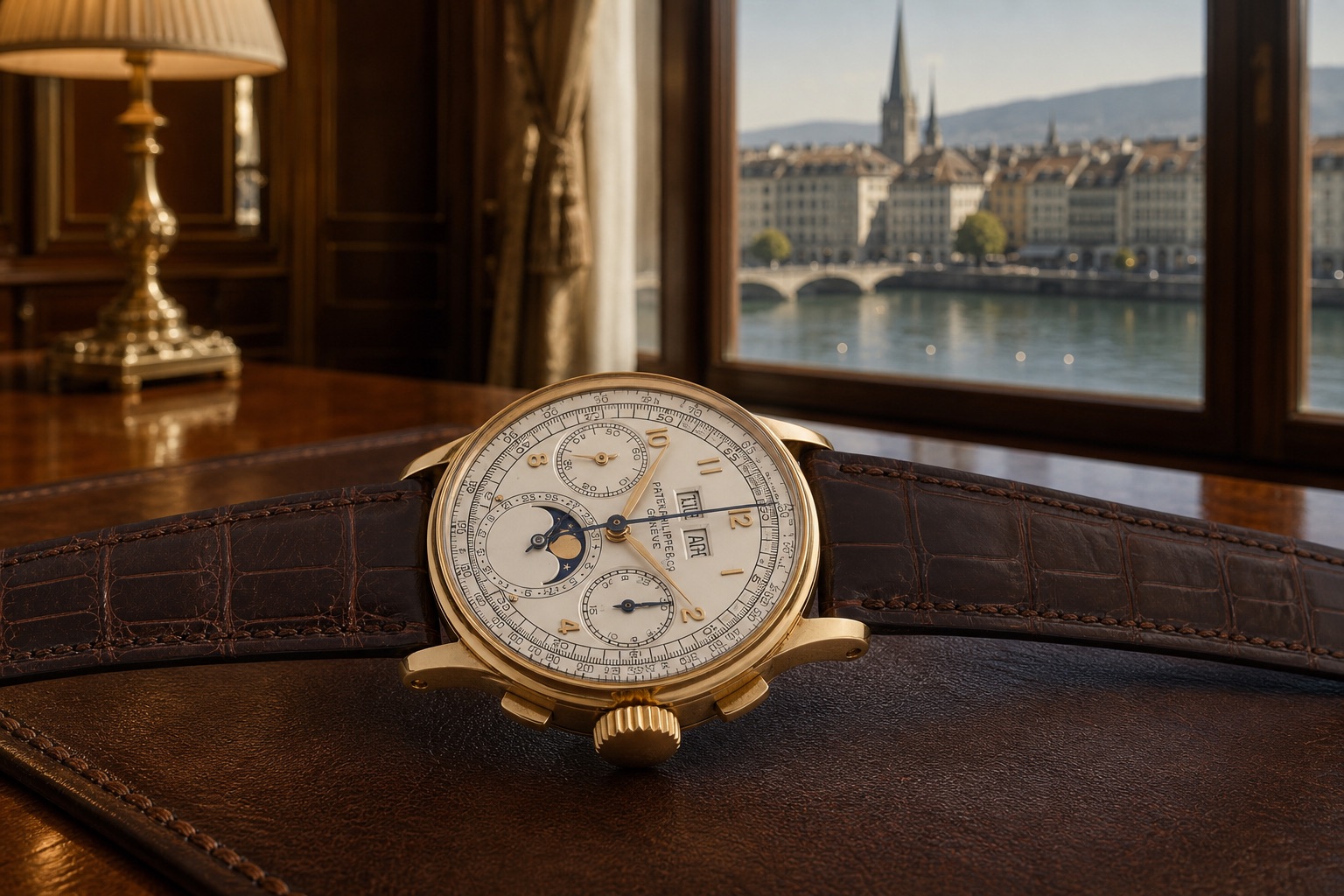
Patek Philippe sold about 72,000 watches in 2025 for around CHF 2.5 billion, by Morgan Stanley's estimate. Rolex made about 1.15 million. On those numbers Patek is a small company, and it holds the records that matter most to collectors: the most expensive watch ever sold at auction, the most expensive pocket watch, and the first wristwatch to pass eight figures.
The history behind the records is less tidy than the company's own telling. The firm was started by a Polish cavalry officer who, by the account of the one partner who knew the trade, didn't know watchmaking. It employed half a dozen people finishing bought-in movements for other Polish exiles. For most of a century its base movements came from the Vallée de Joux. In 1932 it nearly went under and was bought by its dial supplier, the Stern family, who still own it. Most of the firsts it is credited with have an earlier claimant.
What Patek did do, and I think this is the real thread, is take complications that had been one-off commissions and put them into regular production: perpetual calendars from 1941, self-winding from 1953, an annual calendar it invented in 1996. And it kept the books. Its sales ledgers run from 1839 (Florkowska-Frančić), which is why an Extract from the Archives can give a buyer the day a watch made in 1842 was sold (Antiquorum). This is that history, including the parts the company's history page leaves out.
Timeline
These are the best-supported dates I found. Where sources split on a year, the era sections say so.
| Year | Event |
|---|---|
| 1839 | Antoni Patek and Franciszek Czapek sign a six-year partnership deed in Geneva, 1 May |
| 1845 | The partners split; Adrien Philippe patents his keyless winding system and joins Patek, 15 May |
| 1851 | The firm becomes Patek, Philippe & Cie; Queen Victoria buys at the Great Exhibition; the Tiffany relationship begins |
| 1868 | A bracelet watch for Countess Koscowicz, Patek's "first Swiss wristwatch" |
| 1877 | Antoni Patek dies, 1 March |
| 1886 | Geneva passes the Geneva Seal law |
| 1894 | Adrien Philippe dies, 5 January |
| 1901 | The partnership becomes a joint-stock company, 1 February |
| 1902 | Patent for a split-seconds chronograph, filed 13 November |
| 1925 | A 1898 pendant-watch movement is recased as a perpetual calendar wristwatch |
| 1932 | Charles and Jean Stern take control; the Calatrava reference 96 |
| 1933 | The Graves Supercomplication is delivered, 19 January |
| 1941 | Regular production of perpetual calendar wristwatches: references 1526 and 1518 |
| 1953 | First self-winding Patek, the reference 2526 |
| 1969–1970 | Beta 21 quartz, reference 3587 |
| 1976 | The Nautilus 3700/1 in steel |
| 1977 | Philippe Stern becomes general director; the calibre 240 |
| 1989 | The Calibre 89 and the "Art of Patek Philippe" auction |
| 1996 | Plan-les-Ouates manufacture, the Annual Calendar and the "Generations" campaign |
| 2009 | The Patek Philippe Seal replaces the Geneva Seal; Thierry Stern becomes president |
| 2019 | A steel Grandmaster Chime sells for CHF 31 million, 9 November |
| 2021 | The steel Nautilus 5711 is discontinued |
| 2024 | The Cubitus, the first new collection since 1999 |
| 2026 | Philippe Stern dies, 14 June |
A Polish officer's workshop, 1839–1851
Antoni Norbert Patek was born in June 1812 at Piaski, near Lublin, joined the Polish cavalry at fifteen and fought in the 1830–31 uprising against Russia as a second lieutenant. He was wounded twice and awarded the Gold Cross of Virtuti Militari (Czapla). After the defeat he was interned in Prussia, then drifted through France, where he set type in a printing shop in Amiens, before a Frenchman called Thomas Moreau persuaded him to move to Versoix, outside Geneva, in the mid-1830s. There he studied painting under Alexandre Calame and married Moreau's niece (Czapla, WorldTempus). None of that is a watchmaker's biography. Halina Florkowska-Frančić, working from the Geneva State Archives and the firm's own ledgers, describes the 1839 partnership as one between two political exiles "of whom only one knew the trade well" (Florkowska-Frančić).
The one who did was Franciszek Czapek, a Bohemian-born watchmaker who had served in Warsaw's national guard in 1831, reached Geneva in 1832 and married into a Geneva watchmaking family. He was already in business with Moreau when Patek arrived. A Polish diarist in 1836 called him "a good watchmaker but limited," who made "the dearest watches for Poles at 425 francs" (Florkowska-Frančić). On 1 May 1839, at Moreau's urging, Patek and Czapek signed a six-year deed and set up at 29 Quai des Bergues (Patek Philippe Museum). That deed is the date Patek Philippe counts from.
The business was an assembler. It bought movements, including keyless ones from Louis Audemars in the Vallée de Joux (Audemars made just 41 of them for the firm), had them cased and decorated, and sold about 200 watches a year with half a dozen workers paid by the piece (WorldTempus, Antiquorum). The customers were Polish exiles and travelling Polish aristocrats, and the watches said so: Kościuszko and Poniatowski in enamel, Our Lady of Częstochowa, the owner's arms. The third entry in the ledger is a watch sold to the poet Adam Mickiewicz in December 1839 for 225 francs. Five years later the firm sold one for 993 francs to Field Marshal Paskevich, the man who had crushed the uprising Patek fought in (Florkowska-Frančić). Patek's letters complain that "in payments the Poles are always worst," so he sold for cash.
The partnership ended badly, and we only have Patek's side. Czapek began taking long trips home to Bohemia, leaving Patek to cover his work, and Patek came to suspect him of passing off Neuchâtel watches as their own. On 19 April 1845 the two decided not to renew the deed (Florkowska-Frančić). Czapek set up Czapek & Cie with a new Polish backer, became a supplier to Napoleon III's court, and his firm was gone by 1869 (Antiquorum). Patek's own museum catalogue gives the liquidation as 18 April 1845 "due to disagreements between the two partners" and leaves it there.
Patek had already found the replacement. Jean Adrien Philippe, a watchmaker's son from La Bazoche-Gouet in France, had shown a watch that wound and set through its crown at the 1844 Paris Industrial Exposition and won a bronze medal for it; Patek's own history says bronze, and Florkowska-Frančić's "gold" traces back to the company's 1939 centenary book (Patek Philippe Magazine). Whether the two men met at the show is disputed inside Patek's own publications, so I won't stage it. Philippe's French patent No. 1317 for the system was filed on 22 April 1845 (Antiquorum), and on 15 May 1845 he, Patek and a lawyer named Wincenty Gostkowski signed the deed of Patek & Cie. Gostkowski's account of the capital is worth having: he put in 40,381 francs, Patek 35,081 in receivables, tools and premises, and Philippe nothing, with some of his debts paid for him (Florkowska-Frančić). Gostkowski ran the money and the local sales, Philippe the workshop, Patek the travel and the selling, and when the firm wobbled in 1848 it was Gostkowski's extra capital that saved it. On 1 January 1851 the firm became Patek, Philippe & Cie (Patek Philippe Museum). Gostkowski's name never went on the dial, and the company's current history pages don't mention him at all.
Exhibitions, Tiffany and the Rue du Rhône, 1851–1901
The Great Exhibition in London in 1851 is the founding story Patek likes to tell, and most of it holds. Philippe wrote home that their display was "undeniably the most important and the most superb of the whole exhibition in terms of its pocket watches," and the English chronometer maker Dent is supposed to have told Patek he was "the King of watchmakers" (Patek Philippe Magazine). Queen Victoria did buy. Which watch is less clear than the brand copy suggests. The company's museum once listed No. 4536, a keyless pendant watch with a brooch, "presented" on 18 August 1851 (Patek Philippe Museum, archived). Collectability, citing the company's archives, says she bought No. 4710, a blue enamel pendant watch set with diamonds, on 30 November 1851 for 612.50 francs, and a quarter-repeating chronometer for Prince Albert in August (Collectability). Either she bought two or the museum relabelled one. The "gold medal" Patek says it won there is also its own wording: the 1851 jury gave a bronze Prize Medal and a Council Medal, nothing in gold (V&A).
The American business started the same decade. Patek dates its agreement with Tiffany, Young & Ellis to 1851 (Patek Philippe); John Reardon, who has worked in the Patek archive, puts the first sale to Tiffany in 1847 (Collectability). Patek sailed for New York just before Christmas 1854, was robbed at his hotel on the first day and wrote home that "this badly organized country is crawling with dangers." He also came back with an order for 150 watches from Charles Lewis Tiffany and the conviction that the future was American (Patek Philippe Magazine). In 1876 Tiffany became general agent for the United States, and Patek took over the steam-powered factory Tiffany had opened in Geneva in 1872 and failed with within four years.
The salon itself dates from this period. The company says it took two floors at 41 Rue du Rhône in 1853 (Patek Philippe); Collectability has it buying the building in 1891 as the back half of a block it had occupied from the Grand Quai side since 1854. The company has been at that address ever since.
Patek died on 1 March 1877. His son Léon stayed in as a sleeping partner and was paid for the use of the name; a quoted contract says 6,000 francs a year, another source says 10,000, and the amount is unsettled (Watch Collecting Lifestyle, Deployant). Gostkowski had already been pushed out. A settlement imposed by Patek and Philippe in 1875 turned him into a creditor, and he sued, lost, and published his grievance in 1878 (Florkowska-Frančić). Philippe ran the technical side into his seventies, publishing a book on keyless watches in 1863 and taking out patents for a precision regulator in 1881, a perpetual calendar mechanism in 1889 and a refined keyless work in 1890 (Google Patents). He handed over to his son Joseph Émile in January 1891 and died on 5 January 1894.
Two things that shaped the next century began here. Geneva passed its Geneva Seal law on 6 November 1886, and the business historian Pierre-Yves Donzé has shown how little it mattered at first: the inspection office averaged "just 475 watches" a year between 1887 and 1918, and Patek was not among the heavy early users (Donzé). And from the 1870s the firm's biggest customer was a retailer in Rio de Janeiro, Gondolo & Labouriau, which comes back below. In 1901 the partners turned the firm into a joint-stock company, Ancienne Manufacture d'Horlogerie Patek, Philippe & Cie SA, with a five-man board chaired by Philippe's son-in-law Joseph Bénassy-Philippe and including Alfred G. Stein, a former Tiffany watchmaker who ran the New York office until his death in 1934 (Phillips).
American collectors and a Brazilian lottery, 1901–1932
The watches that made Patek's reputation for complications were commissions for rich Americans, built on movement blanks bought in. The split-seconds chronograph the firm patented on 13 November 1902 was built on a Victorin Piguet ébauche (Google Patents, Phillips), and Jacques-David LeCoultre's firm was the principal ébauche supplier from 1905 (WorldTempus). James Ward Packard, the car maker, bought from 1900 by Patek's count, and his 1916 watch with sixteen complications was the most complicated the firm had made (SJX). Henry Graves Jr., a New York banker, commissioned about thirty watches between 1922 and 1951 (Christie's). The famous rivalry between the two is a later invention: SJX and Collectability both looked for evidence of contact and found none.
Wristwatches came slowly. The earliest Patek examples were made in 1911 and not sold until 1919 and 1920 (Phillips). In 1923 the firm sold No. 124 824, which Sotheby's calls "the world's earliest known split-seconds chronograph born as a wristwatch by any maker" (Sotheby's). The 1925 perpetual calendar wristwatch, No. 97 975, is the one Patek calls a world first. It is a 1898 pendant-watch movement in a new 34 mm case, a one-off, sold in 1927 (Revolution). Breguet's No. 2516 of 1929 is, in Christie's words, "most probably the first wristwatch ever with a perpetual calendar, not using a converted pocketwatch movement" (Christie's). Series production of wrist chronographs began in 1927 (Patek Philippe).
The unflattering part of this era is in Rio. From 1902 Gondolo & Labouriau sold a Patek made to its order, the Chronometro Gondolo, and sold it through clubs: 180 members paid 10 francs a week for 74 weeks, with a weekly draw that freed the winner from further payments. There were 118 such clubs between 1901 and 1915, and a 740-franc watch cost roughly a Brazilian worker's annual wage (Collectability). The company's own museum catalogue says that "for over a quarter century, the Brazilian retailer absorbed nearly a third of Patek Philippe's production" (Patek Philippe Museum). When the Depression came, Patek watches turned up in Rio pawnshops from 1932, the store closed in May 1935, and Patek was the largest unpaid European creditor (Collectability).
Nobody has published Patek's own sales or losses for 1929 to 1932. The company's magazine says it "teetered on the brink of collapse" (Patek Philippe Magazine), and a Gisbert Brunner piece drawing on the board minutes says orders dried up and payments stopped. The same piece names a rival bidder: Jacques-David LeCoultre and his holding company SAPIC wanted control on terms the board found "absolutely unacceptable," and Charles and Jean Stern, whose firm Cadrans Stern Frères made Patek's dials, "quietly and successively" bought shares instead (LGT). No source gives a price or an exact date. Donzé adds a detail that reframes the Geneva Seal: Patek's share of the watches submitted for it rose from under 5% before 1924 to 48% in 1932 and over 80% after 1934, until the office "almost resembled a privatized institution" (Donzé). Patek didn't lead the Seal from the start. It took it over once everyone else had left.
The Sterns build a movement, 1932–1958
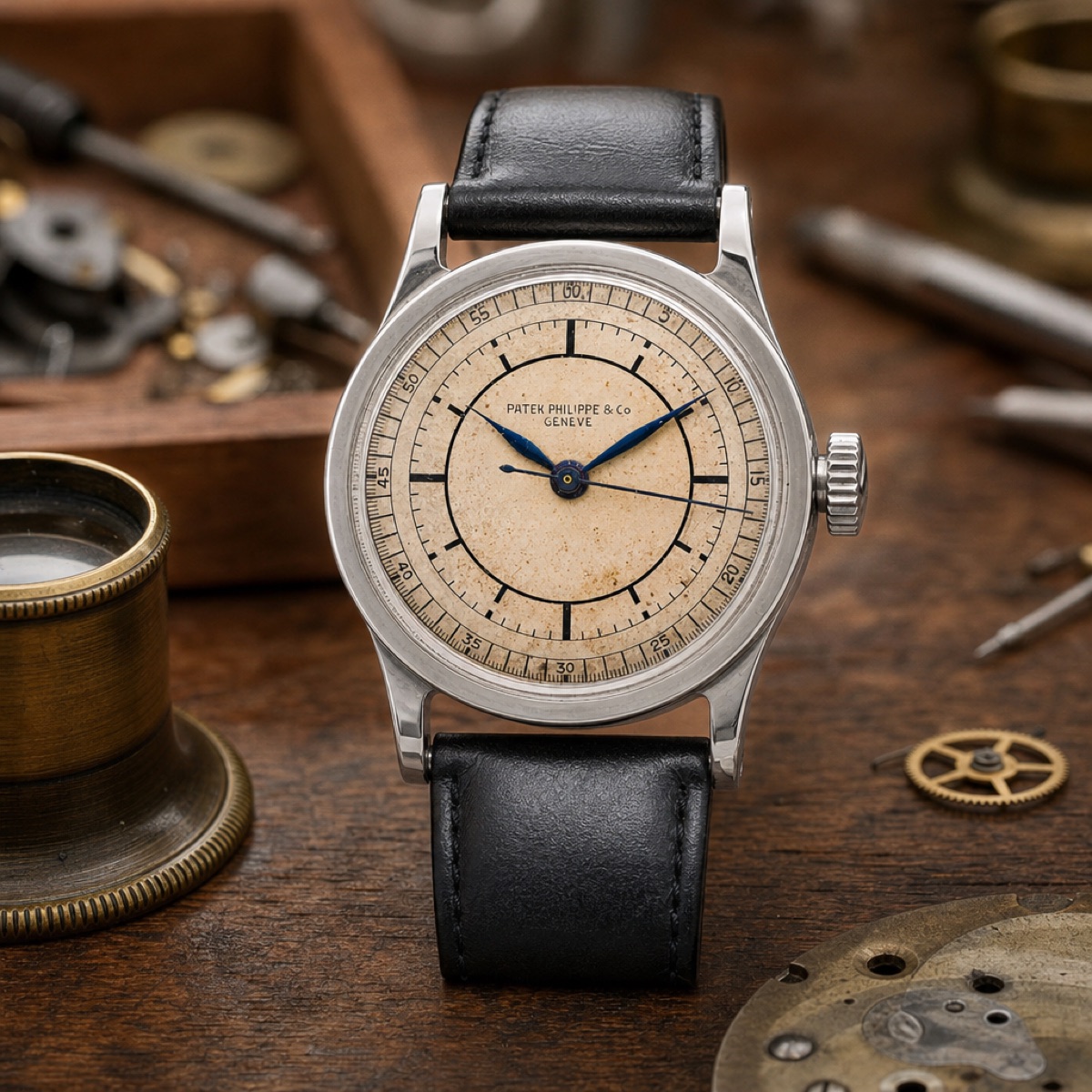
The first thing the new owners did was hire a technical director, Jean Pfister from Tavannes, with a brief to make Patek's own movements (Patek Philippe). The first in-house calibre, the 12-120, arrived in 1934, and it went into the watch the Sterns had launched in 1932 on a LeCoultre 12-ligne movement: the reference 96, a 31 mm time-only watch that was also the first Patek with a reference number (Revolution, Patek Philippe). Who designed it is unknown. The story that an Englishman named David Penney drew it is a misreading of the illustrations he made for a 1982 book; Penney, who is alive, says so himself, and the trade's "Bauhaus" label has no better pedigree (Collectability). The name "Calatrava" wasn't applied to the line until 1985 (Sotheby's). The 96 stayed in production until 1973, and every Patek dress watch since descends from it.
AI-generated illustration.
In 1941 the firm put perpetual calendars into regular production, which Patek itself words carefully ("begins regular production") and the auction houses word as firsts: the reference 1526, "the very first serially produced perpetual calendar wristwatch," about 210 made through 1952 (Phillips), and the reference 1518, the first perpetual calendar chronograph wristwatch, 281 made through 1954, four of them in steel (Phillips). Both ran on Valjoux-based 13-ligne ébauches. One of the four steel 1518s sold at Phillips in November 2016 for CHF 11,002,000, the first wristwatch past eight figures and still the most expensive vintage Patek sold at auction (Phillips).
Charles Stern's son Henri joined in 1935 and was sent to New York in 1937; the distributor took his name, the Henri Stern Watch Agency, in 1945 by Patek's date and 1946 by the museum's. Collectability's estimate is that over half of all Pateks were sold in the United States until the end of the 1980s (Collectability). The same years produced two things the company rarely mentions. In 1948 it opened an Electronic Division under Henri's half-brother Georges Delessert, which built photoelectric clocks by 1952 and what Patek calls the first all-electronic clock in 1956 (Phillips, Collectability). And its adjuster André Zibach developed the Gyromax balance, patented in 1949 and 1951 (Google Patents), which regulates a watch by turning weights on the balance rim, with no regulator index to disturb the hairspring. The 2526 of 1953 was the first self-winding Patek, on the calibre 12-600 AT, with an enamel dial; Christie's puts production at about 3,000 (Phillips, Christie's). Henri Stern came home to run the company in 1958.
Quartz, and the decision to stay mechanical, 1958–1989
Patek was in on quartz from the beginning. It was a founding member of the Centre Electronique Horloger in 1962 alongside Rolex and Omega, and the consortium's Beta 21 movement went into the reference 3587/1, shown at Basel in 1969 and sold from 1970: 43 mm across, the largest serially made Patek to that date, with 6,000 movements shared among the member brands (Phillips). The same decade brought the 3448 of 1962, the first self-winding perpetual calendar wristwatch, 586 made (Christie's), and the Golden Ellipse in 1968.
What the Sterns chose next is the company's best story, and for once its own telling is the sharpest. In the middle of the quartz crisis, Patek wrote in 2017, "the Genevan manufacture had the courage to invest in a new mechanical movement." In 1976 Henri Stern and his son Philippe planned a thin self-winding calibre that would beat quartz on elegance, since it couldn't on accuracy; it became the calibre 240 of 1977 (Patek Philippe). Philippe Stern became general director the same year. SJX's estimate is that the company was making about 5,000 watches a year when he took over (SJX); Patek publishes no figures, so treat it as an estimate.
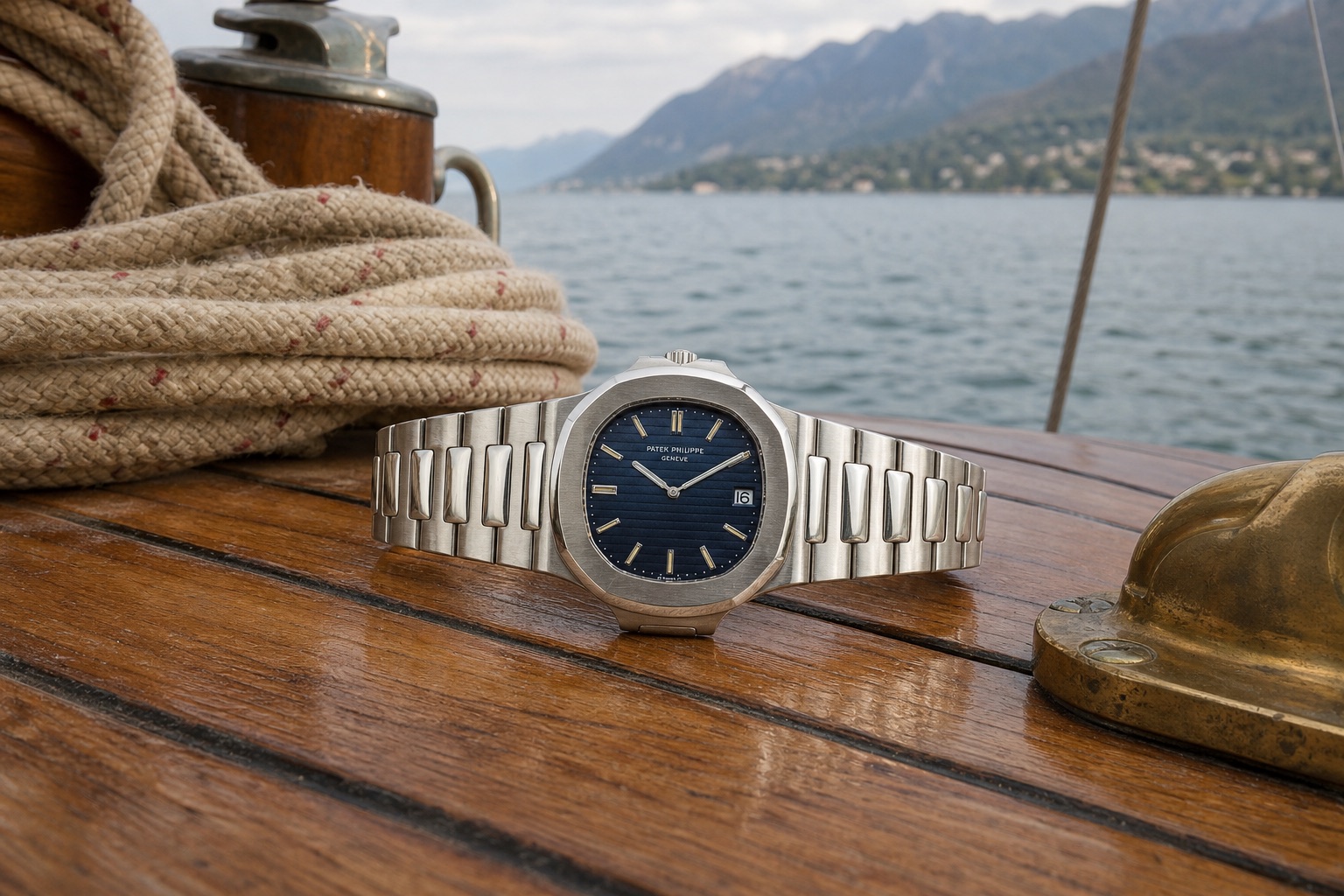
The other 1976 decision was the Nautilus. "A little revolution took place in Geneva in 1976: the launch of a luxury watch in a steel case," says Patek's own release, which quotes the adverts: "One of the world's most expensive watches is made of steel" and "It goes with a wet suit as well as with a tuxedo" (Patek Philippe). Gérald Genta designed it, four years after his Royal Oak for Audemars Piguet; Patek's 2006 release doesn't name him, its 2016 one does (Patek Philippe). The movement was a Jaeger-LeCoultre 920 finished in Geneva, the price was $3,100, and Christie's says it "did not achieve great commercial success at the time," being too expensive, too big and too strange (Christie's, Christie's).
AI-generated illustration.
The 240 found its purpose in 1985. The reference 3940, a perpetual calendar 3.75 mm thick on the calibre 240 Q, launched with a first series of 25 for the Zurich retailer Beyer, and Philippe Stern wore one himself (Phillips). The 3970 followed in 1986, the first Patek perpetual chronograph on a Lemania base, and unsold examples were still sitting in dealers' windows in the early 1990s (Phillips). A Collected Man's reading is that these two "essentially kick-started the serial production of complicated Patek Philippe watches" (A Collected Man). I agree, and I'd add that this is the moment the modern company begins.
The 150th anniversary made it visible. The Calibre 89, a pocket watch with 33 complications and 1,728 parts, was begun in 1980 and finished in April 1989 (Antiquorum). It was lot 301 of "The Art of Patek Philippe," an Antiquorum sale in Geneva on 9 April 1989 of 301 lots, where it made CHF 4,950,000 (WorldTempus). By Stern's account it was the first single-brand auction of its kind; a reference 1436 that had retailed for about $665 in 1961 made about $235,900, and Stern later called some of the prices "unnaturally high" (WatchTime). My read is that the vintage Patek market dates from that afternoon.
Building the manufacture, 1989–2009
Phillips says an internal memo in 1989 set the modern identity, and the 1990s read like its execution: the 5004 split-seconds perpetual from 1994, the 5016 with minute repeater, tourbillon and perpetual calendar from 1993 (Phillips). Philippe Stern became president in 1993. Then came 1996, the year the company itself singles out. Production scattered across more than a dozen Geneva sites moved into one building at Plan-les-Ouates (SJX). The Annual Calendar launched on a patent filed in January 1994 and published in February 1996 (Google Patents), a complication nobody had made before and one Quill & Pad calls "the industry-first annual calendar" (Quill & Pad). And in the autumn the London agency Leagas Delaney launched "Generations," with the line "You never actually own a Patek Philippe. You merely look after it for the next generation" (Patek Philippe). Tim Delaney is credited with the concept and the claim line "Begin your own tradition"; neither Patek nor Hodinkee's history of the campaign names who wrote the headline (Hodinkee, archived).
The Aquanaut arrived in 1997 as the reference 5060A, 35.6 mm in steel on a rubber strap (Phillips). The Graves Supercomplication sold at Sotheby's New York in December 1999 for about $11 million (Europa Star). The Patek Philippe Museum opened in November 2001 with about 2,500 objects (SJX), and Henri Stern died in September 2002 at 91 (JCK). The 5970 of 2004 was the first watch Thierry Stern designed (Phillips).
Silicon came through a consortium, which the company's own copy tends to leave out. After Ulysse Nardin's Freak showed a silicon escapement in 2001, Patek, Rolex and the Swatch Group funded joint research at the CSEM in Neuchâtel and jointly hold an exclusive licence (WorldTempus, Europa Star). Patek's Advanced Research series put a silicon escape wheel in 100 watches in 2005 and the Spiromax hairspring in 2006, the same year Breguet showed its own (Quill & Pad). In October 2006 the Nautilus turned thirty and the 5711 replaced the 3700's line.
Philippe Stern's last act as president was the Patek Philippe Seal. From spring 2009 every Patek movement carried the company's own mark instead of the Geneva Seal it had used since 1886, with a rate standard of -3 to +2 seconds a day for most calibres (Patek Philippe). Stern's reason: the Geneva Seal "essentially defines the finishing of the components, which is fine, but it does not deal with the movement's reliability, nor its precision" (WorldTempus). SJX wrote two years later that the old seal "was losing prestige bit by bit, especially after Patek Philippe abandoned it" (SJX). Given Donzé's numbers, Patek had been most of the Seal's business for seventy years, so its leaving was closer to a closure than a defection. Thierry Stern took over as president at the end of August 2009 (WorldTempus). Output by then was around 40,000 a year by SJX's estimate.
Scarcity, 2009–2026
Thierry Stern's Patek is the one that sells fewer watches than it could. The company told the Swiss press it sold 58,000 watches in 2014 (Bilanz), and Stern told AFP in 2024 that 72,000 in 2023 was a record he intended to hold, with the United States taking 38% of sales (AFP). The 175th anniversary in October 2014 brought the Grandmaster Chime 5175, seven made at CHF 2.5 million each (JCK), and a month later the Graves Supercomplication sold again at Sotheby's Geneva for CHF 23.2 million with premium, CHF 20.6 million at the hammer (Europa Star, Antiques Trade Gazette). A steel 5016 made CHF 7.3 million for Only Watch in 2015 (Phillips). On 9 November 2019 a steel Grandmaster Chime 6300A-010 made CHF 31 million at the same charity auction, the most expensive watch ever sold at auction (Guinness World Records). "I didn't expect 31 million, to be frank," Stern said (Watchonista).
The PP6 building at Plan-les-Ouates, ten floors and 133,000 square metres, was inaugurated in 2020 (Patek Philippe) at a cost the Swiss wire service put at CHF 600 million (Allnews). Patek shut every site from 18 to 27 March 2020 (Revolution), and on 14 April it left Baselworld with Rolex, Chanel, Chopard and Tudor; Stern's line was "there have been too many discussions and unsolved problems; trust is no longer present" (National Jeweler).
Then the 5711. The end of the steel Nautilus leaked through a retailer in January 2021, before the company said anything (Monochrome). Stern's explanation to the NZZ is the clearest statement of the strategy there is: he didn't "want a single model to suddenly make up 50% or more of our collection and dominate Patek's image," he didn't want more than a third of production in steel, and "we had to work very hard to get into the gold and platinum league, and that's where we should stay." Waiting lists ran past ten years and a CHF 28,000 watch traded over CHF 100,000. Patek confirmed in April 2021 that it was the steel 5711's last year (Patek Philippe); in December a Tiffany-blue one sold for $6,503,500 for charity (Phillips). The white-gold 5811 replaced it in October 2022, and Stern told the New York Times "we made enough" (Time+Tide). I'd like a 5711 one day. I've never handled one, which I suspect is the point.
The Cubitus, launched in October 2024 at 45 mm, was the first new collection since the Twenty~4 in 1999 and the most argued-about Patek in years (SJX). Stern's reply to the critics was that "the haters are mostly people who have never had a Patek and never will," and, in the same interview, "I don't work with external designers either. We've done that, but it never worked" (JCK, Time+Tide). The Nautilus, drawn by an outside designer, is the obvious objection, and I think the Cubitus's reception is partly about that gap. The United States put a 39% tariff on Swiss goods in August 2025 (Swissinfo); Patek raised American prices, then cut them by up to 8% from February 2026 when the tariff fell to 15% (The Centurion). In March 2026 it bought Beyer Chronometrie, its oldest retailer, to turn the Bahnhofstrasse shop into its own salon (Hypebeast). At Watches and Wonders in April 2026 it marked fifty years of the Nautilus with time-only anniversary editions and showed its first automaton wristwatch (Wallpaper). Philippe Stern died on 14 June 2026, aged 87 or 88 depending on the obituary; he was born in 1938 (Swisswatches, WatchTime).
What Patek Philippe gave watchmaking
Start with what it didn't. Adrien Philippe's crown-winding system is the one every mechanical watch still uses, and SJX's wording is the fair one: he "invented the keyless works as we know it today," but "he wasn't the first to entertain the idea." Thomas Prest patented a keyless watch in England in 1820, Breguet's workshop made some in the early 1830s, and Louis Audemars had a system in 1838 that Patek and Czapek were already buying (SJX, Boettcher). The "first wristwatch" of 1868 is a claim Patek itself limits to "first Swiss wristwatch"; Breguet's ledgers record a bracelet watch ordered in 1810 and finished in 1812, though the watch is lost (WorldTempus).
What survives scrutiny is the list of complications Patek was first to make as a product. The 1526 and 1518 of 1941 made the perpetual calendar a catalogue item, and for nearly forty years no other maker matched the 1518 (Christie's). The 1923 split-seconds wristwatch is the earliest known by any maker, on Sotheby's independent reading. The annual calendar of 1996 was a new complication, and Patek patented it. The Gyromax balance of 1949 is still how Patek regulates its watches. And the Patek Philippe Seal of 2009 forced the Geneva Seal to add functional testing two years later.
Donzé's figures show Patek carrying the Geneva Seal almost alone from the 1930s to the 1990s. The silicon consortium with Rolex and Swatch Group gave the whole industry its hairspring material. The Rare Handcrafts programme keeps enamelling, engraving and guilloché in production in Geneva at a scale of 82 pieces a year as of 2024 (Patek Philippe). And "Generations" showed the trade that a watch advert could leave the watch out of the picture and sell more watches; the campaign was still running in its 23rd year in 2019 (The Drum).
I'd put one more thing on the list, which the auction results depend on: the archive. Patek has recorded every watch it sold since 1839 and will still confirm a serial number's dial, case and date of sale. The steel 1518 that made CHF 11 million came with the record that it was sold to Joseph Lang of Budapest on 22 February 1944 (Phillips). That paper trail is worth more to a buyer than any complication.
Significant references
Production counts are the auction houses' estimates, named in the era sections; Patek doesn't publish them.
| Reference | Model | Years | Why it matters |
|---|---|---|---|
| 96 | Calatrava | 1932–1973 | The Sterns' first watch and the template for every Patek dress watch since |
| 1518 | Perpetual Calendar Chronograph | 1941–1954 | First series-made perpetual calendar chronograph; a steel one made CHF 11 million |
| 2499 | Perpetual Calendar Chronograph | 1951–1985 | 349 made in 34 years; the reference collectors call mythical |
| 2526 | Calatrava, self-winding | 1953–1960 | Patek's first self-winding wristwatch, with the enamel dial collectors chase |
| 3700/1A | Nautilus "Jumbo" | 1976–1990 | Genta's steel sports watch gave a gold dress-watch company a second identity |
| 3940 | Perpetual Calendar | 1985–2007 | The thin 240 Q perpetual that restarted serial complications; Stern's own watch |
| 5035 | Annual Calendar | 1996–2005 | Patek's first annual calendar, a new complication that became a staple |
| 5970 | Perpetual Calendar Chronograph | 2004–2010 | Thierry Stern's first design and the end of the Lemania-based line |
| 5711/1A | Nautilus | 2006–2021 | The steel watch Patek killed at the peak of its demand |
| 5167A | Aquanaut | 2007– | Patek's steel sports watch that is still in the catalogue, on rubber |
Patek Philippe today
As of 2026 the company is still owned by the Stern family, in its fourth generation. Thierry Stern is president, Laurent Bernasconi has been chief executive since July 2024, and Philippe Stern was honorary president until his death in June (Chris Hall). Patek calls itself "the last independent, family-owned Genevan watch manufacture" (Patek Philippe); no source states a shareholding percentage. Stern told Bloomberg in 2023 that selling to a group would "kill" the company and that his two sons intend to join (SCMP). The registered company is Patek Philippe SA Genève, still at 41 Rue du Rhône (Moneyhouse).
Production and sales are estimates, since the company publishes no accounts. Patek's own figure, as relayed by WorldTempus in June 2025, was a target of 72,000 watches: 58,000 automatic, 7,000 hand-wound and about 7,000 quartz, with 2,670 staff in Switzerland (WorldTempus). Morgan Stanley and LuxeConsult estimate 2025 sales at CHF 2.5 billion, up 9%, which would make Patek the fourth-largest Swiss watch brand by revenue (Professional Watches). Watches are made at Plan-les-Ouates, where PP6 now houses the Geneva workshops, with cases from the former Perly operation, dials from Cadrans Flückiger, and casemaking, polishing and gem-setting partners at Le Crêt-du-Locle (Patek Philippe). What it still buys in is not documented independently; I couldn't find a credible account.
The catalogue runs to Calatrava, Nautilus, Aquanaut, Cubitus, Golden Ellipse, Gondolo, Twenty~4, the Complications and Grand Complications lines and the Rare Handcrafts pieces, over 150 references in series of ten to a few hundred (Patek Philippe). The Seal's rate standard tightened in December 2024 to -1 to +2 seconds a day for watches with a Spiromax or overcoil spring, and every water-resistant Patek is now rated to 30 metres (SJX). The seventh Watch Art Grand Exhibition ran in Milan from 2 to 18 October 2026 and drew 68,000 visitors (Patek Philippe). The Polish officer's assembler is now the company that decides, every year, how many watches the world is allowed to have.
Sources
- Halina Florkowska-Frančić, "Polskie początki firmy Patek-Philippe", Kwartalnik Historii Nauki i Techniki, 1985 (PDF)
- Beniamin Czapla, "Kontakty Antoniego Patka ze zmartwychwstańcami", Biografistyka Pedagogiczna, 2023 (PDF)
- WorldTempus, "Les origines de la maison Patek Philippe & Cie", Antoine Norbert de Patek (archived)
- WorldTempus, "Les origines de la maison Patek Philippe & Cie", Patek et Czapek (archived)
- WorldTempus, "Les origines de la maison Patek Philippe & Cie", Les successeurs (archived)
- Patek Philippe Museum catalogue preview, volume I (PDF)
- Patek Philippe Museum catalogue preview, volume II (PDF)
- Patek Philippe Museum, watch No. 4536 (archived)
- Patek Philippe Magazine, "The History of Patek Philippe" pictorial timeline (PDF)
- Patek Philippe Magazine, "Industry of Nations" (PDF)
- Patek Philippe Magazine, "Patek Philippe in America" (PDF)
- Patek Philippe, press release, Patek Philippe and Tiffany & Co. celebrate 170 years, 2021 (PDF)
- Patek Philippe, "The founders"
- Patek Philippe, "The Stern family"
- Patek Philippe, "Anchored in Geneva and Switzerland"
- Patek Philippe, "A story of independence"
- Patek Philippe, "Chronograph watches"
- Patek Philippe, Watch Art Grand Exhibition Milan 2026
- Patek Philippe, press release, Calatrava Ref. 6119, 2021 (PDF)
- Patek Philippe, press release, Caliber 240 40th anniversary, 2017 (PDF)
- Patek Philippe, press release, Nautilus, 2006 (PDF)
- Patek Philippe, press release, Nautilus 40th anniversary, 2016 (PDF)
- Patek Philippe, press release, new Nautilus models, 2021 (PDF)
- Patek Philippe, press release, 20 years of "Generations", 2016 (PDF)
- Patek Philippe, press release, the Patek Philippe Seal, 2009 (PDF)
- Patek Philippe, press release, Rare Handcrafts 2024 (PDF)
- Antiquorum, Patek i Czapek No. 545, 14 November 2004, lot 453
- Antiquorum, Czapek & Cie No. 3430, 16 October 2005, lot 175
- Antiquorum, Patek Philippe keyless watch, 11 November 2007, lot 81
- Antiquorum, "The Art of Patek Philippe", 9 April 1989, lot 301, the Calibre 89
- Collectability, "Kings, queens, popes and their Pateks"
- John Reardon, "Chronology of Patek Philippe in the US", Collectability
- Collectability, Gondolo & Labouriau, part 2
- Collectability, Gondolo & Labouriau, part 3
- John Reardon, "Did David Penney really design the ref. 96?", Collectability
- Collectability, "Solar desk timepieces"
- V&A, Prize Medal, Great Exhibition 1851
- Watch Collecting Lifestyle, "History of Patek Philippe"
- Deployant, "The story of Patek Philippe"
- Google Patents, CH 2680, keyless work, 1890
- Google Patents, CH 27052, double chronograph, 1902
- Google Patents, CH 261431, balance wheel (Gyromax), 1949
- Google Patents, CH 685585, calendar mechanism (Annual Calendar), 1996
- Pierre-Yves Donzé, "History of the Geneva Seal, part 1", Watchonista
- Pierre-Yves Donzé, "History of the Geneva Seal, part 2", Watchonista
- Phillips, the Alfred G. Stein minute repeater
- Phillips, reference 767 split-seconds chronograph
- Phillips, 1911 tonneau wristwatch
- Phillips, reference 1526
- Phillips, reference 1518 in yellow gold
- Phillips, press release, the first steel reference 1518, August 2025 (PDF)
- Phillips, reference 2526
- Phillips, reference 3587/1 Beta 21
- Phillips, reference 3940 first series for Beyer
- Logan Baker, "A collector's guide to the 3970", Phillips
- Logan Baker, "When Patek goes small and complicated in the modern era", Phillips
- Logan Baker, "Patek Philippe 5970 guide", Phillips
- Phillips, reference 5167R
- Phillips, Only Watch 2015, reference 5016A-010
- Phillips, reference 5711/1A-018 Tiffany
- Phillips, ref. 730 solar dome clock
- Sotheby's, No. 124 824 split-seconds chronograph wristwatch, 2014, lot 175
- Stephen Pulvirent, "The complete collector's guide to the Calatrava", Sotheby's
- Christie's, Henry Graves Jr.
- Christie's, Breguet No. 2516, lot 427
- Christie's, reference 3448
- Christie's, "The 10 most desirable Patek Philippe references" (Chinese edition)
- Christie's, "Secrets of the Patek Philippe Nautilus"
- SJX, "Complicated collectors: James Ward Packard"
- SJX, "Insight: the keyless works"
- SJX, obituary: Philippe Stern
- SJX, improvements to the Geneva Seal, 2011
- SJX, review: Cubitus 5821 and 5822P
- SJX, updated criteria for the Patek Philippe Seal, December 2024
- Revolution, "1925 Patek 97975"
- Revolution, "The evolution of the Patek Philippe Calatrava movement"
- Revolution, Patek Philippe closes all sites, March 2020
- Revolution, "What we can learn from Morgan Stanley's ninth annual Swiss watch report"
- Gisbert Brunner, "Patek Philippe: a family-owned company", LGT
- Boettcher, "Keyless work", VintageWatchstraps
- WorldTempus, "Breguet: the first wristwatch"
- WorldTempus, "The silicon revolution, part 1"
- WorldTempus, Calibre 89 for CHF 5,120,000, 2009
- WorldTempus, a candid interview with Philippe Stern, 2009
- WorldTempus, Thierry Stern appointed president, 2009
- WorldTempus, "Patek Philippe in 2025 and in numbers"
- Europa Star, Patek Philippe silicon interview
- Europa Star, Graves Supercomplication beats its own record, 2014
- Quill & Pad, all five Advanced Research editions
- Quill & Pad, 5002 Sky Moon Tourbillon
- Hodinkee, "The untold story of the Generations campaign" (archived)
- The Drum, Leagas Delaney "Generations"
- A Collected Man, reference 3940P
- WatchTime, "In memoriam Philippe Stern"
- Swisswatches, Philippe Stern obituary
- JCK, "Veteran watchmakers die", 2003
- JCK, Patek Philippe unveils 175th anniversary collection, 2014
- JCK, Patek Philippe president calls Cubitus critics "haters", 2024
- Bilanz, "Patek Philippe: Strategie der kleinen Schritte", 2015
- AFP via Inquirer, Patek Philippe chief not worried for top-end Swiss watches, 2024
- Antiques Trade Gazette, new high for timepiece at auction, 2014
- Guinness World Records, most expensive watch sold at auction
- Watchonista, Only Watch 2019 and Thierry Stern's reaction
- Allnews (AWP), "600 millions investis", 2020
- National Jeweler, Rolex, Patek, Chanel exit Baselworld, 2020
- Monochrome, Thierry Stern on stopping the 5711, 2021
- Time+Tide, "We made enough", 2022
- Time+Tide, what Thierry Stern has to say after the Cubitus launch, 2024
- Swissinfo/Bloomberg, Trump shocks horology with tariffs, 2025
- The Centurion, Patek Philippe plans US price cuts of up to 8%, 2026
- Hypebeast, Patek Philippe acquires Beyer Chronometrie, 2026
- Wallpaper, Patek Philippe at Watches and Wonders 2026
- Chris Hall, The Fourth Wheel, issue 117, 2024
- SCMP/Bloomberg, Patek Philippe's revelations at Watches and Wonders, 2023
- Moneyhouse, Patek Philippe SA Genève, commercial register
- Professional Watches, Morgan Stanley top 20 for 2026