Patek Philippe Nautilus 5711
- Make
- Patek Philippe
- Reference
- 5711
- Model
- Nautilus
- Variants
- 5711/1A, 5711/1R, 5711/1P, 5711/1300A
- Production
- 2006–2021
- Case diameter
- 40 mm
- Calibre
- 324 S C
- Case material
- Steel
- Water resistance
- 120 m (394 ft)
AI-generated illustration.
In October 2006 Patek Philippe put out a press release for the Nautilus's thirtieth birthday, and the most interesting part of it is the history Patek chose to tell. The 1976 original, it says, was "a little revolution": a luxury watch in a steel case that cost "more than many gold watches in those days", made for clients who "were at the helm of sailing yachts, raced down icy runs, and went running in Central Park at dawn". One advert from the period put it in a single line: "One of the world's most expensive watches is made of steel" (Patek, 2006).
The same release introduced the watch that turned that line into a problem: the Patek Philippe Nautilus 5711, the new steel flagship of a redesigned collection. It was the 1976 "Jumbo" brought up to date, with a three-part case, a sapphire back and a Geneva-sealed movement. Over fifteen years it became the steel watch people queued a decade for, and in early 2021 Patek did something unusual with its most wanted watch: it stopped making it (Patek, 2021).
I don't own one. I'd like to, and that's the honest frame for everything below: I've spent more time with the auction catalogues than with the watch.
Where it came from
Patek launched the Nautilus as the Ref. 3700 in 1976, and calls it a calculated risk. Its 2006 account describes a "paradigm shift" among wealthy clients, for whom "a precious, scratch-prone 1970s gold dress watch" no longer suited daily life, and says the steel Nautilus was meant both to find new buyers and to give existing owners "a ruggedly strong" alternative to their gold watch (Patek, 2006). The case was the provocation. The 3700 was 42 mm wide across its hinges, which "some called them ears", and 7.6 mm thick, milled as a single block of steel with the bezel screwed down at four points. Patek compares the construction to a ship's porthole, and it was rated to 120 metres. Reaction ran, in Patek's words, from "shocking" to "fantastic", and the size that was criticised at first earned it the nickname "Jumbo".
The designer is Gérald Genta, credited by every auction house I read, and the story most often told is his own. Christie's cites a 2009 interview in which Genta describes sitting in a restaurant during the Basel fair in the mid-1970s, watching a table of Patek people across the room, and producing "a sketch that I completed in five minutes". Phillips and Antiquorum repeat it. Two things are worth knowing about that story. Every version I found traces back to Genta, and you'll often see 1974 given as the year of the sketch, which I couldn't confirm. Patek's own 2006 and 2021 releases don't name a designer at all. Christie's gives the original price of the time-only 3700 as $3,100.
The 3700 left production in 1990. In between, Patek widened the line: a medium 37.5 mm Ref. 3800 in 1981, a ladies' 4700, then large-format watches again from 1998 with the power-reserve 3710, the white gold 3711 in 2004 and the complicated 3712 in 2005 (Patek, 2006). Dealer copy often calls the 3800 the 5711's predecessor. Patek's own lineage says otherwise: the 3800's replacement in 2006 was the 5800, and the 5711 was the new "Jumbo".
For the anniversary, Patek redesigned the whole collection. The release lists what changed, and it is a designer's list: the straight hinges became "gently rounded", the hour markers were reshaped to follow the octagonal bezel, the hands got larger, the bracelet was rebalanced, and every model got a sapphire caseback. On the 5711 the monocoque gave way to a three-part case (back, caseband and bezel) with a screw-down crown, though Patek says the porthole-style sealing of the bezel stayed. Patek says the case grew by "one millimeter", and pins the growth on "the rounder contours of the lateral hinge ridges" (Patek, 2006). Nobody I read names who did that redesign. It is undocumented, and I'd rather say so than guess.
The watch
Patek has measured the same case two ways, which is why you'll see both 40 mm and 43 mm quoted for it. The table gives both.
| Spec | Value |
|---|---|
| Case | Three-part (back, caseband, bezel), stainless steel; screwed sapphire caseback; screw-down crown |
| Width | 43 mm from 3 to 9 o'clock including the hinges; 44.02 mm with the crown (Patek, 2006) |
| Diameter | 40 mm measured from 10 to 4 o'clock (Patek's product pages, 2017 to 2021) |
| Thickness | 8.3 mm |
| Water resistance | 120 m |
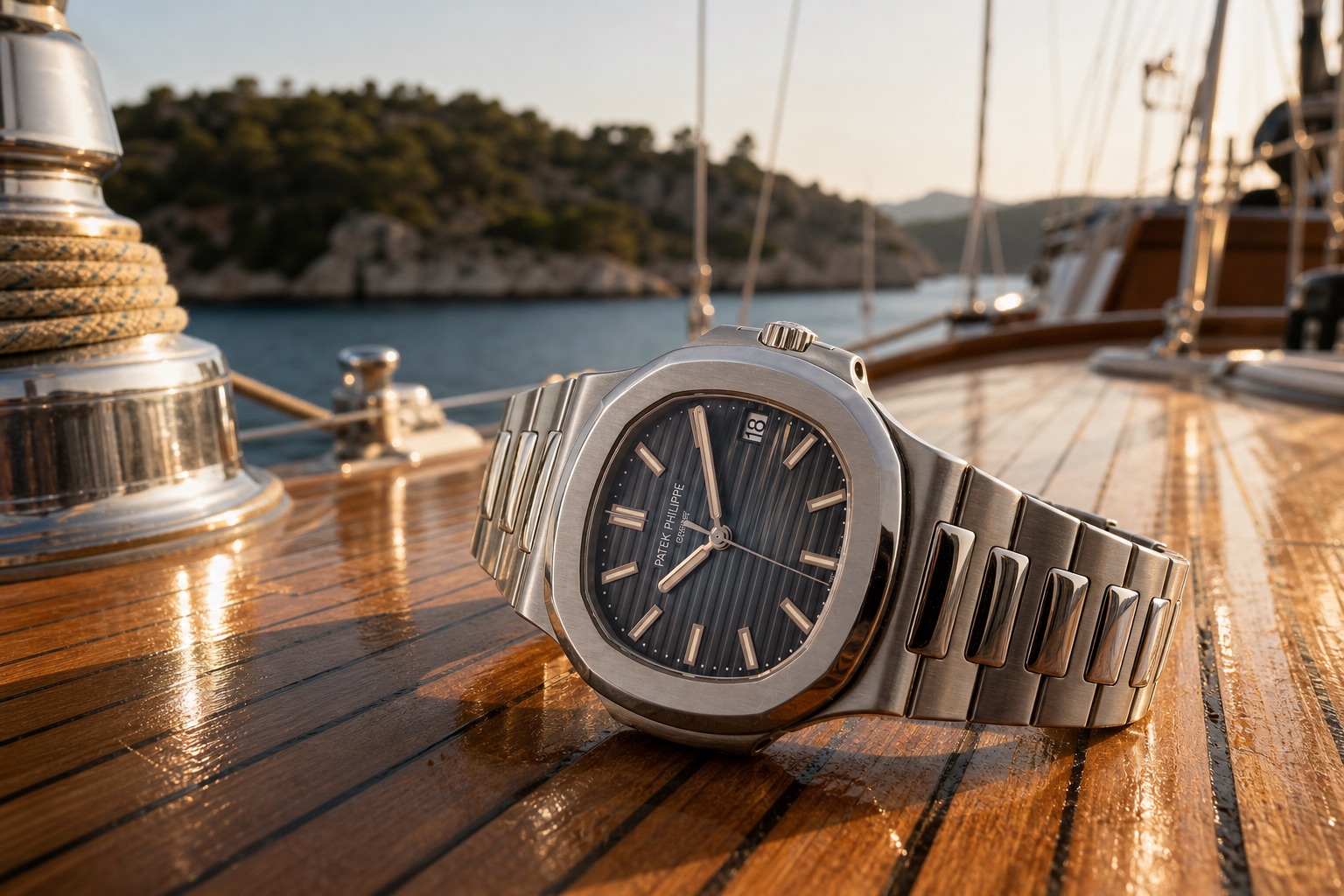
| Dial | Horizontally embossed, gradated blue to black at launch; 18K white gold applied batons and baton hands with luminous coating |
| Movement | Cal. 315 SC at launch; 324 S C for most of the run; 26-330 S C from 2019 |
| Bracelet | Integrated steel, polished centre links, satin outer links, steel fold-over clasp |
| Retail (Geneva, 2017) | CHF 21,900 in steel; CHF 45,000 in rose gold |
The dimensions come from Patek's 2006 technical sheet and its later product pages, and the prices from the 2017 product pages. The two size figures don't disagree. Forty millimetres is the diagonal across the bezel; 43 mm is the full width, ears included, and it's the number Patek used in 2006 when it wanted to compare the new watch with the 42 mm original. On the wrist, I'd expect the 8.3 mm height to matter more than either figure. It is thin for a steel sports watch with a date and 120 metres of water resistance.
The three movements are the reference's real timeline. The 315 SC that launched it was a 3 Hz movement with a flat balance spring, 29 jewels, 38 to 48 hours of reserve and the Geneva Seal (Patek, 2006). The 324 S C that replaced it ran at 4 Hz with a Spiromax spring and 35 to 45 hours, and carried the Patek Philippe Seal (patek.com, 2017). The 26-330 S C, which Patek says has powered the 5711 "since 2019", is a development of the 324 with a reworked winding system and, at last, a stop-seconds (Patek, 2021). All three have a 21K gold central rotor and show through the sapphire back.
Patek's 2021 release says each watch takes "55 individual finishing steps" of hand work on the case and bracelet, and the brushed-and-polished alternation is the thing that photographs never quite get right. It is also the thing a careless polish ruins.
How it changed
Approximate years, from Patek's releases and dated auction lots. Changes inside a reference code didn't happen on one day, and where sources disagree the prose says so.
| Years | Reference | Case | Dial | Movement |
|---|---|---|---|---|
| 2006–c.2007 | 5711/1A-001 | Steel | Blue-black gradated, embossed | 315 SC, Geneva Seal |
| c.2007–2009 | 5711/1A-001 | Steel | Blue-black gradated | 324 S C, Geneva Seal |
| 2010–2021 | 5711/1A-010 | Steel | Blue-black gradated; raised signature cartouche from about 2018 | 324 S C, Patek Philippe Seal; 26-330 S C from 2019 |
| 2012–2019 | 5711/1A-011 | Steel | Silvery white, embossed | 324 S C |
| 2015–2021 | 5711/1R-001 | Rose gold | Brown gradated to black | 324 S C, then 26-330 S C |
| 2016 | 5711/1P-001 | Platinum, 700 pieces | Blue, baguette diamond indexes, "40 1976-2016" | 324 S C |
| 2021 | 5711/1A-014 | Steel | Olive green sunburst, embossed | 26-330 S C |
| 2021 | 5711/1300A-001 | Steel, baguette diamond bezel | Olive green sunburst | 26-330 S C |
| 2021 | 5711/1A-018 | Steel, 170 pieces | Tiffany Blue, double-signed | 26-330 S C |
The first change came within a year, and it's the one collectors pay for. Phillips divides the run into three series. Its catalogue says the 315 SC watches were made for "less than a year", mostly in 2006 with some sold in early 2007, and estimates the ratio of first-series watches to the rest at "most likely 1 in 30-50 or lower" (Phillips). A Christie's essay says "the first six months" and offers a belief that around 1,000 exist. 41watch puts the switch to the 324 S C as late as mid-2008. Patek never announced it, so nobody has the date. A watch with a 324 was certainly on sale by October 2009 (Antiquorum).
The second change was a hallmark. Patek left the Geneva Seal for its own Patek Philippe Seal, announced at Baselworld in 2009 according to 41watch, and Phillips splits the 324 watches into "Geneve Seal (pre-2010)" and Patek Seal after. The reference code moved at about the same time: Patek's own dates are -001 from 2006 to 2009 and -010 "starting in 2010" (Patek, 2021). You'll see dealer sites put the -010 at 2012. I'd go with Patek.
After that the steel watch barely moved for almost a decade. Phillips notes one dial change, "the introduction, around 2018, of a raised 'cartouche' for the signature" in place of printing it straight onto the ribs (Phillips). The 26-330 S C followed in 2019, and here the lots show the change wasn't clean: Phillips has catalogued a 2019 white dial and a rose gold watch certificated in September 2020 with the 324 S C (Phillips, Phillips), while Antiquorum sold a rose gold watch certificated in September 2019 with the 26-330 (Antiquorum). Check the movement, not the year on the papers.
Then the ending, which was announced before the watches that ended it. The news leaked through a retailer, and in February 2021 Thierry Stern confirmed it to the Neue Zürcher Zeitung: "soon it will be over" (Monochrome, relaying the interview). On 7 April 2021 Patek confirmed that "2021 will be the last production year" of the steel 5711/1A and launched the olive green -014 and the diamond-bezel 1300A for it (Patek, 2021). The olive was presented as the last. In December, Tiffany got 170 more.
The variations that matter
Dials
The blue-black dial is the 5711. Patek's 2006 sheet describes a gradation "from dark blue in the middle to black at the periphery" with horizontal embossing, which is a direct descendant of the 3700's ribbed dial. Collectors argue the early -001 dials look greyer. Phillips calls one a "smoky grayish blue", and you'll find owners saying the same on forums, but I found no Tier A source that says Patek changed the colour between -001 and -010. Photographs can't settle it; lighting moves gradated dials around too much.
The white -011 arrived at Baselworld 2012, and its nickname is "piano" (Phillips). It keeps the ribs but drops the gradient, and Phillips notes the hands and markers turned black. Phillips says its research shows the white dial "only produced between 2012 and 2019" (Phillips), which matches Patek's own dates.
AI-generated illustration.
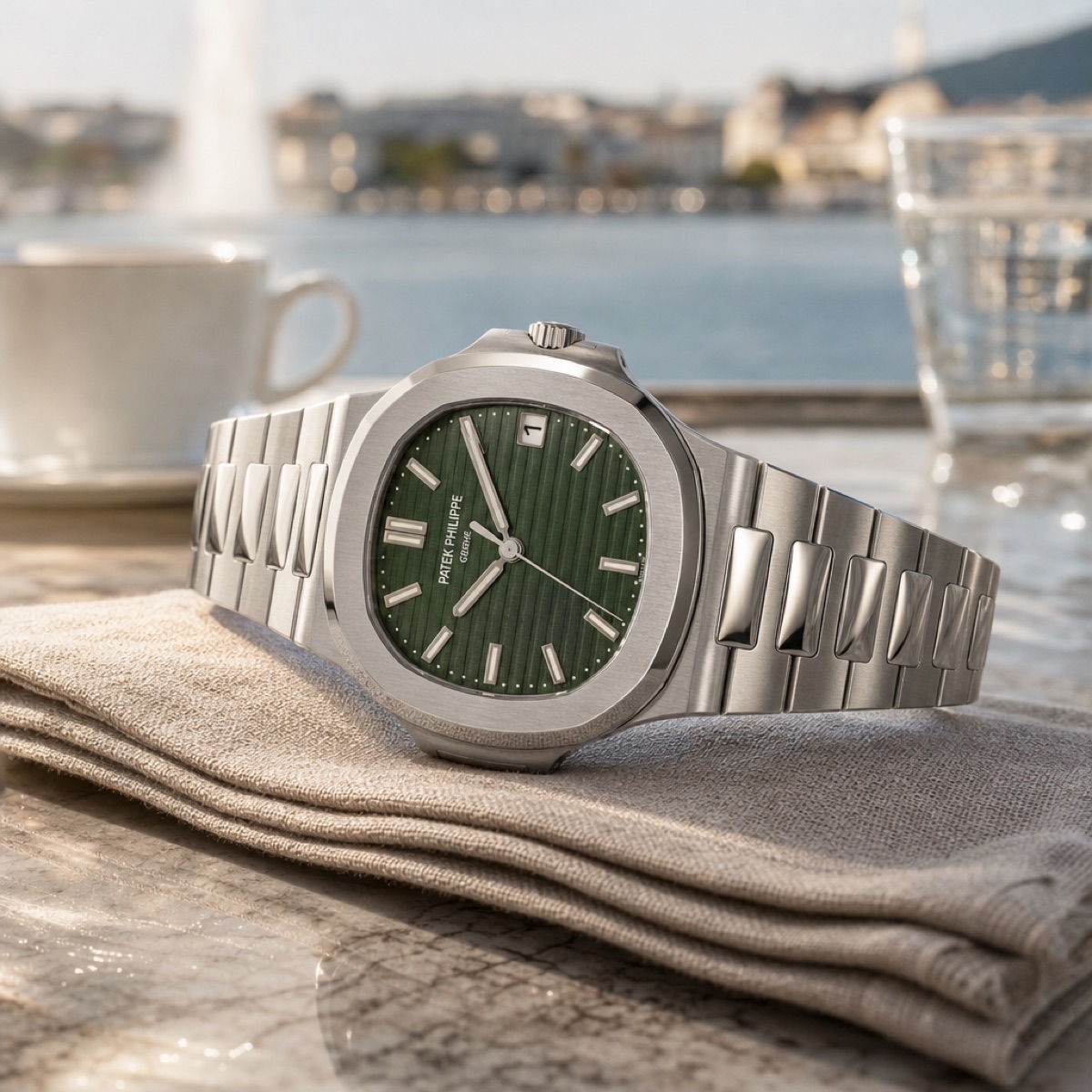
The olive green -014 is the one dial Patek itself called new to the line: "a hue that never existed before in the Nautilus collection", with a sunburst finish over the embossing (Patek, 2021). Phillips describes it as made "for one year" to mark the steel watch's departure (Phillips). Patek gave no production number. I think it's the best-looking dial of the run.
Case and metals
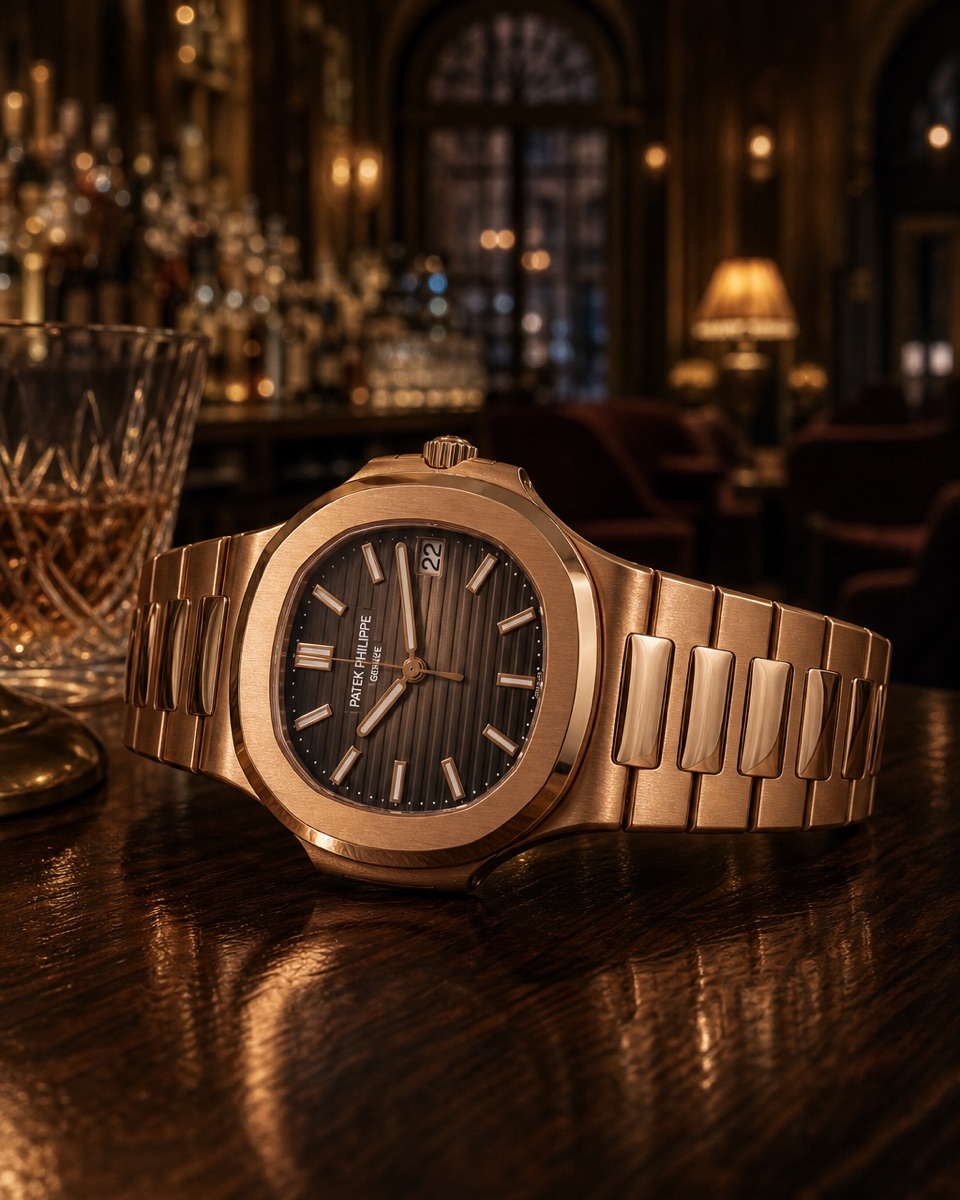
In steel the case never changed shape, so the metal is how you tell the big versions apart. The rose gold 5711/1R-001 launched at Baselworld in 2015, which Phillips calls "the first pink gold Nautilus with a bracelet", with a brown dial that fades to black at the edge (Phillips, Patek, 2021). It cost about twice the steel watch in 2017, and it outlived it: Patek's 2021 release says the olive steel watch "joins the Ref. 5711/1R-001 in rose gold in the collection".
AI-generated illustration.
There was also an earlier white gold 5711, and it's the variant that most writing skips. Phillips catalogues a 5711G-001 on a crocodile strap, introduced in 2007 for the anniversary, and says each gold metal got its own dial: "silver dial for yellow gold, brown charcoal for rose gold and cool slate grey for the white gold" (Phillips). Antiquorum sold one with a 324 S C that was first sold in July 2008 (Antiquorum). Patek's 2006 release doesn't list them, and its 2021 history of the reference leaves them out, so I'd treat the strap models as a short side branch I couldn't fully document.
The 40th anniversary platinum 5711/1P of 2016 was limited to 700 pieces, with baguette diamond indexes, a single diamond in the bezel at 6 o'clock and "40 1976-2016" on the dial (Sotheby's, Monochrome). aBlogtoWatch made the fair point that from across a room it could be confused for the steel watch.
The 5711/1300A-001 of 2021 is the odd one: a steel case with 32 baguette diamonds round the bezel, about 3.6 carats, on the olive dial. Patek's own framing is that baguettes "are usually only paired with precious metal" (Patek, 2021). The diamond-bezel white gold Nautilus you see in photographs is a different reference, the 5713/1G.
Bracelet
The bracelet is the 3700's H-link design rebalanced for the new case: polished centre links, satin outer links, tapering to a fold-over clasp (Patek, 2006). I looked for a dated clasp or link change through the run and found nothing better than a single owner's account of a service, so I'm leaving that out.
Co-branded, commissioned and error dials
Tiffany & Co.
Tiffany is the only retailer name I found on a 5711 dial, and there's a reason for it. Phillips explains that an 1851 agreement made Tiffany Patek's first official partner in the United States (Phillips), and that Tiffany "remains the only retailer that is still allowed to stamp their logo" on a Patek dial (Phillips).
Before 2021 that meant a small run of ordinary dials with "Tiffany & Co." printed at 6 o'clock. Phillips has sold them in blue -010 for $254,000, white -011 for $239,400, rose gold for $241,300 and, in Hong Kong, a white gold 5711G for HK$762,000 (Phillips, Phillips, Phillips, Phillips). The lot pages don't give sale dates, so treat those prices as points, not a trend. In the white-dial catalogue Phillips counts "a total of 16 Tiffany-signed 5711s in stainless steel to appear publicly". That's an auction house's count of what has surfaced. Patek has never published one.
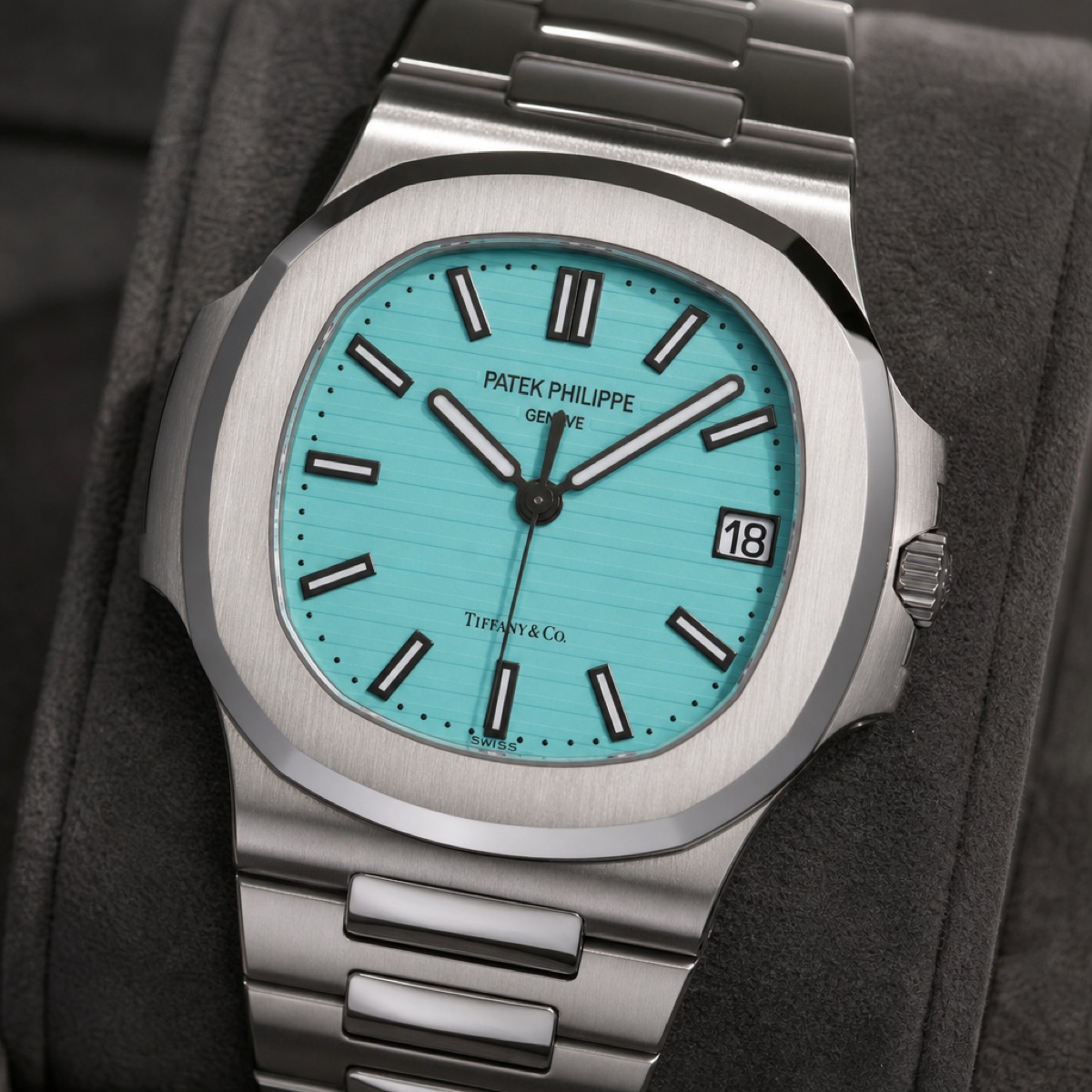
Then came the 5711/1A-018 of December 2021, for the 170th anniversary of the partnership: 170 pieces with a Tiffany Blue lacquer dial, which Phillips says was a Tiffany Blue dial "for the first time ever", the Tiffany signature at 6, and a caseback engraved "170th Anniversary 1851-2021 Tiffany & Co. - Patek Philippe". They were sold through Tiffany's New York, Beverly Hills and San Francisco stores, except for one (Phillips).
AI-generated illustration.
That one went to Phillips in New York on 11 December 2021 with no reserve and all proceeds to The Nature Conservancy. The hammer fell at $5.35 million, $6,503,500 with premium (Phillips, Time+Tide, Quill & Pad). Some coverage calls $6.5 million the hammer; it isn't. Time+Tide puts the retail at about $52,000. Sotheby's later sold one in Hong Kong in 2023 for $2.6 million (Sotheby's), which tells you how much of the first price was the charity and the moment.
A unique engraved 5711
The highest price I found for any 5711 is a piece Patek made once. The 5711/1500A-011 is steel with its case and bracelet hand-engraved at the factory in Maori-inspired motifs, a charcoal grey sunburst dial and "Children Action 2024" on the caseback. Phillips calls it the first engraved Nautilus Patek has made. It sold at the Children Action charity auction in Geneva in November 2024, hammered for CHF 6.7 million (Phillips, SJX). Phillips' own headline says CHF 6.8 million, and its text says 6.7; I've used the text.
What I couldn't find
I looked for other retailer signatures (Gübelin, Beyer and the rest), Gulf state emblem dials, an Only Watch 5711 and any named misprint, and found none documented on this reference. An Oman-commissioned Nautilus turned up only on the older 3700. If you see one of these offered on a 5711, I'd want the Patek extract before anything else.
Why it matters
The 5711 matters because of what it did to Patek, and Stern was unusually direct about it. In the February 2021 interview he said he didn't "want a single model to suddenly make up 50% or more of our collection and dominate Patek's image", that "I don't want us to have more than a third steel watches", and that "we had to work very hard to get into the gold and platinum league, and that's where we should stay" (Monochrome, relaying the NZZ). The same report gives a retail price of about CHF 28,000, retailer waiting lists of "more than 10 years", and second-hand prices "over CHF 100,000".
You can read that two ways. One is that a steel watch built to sell gold-watch prices to yachtsmen had become a currency, and Patek withdrew it to protect the brand. The other, which I find harder to dismiss, is that ending a watch with a ten-year waiting list was the most effective marketing Patek did that decade. The olive and Tiffany editions sold into exactly the frenzy Stern said he disliked. Both can be true.
The replacement settled the question of intent. The 5811/1G of October 2022 is a 41 mm time-and-date Nautilus in white gold only (Monochrome, Patek), and Stern's line to the New York Times, as reported by Time+Tide, was "We made enough". Steel stayed with the Aquanaut 5167.
The market has since cooled. Bloomberg figures reported by Time+Tide put the steel 5711 at a $237,700 peak in 2022, down to $192,800 by early July that year, and Loupe valued a blue -010 at $133,952 in April 2026. That's still several times what it cost new, and a price I'd only pay knowing exactly which watch I was buying.
What I'd check before buying one
- The movement through the caseback against the papers: 315 SC for an early first series, 324 S C for most, 26-330 S C from 2019. A 315 commands a premium, so check the movement number with Patek.
- A Patek Extract from the Archives, which confirms reference, case and movement numbers, dial and dates. For a Tiffany-signed watch, I wouldn't buy without one.
- The seal: Geneva Seal on early 324 watches, the Patek Philippe Seal after about 2009.
- The dial code against the period: -001 to 2009, -010 from 2010, a raised signature cartouche only from about 2018.
- The case edges. The brushed bezel and polished bevels are easy to soften with a careless polish, and that's hard to undo.
- Fakes exist at a high level. Wristcheck tested one and found slightly oversized batons, a case about a gram light and poor timing. Buy the seller as much as the watch.
Sources
- Patek Philippe, Nautilus press release and technical data, October 2006
- Patek Philippe, "New Nautilus Models" press release, 7 April 2021
- Patek Philippe, Ref. 5711/1A-010 product page (archived 2017)
- Patek Philippe, Ref. 5711/1A-014 product page (archived 2021)
- Patek Philippe, Ref. 5811/1G-001
- Christie's, a collector's guide to the Patek Philippe Nautilus
- Christie's, 5711/1A-001 first series
- Phillips, Ref. 3700/1, Geneva Watch Auction: SEVEN
- Phillips, Ref. 5711/1A-001, 2006
- Phillips, Ref. 5711/1A-011, 2019
- Phillips, Ref. 5711/1R-001, 2020
- Phillips, Ref. 5711/1A-014
- Phillips, Ref. 5711/1A-018, The 2021 New York Watch Auction
- Phillips, Tiffany-signed Ref. 5711/1A-010
- Phillips, Tiffany-signed Ref. 5711/1A-011
- Phillips, Tiffany-signed Ref. 5711/1R-001
- Phillips, Tiffany-signed Ref. 5711G-001
- Phillips Perpetual, the white-dial 5711/1A-011
- Phillips, a unique Nautilus 5711 raises a record for charity, November 2024
- Antiquorum, Ref. 3700/1A
- Antiquorum, Ref. 5711/1A-001 with cal. 324 S C
- Antiquorum, Ref. 5711/1R-001 with cal. 26-330 S C
- Antiquorum, Ref. 5711G-001
- Sotheby's, Ref. 5711/1P-001
- Sotheby's, the 50-year history of the Nautilus at auction
- Monochrome, Thierry Stern on why Patek is stopping the 5711, 10 February 2021
- Monochrome, the 40th anniversary 5711/1P
- Monochrome, the Nautilus 5811/1G
- aBlogtoWatch, the 5711/1P
- 41watch, the 5711 from Geneva Seal to Patek Seal
- Time+Tide, Aurel Bacs on the Tiffany Blue 5711 sale, December 2021
- Time+Tide, "We made enough", October 2022
- Time+Tide, 5711 market prices, August 2022
- Quill & Pad, the Tiffany Blue 5711 auction, December 2021
- SJX, the unique engraved 5711/1500A
- Loupe, 5711/1A-010 market report 2026
- Wristcheck, real vs fake Nautilus 5711