Patek Philippe Aquanaut 5167
- Make
- Patek Philippe
- Reference
- 5167
- Model
- Aquanaut
- Variants
- 5167A, 5167/1A, 5167R
- Production
- 2007–present (in production)
- Case diameter
- 40.8 mm
- Calibre
- 324 S C
- Case material
- Steel
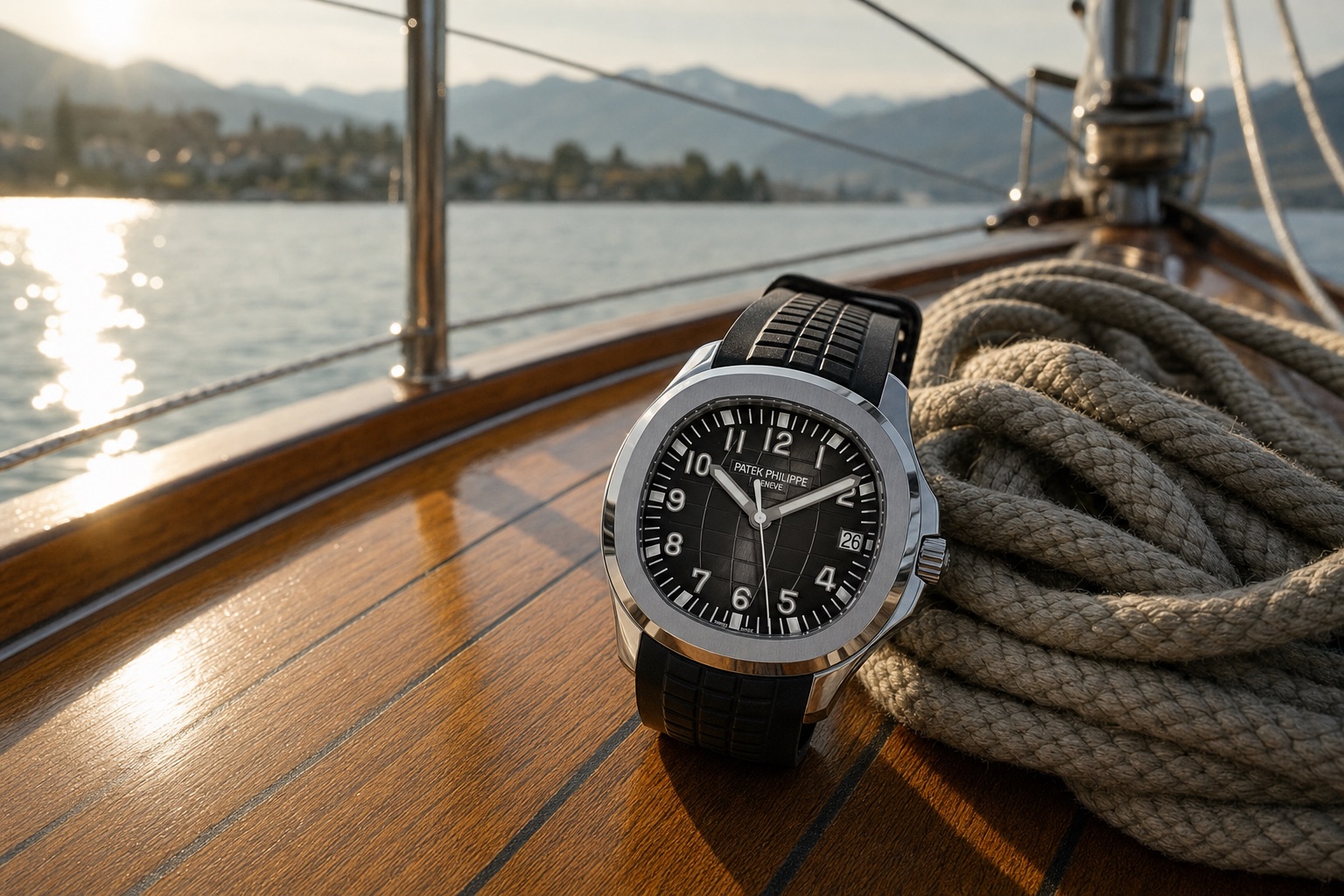
AI-generated illustration.
In July 2007 Patek Philippe put out a press release to mark ten years of the Aquanaut, and it is a useful document, because Patek explains the watch in its own words. The Aquanaut, it says, had arrived in 1997 "as a statement of casual elegance", with a stainless steel case that was "rare for a Patek Philippe" and a composite strap Patek called the "Tropical". It had brought "an entire new generation" to the brand. For the anniversary, Patek replaced the men's line with two new references, and the larger of them was the Patek Philippe Aquanaut 5167.
My read is that the 5167 is the Aquanaut most people picture when they hear the name: a 40 mm steel octagon on a black embossed strap, time and date, nothing else. It replaced three sizes with one larger one, took a reworked dial and strap and a new clasp, and has stayed in the catalogue ever since. Nineteen years on it has gone through three movements, a rose gold version, a steel bracelet version that came and went, a run of retailer-signed and exhibition dials, and a quiet change to its published water resistance that I didn't expect to find. And it's the core of the Aquanaut line, which is the steel Thierry Stern said in 2022 that Patek would keep making.
Where it came from
Patek introduced the Aquanaut with the steel reference 5060A in 1997. Monochrome's two-part history, written from Patek's July 1997 press release, describes a company that "made no secret that it had specifically created this watch for a new and younger sporty clientele" (Monochrome). The obvious model for that buyer was the Nautilus, and Patek's 2007 release says the Aquanaut's softly rounded octagonal case "illustrated its kinship with the Nautilus" (Patek, 2007).
The new part was the strap. Monochrome reports it was in development for more than a year and that more than 20 materials were tried before Patek "christened its new strap 'Tropical'", and Phillips and Christie's both describe the Aquanaut as the first Patek sold on a rubber strap (Monochrome, Phillips, Christie's). Dial and strap shared the same embossed pattern, which is still the single thing that makes an Aquanaut recognisable from across a room.
Who designed it is a question I couldn't answer. None of the auction essays or editorial histories I read names a designer. Monochrome makes the careful version of the Genta argument: the porthole-shaped bezel was "initially conceived by" Gérald Genta, but the Aquanaut itself "wasn't designed by" him. That is as far as the evidence goes, and you'll see dealer copy go further.
You'll often read that the first Aquanaut was limited to 1,000 pieces. A Phillips catalogue says so (Phillips), but Monochrome's author went looking and "could not find any concrete evidence to support this", and reports there was "no official communication concerning limited or special editions at that time" (Monochrome). I'd leave it in the folklore column.
A larger 38 mm model, the 5065, followed in 1998 (Monochrome, Christie's). Before the anniversary the men's Aquanaut came in three sizes, the 5064, 5065 and 5066. In Patek's words, the 5167 ("Extra large", 40 mm) and the 5165 ("Large", 38 mm) "replace the previous generation which came in three sizes" (Patek, 2007). Philippe Stern was still president; Thierry Stern took over at the end of August 2009 (WorldTempus). One Phillips catalogue dates the handover to 2006 (Phillips), but Patek's own release and every other source I read put it in 2007.
The 2007 changes read like a designer tidying a good idea. Patek kept the case shape and reworked everything around it: a dial "with gently curved, embossed grooves", a strap with flat sides and a reshaped taper that meets the case "forming a visually seamless transition", and "a new double-security fold-over clasp" (Patek, 2007). Monochrome called the result "more of a refinement" than a new watch, and I think that's right. Christie's calls the 5167 the first Aquanaut to pass 40 mm (Christie's), which I think matters more than it sounds: it's the size that let the Aquanaut sit next to a 2000s sports watch without looking small.
The 5165 is long gone (Monochrome). The 5167 is still in the catalogue.
The watch
Patek has published the 5167's specification three ways over its life: in the 2007 press kit, on its website from at least 2017 to 2022, and on the current site. They don't all agree, and the disagreements are part of the story, so the table gives the launch figures beside today's.
| Spec | At launch (Patek, July 2007) | Today (patek.com, October 2026) |
|---|---|---|
| Case | Steel, polished, bezel and flank satin-finished | Steel |
| Diameter (10–4 o'clock) | 40 mm | 40.8 mm |
| Thickness | 8.10 mm (crystal to back), 8.95 mm (crystal to lugs) | 8.1 mm |
| Crown | Screw-down | Screw-down |
| Case back | Sapphire crystal | Sapphire crystal |
| Water resistance | 120 m | 30 m |
| Movement | Calibre 315 S C, self-winding | Calibre 26-330 S C, self-winding |
| Frequency | 21,600 vph (3 Hz) | 28,800 vph (4 Hz) |
| Jewels / parts | 29 / 213 | 30 / 207 |
| Power reserve | Max. 48 hours | Min. 35, max. 45 hours |
| Hallmark | Geneva Seal | Patek Philippe Seal |
| Dial | Black, new Aquanaut pattern; 18K white gold Arabic numerals with lume | Sunburst charcoal gray with black-gradient rim, embossed Aquanaut pattern; white gold applied numerals with lume |
| Strap | Black "Tropical" composite, double-security steel fold-over clasp with Calatrava cross | Black composite, steel patented fold-over clasp |
Sources: Patek press release, July 2007; patek.com 5167A-001.
The diameter is the easy one. Patek's own page said 40 mm until mid-2020 and 40.8 mm from May 2021, with the thickness unchanged at 8.1 mm (archived June 2020, archived May 2021). Both figures are measured 10 to 4 o'clock, and nobody I read claims the case was changed. I read it as a more precise number for the same case.
The water resistance needs more care. The 2007 release says 120 metres, and Patek's site kept saying "Water resistant to 120 m" through at least June 2022 (archived 2022). By June 2025 the same page said "Water-resistant to 30m" (archived 2025), and it still does, for the steel, gold and limited-edition 5167s alike. I couldn't find a Patek statement explaining the change. Collector forums treat it as a brand-wide switch to one standard rating that appeared on the site around April 2024, with no change to the cases, but that's forum talk and I haven't confirmed it. Whatever the reason, Patek's own current claim for a watch called the Aquanaut is 30 metres, and that's worth knowing before you swim in one.
The strap is the part of the spec I'd spend the most time with in person. Patek's 2007 technical sheet describes it as black "Tropical" composite "integrated in the case", with the inside and the taper redesigned for comfort (Patek, 2007). Patek's claim for the material is that it is "extraordinarily resistant to wear, salt water, and UV radiation". That integration is why the 5167 belongs with the Nautilus and the Royal Oak more than with a sports watch on a strap: the strap is part of the case design, and to my eye a generic rubber strap on a 5167 looks wrong immediately.
The movement changed twice, and that's the best way to date a 5167 from the back.
How it changed
| Years | Calibre | Steel dial | Published water resistance |
|---|---|---|---|
| 2007 launch | 315 S C, 3 Hz, Geneva Seal | Black embossed | 120 m |
| From about 2008 | 324 S C | Black embossed | 120 m |
| By mid-2025 (change between mid-2022 and mid-2025) | 26-330 S C, 4 Hz | Sunburst charcoal gray, black-gradient rim | 30 m |
Dates in this table are approximate and come from the sources in the paragraphs below.
The first change is a small dispute in its own right. Christie's says the 5167 launched with the 324 S C (Christie's). Monochrome says it launched with the 315 S C carried over from the 5065 and switched to the 324 S C the following year (Monochrome). Patek's July 2007 technical sheet settles it: "Caliber 315 S C" for both the 5167 and the 5165 (Patek, 2007). By 2008 the 324 family was in the case, going by a Sotheby's lot of a 2008 watch catalogued "cal. 324/393" (Sotheby's). The 324 S C then ran a very long time: a 2011 example sold by Antiquorum has it stamped with the Geneva Seal (Antiquorum), and it was still in the 2019 Singapore edition (SJX). That's why the 324 S C is the calibre I'd call "the 5167 movement".
The second change is harder to date. Patek's own 5167A page lists the 324 S C in its last archived copy before the gap, June 2022, and the 26-330 S C in the first one after it, June 2025. I couldn't find a Patek announcement or a specialist report that pins the switch any tighter. Some dealer and aggregator pages say mid-2022 and others say 2019; the Singapore edition makes the 2019 claim unlikely.
The dial changed in the same window. Patek's 2007 release calls it both "charcoal" and "black", and the website said "black embossed dial" as late as June 2022 (archived 2022). By June 2025 it read "sunburst charcoal gray with black-gradient rim". So the current 5167A arrived as a package of movement, dial and water-resistance claim sometime between those two snapshots, and my guess (only a guess) is that they changed together.
AI-generated illustration.
The variations that matter
Rose gold: the 5167R
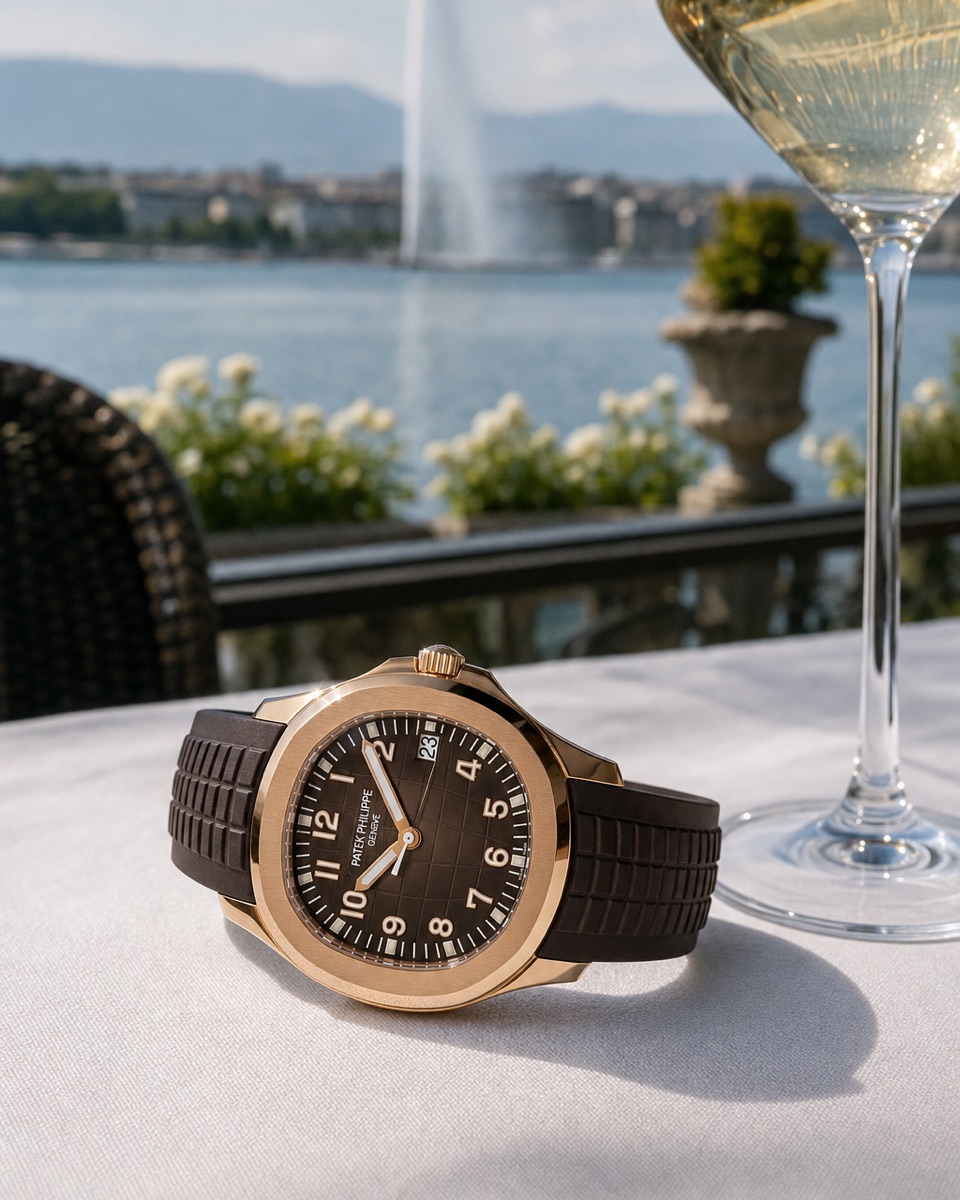
A rose gold 5167R arrived in 2009 with a brown dial (Phillips, Monochrome). Patek's current page fits it with a dark brown composite strap and a rose gold fold-over clasp, and lists it at $53,514 against $27,257 for the steel 5167A (patek.com 5167R-001, 5167A-001). It is the same watch in a heavier, warmer metal, and it's still in production.
Steel bracelet: the 5167/1A
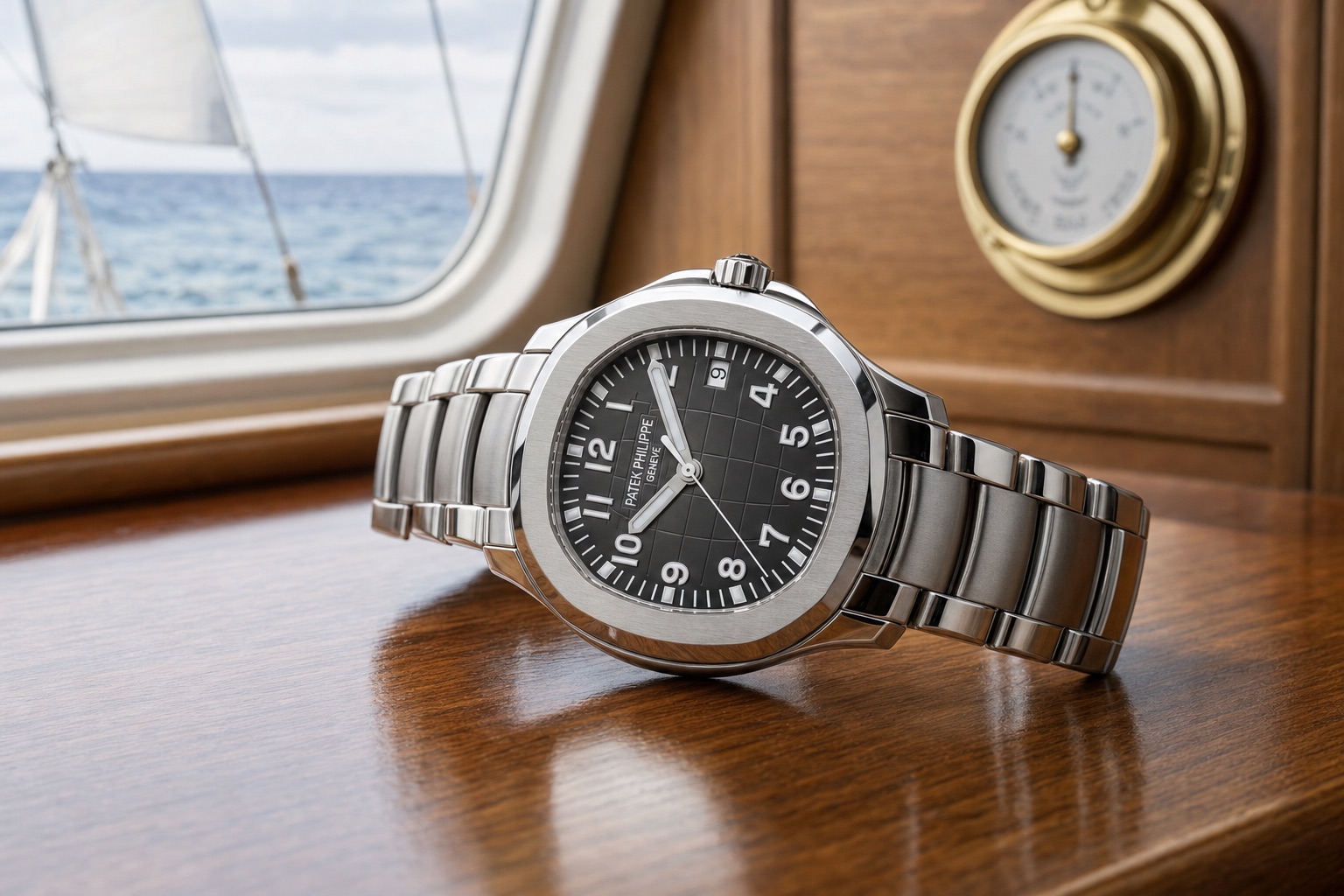
The 5167/1A put the same case, dial and movement on an integrated steel bracelet. Sotheby's describes it as the only steel time-and-date Aquanaut offered on a bracelet (Sotheby's). It followed the strap model in 2008 by Monochrome's account (Monochrome), and Patek dropped it in early 2025 while keeping the 5167A on its strap (Monochrome, February 2025). Patek gave no reason I could find. Monochrome's guess is that Patek wants steel bracelets to belong to the Nautilus and the composite strap to belong to the Aquanaut, which is plausible and still a guess.
If you're looking at one, Watch Collecting Lifestyle's hands-on with a 2009 example notes the code A614AAC engraved on the reverse of the last link and a "1/A" marking at the clasp (Watch Collecting Lifestyle). The same piece says that 2009 watch has no "Swiss Made" at six o'clock. That's one watch from one source, so I'd treat it as a lead for early dials and not a rule.
AI-generated illustration.
The neighbours
Two Aquanauts get mixed up with the 5167 in listings. The 5164 Travel Time arrived in 2011 as the collection's first complication, in a case Monochrome says is only 2.1 mm thicker than the 5167's (Monochrome). The 20th-anniversary Aquanaut of 2017 was a separate reference, the 42 mm white gold 5168G, which Patek's release describes with a "finely embossed checkerboard pattern" (Patek, 2017). Neither is a 5167 variant, whatever a dealer headline says.
Co-branded, commissioned and error dials
Tiffany & Co.
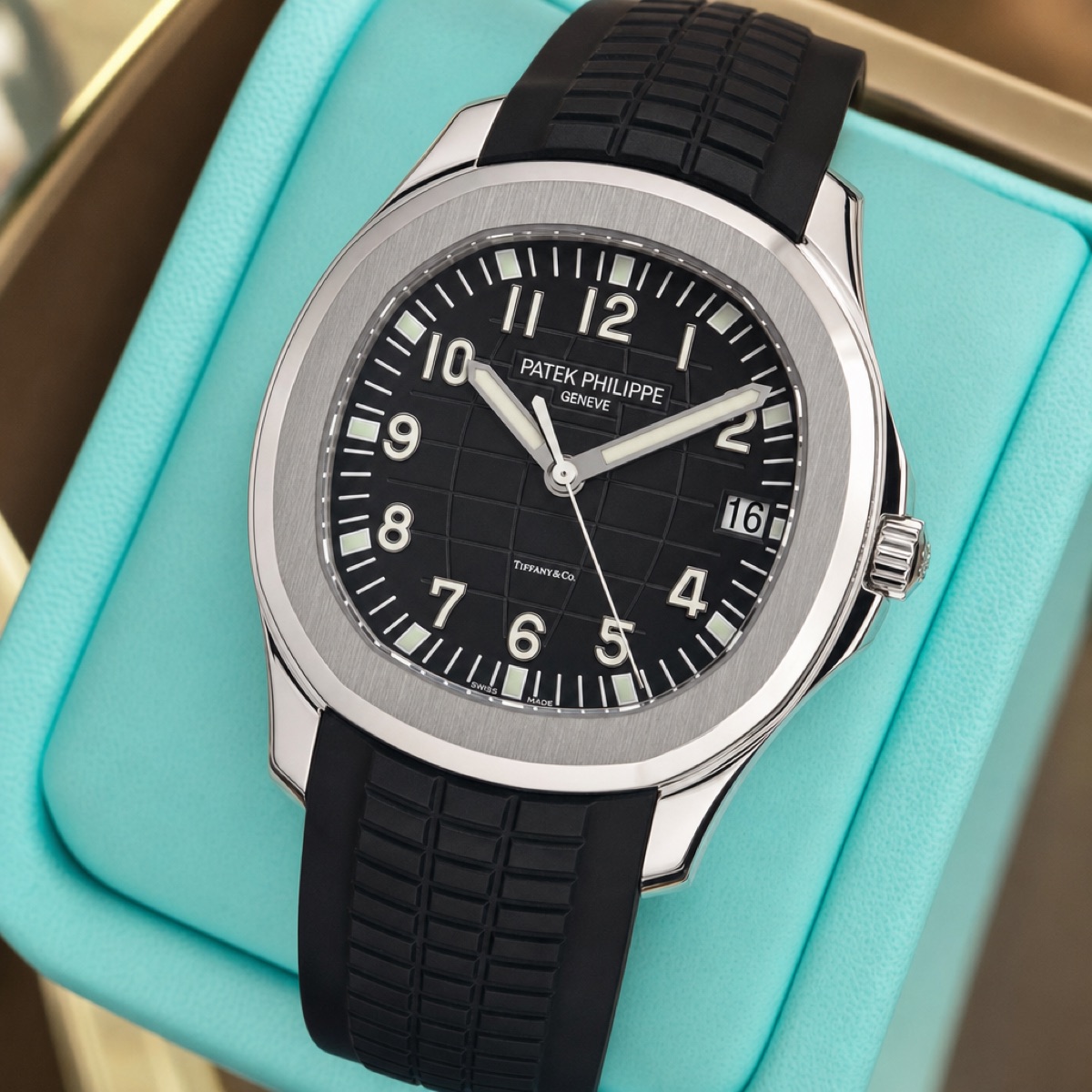
Tiffany-signed 5167s exist in steel and in rose gold, with the retailer's name at six o'clock (Phillips). The earliest dated example I found is a 2008 steel watch at Sotheby's with a dial "signed by maker and retailer" (Sotheby's). A 2016 example sold in Hong Kong was signed on the case, dial and movement (Sotheby's), though I can't say every Tiffany 5167 is.
The paper trail is the useful part. A 2011 steel example Phillips sold in New York came with a Certificate of Origin dated June 21, 2011 and "stamped Tiffany & Co. Honolulu HI"; it made $95,250 against a $40,000–80,000 estimate (Phillips). A 2022 example made $146,050 (Phillips). In Geneva, a 2016 rose gold 5167R with a Tiffany dial sold for CHF 120,650, and Phillips described it as "the eighth example of a reference 5167 in pink gold with the signature of Tiffany & Co." to come to market (Phillips). That is a count of watches seen at sale, not a production figure. Nobody publishes how many Tiffany 5167s were made.
One warning from the same catalogues: Phillips also sold a 2005 Aquanaut with "Tiffany & Co." on its caseback, but that watch is a 5066 (Phillips). Tiffany stories drift between Aquanaut references, so check the reference on the papers.
AI-generated illustration.
The khaki 5167A-010
A steel 5167 with a khaki green dial, reference 5167A-010, exists: Christie's sold one in Hong Kong, catalogued as about 2015 (Christie's). How many were made, and when, is less settled. The Christie's essay says Patek researchers believe, without confirmation, that two were made around 2012 and several more around 2015. Collector histories such as 41watch date it to 2011 and call it a clients-only piece (41watch). I'd treat any number you're quoted for this one with suspicion.
Exhibition editions: Singapore 2019 and Milan 2026
Patek has twice used the 5167 for its Watch Art Grand Exhibition. The Singapore edition, reference 5167A-012, was limited to 500 pieces at 22,400 Swiss francs, with "red minute markers and a red central hand", a red strap, "Patek Philippe Singapore 2019" printed on the sapphire back, and the 324 S C inside (SJX).
The Milan edition, reference 5167A-014, is limited to 250 pieces for the exhibition that ran from October 2 to 18, 2026. It has a sunburst blue dial with a black-gradient rim, a red minute scale and a red seconds hand, "Patek Philippe Milano 2026" on the back, and the 26-330 S C (Monochrome, patek.com 5167A-014). Monochrome gives the price as EUR 41,200; Patek's US page lists $43,761. Between them, the two editions bracket the movement change neatly.
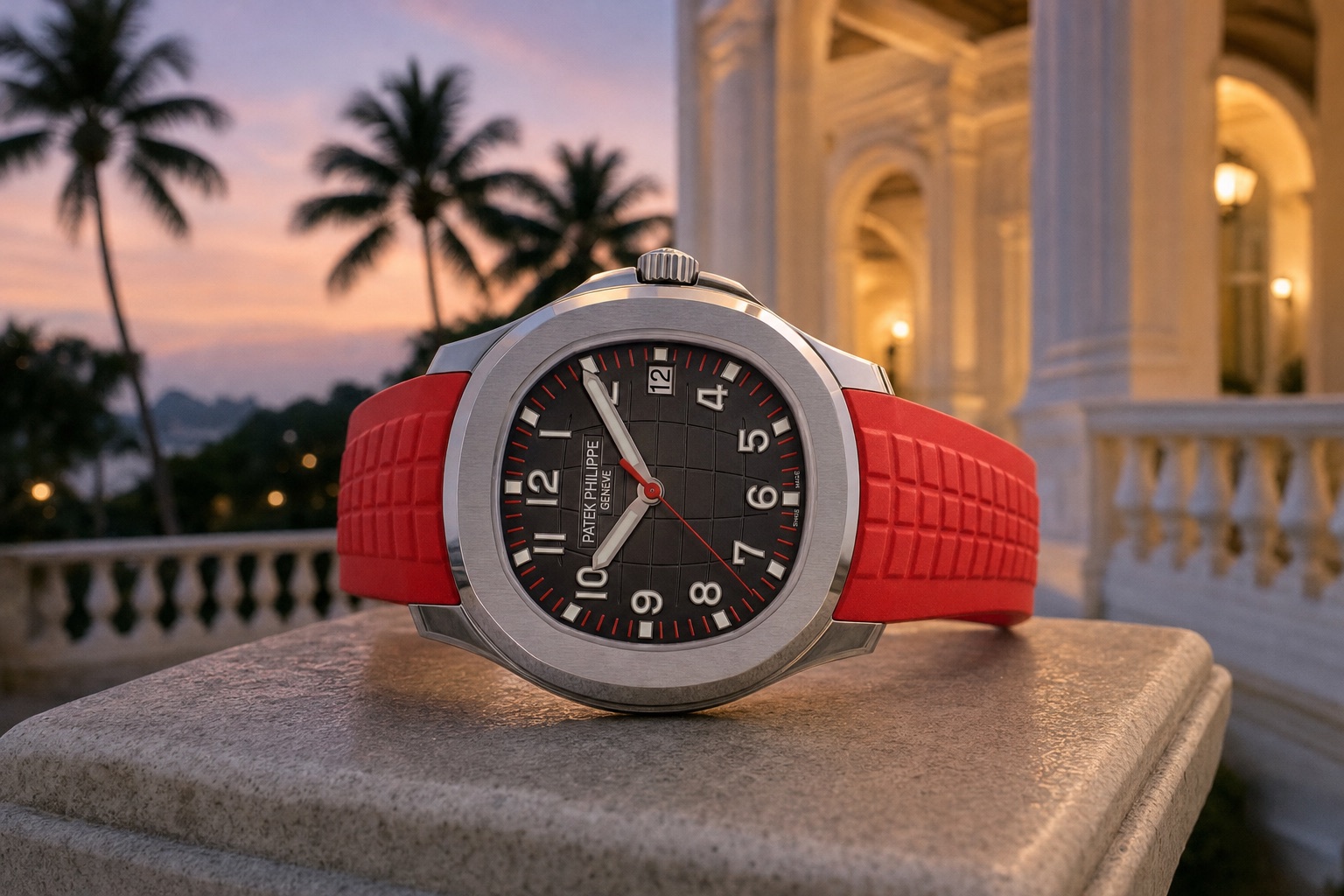
AI-generated illustration.
Errors
I looked for named factory errors and misprints on the 5167 and found none documented by a source I'd trust. If you've seen one with paperwork, I'd like to hear about it.
Why it matters
The 5167 is the reference that made the Aquanaut a fixed point in Patek's catalogue. The 1997 watch introduced the idea; the 5167 settled the size, the dial and the strap, and Patek has spent nineteen years adjusting it in ways only a collector would notice. That staying power has a market side. A 5167A from about 2020, estimated at $15,000–25,000, sold at Phillips for $67,310 (Phillips). A rose gold 5167R from about 2014 made CHF 76,200 in Geneva in autumn 2025 (Phillips), and a 5167/1A on its bracelet made CHF 46,250 at Antiquorum in May 2021 (Antiquorum).
Patek's own view of steel helps explain those numbers. In October 2022, after ending the steel time-and-date Nautilus, Thierry Stern told the New York Times: "We'll keep steel for sporty watches, mostly the Aquanaut, but it's dangerous and too easy for me to make only steel" (Time+Tide). The same interview gives the reason the steel is hard to buy. "At Patek, 66,000 is the max," Stern said of annual production, and "There will not be enough pieces for everybody" (Time+Tide). The 5167A is the watch that sentence about steel protects. The obvious objection is that it's a time-and-date watch on a rubber strap with a list price near $27,000 and a market price well above it, and that is a fair objection. My answer is that you're paying for Patek's finishing and a reference with nineteen years of documented history behind it. I haven't owned one, so weigh that accordingly.
What I'd check before buying one
- Papers: Patek calls the Certificate of Origin a watch's birth certificate and says it "can unfortunately never be re-issued" (Patek). An Extract from the Archives is only available once the first sale is more than ten years old (Patek), so many 5167s won't qualify yet.
- Movement against year: A 315 S C belongs only to the first watches; 324 S C covers most of the run; 26-330 S C is current. The sapphire back makes this a ten-second check, and a mismatch with the papers is a question to ask.
- Tiffany provenance: The auction examples above came with Tiffany-stamped papers. A Tiffany dial without them deserves extra scrutiny.
- Reference on the papers: 5167A, 5167/1A, 5167R, 5164 and 5168G all appear in listings with the same photos and the same stories.
Sources
- Patek Philippe, Aquanaut tenth-anniversary press release, July 2007 (PDF)
- Patek Philippe, Aquanaut 5168G press release, 2017 (PDF)
- Patek Philippe, 5167A-001, 5167R-001 and 5167A-014, read October 28, 2026
- Patek Philippe 5167A-001 page as archived in 2020, 2021, 2022 and 2025
- Patek Philippe FAQ: Extract from the Archives, Watch authenticity
- Phillips lots: 5167A c.2020, New York EIGHT; 5167A Tiffany 2011, New York NINE; 5167A Tiffany 2022, New York XII; 5167R Tiffany 2016, Geneva XX; 5167R c.2014, Geneva Fall 2025; 5066 Tiffany 2005, New York EIGHT
- Sotheby's: Exploring the Patek Philippe Aquanaut; the discontinued 5167/1A; Tiffany 5167, 2008; Tiffany 5167, 2016
- Christie's: 5167A-001 lot essay; khaki 5167A-010, Hong Kong
- Antiquorum: 5167, Geneva 2011; 5167/1A, Geneva 2021
- Monochrome: Aquanaut history, part 1 and part 2; 2025 discontinuations; 5167A-014 Milano 2026
- SJX, Aquanaut 5167A-012 Singapore 2019
- Time+Tide, Thierry Stern to the New York Times, October 2022
- WorldTempus, Thierry Stern appointed president, 2009
- Watch Collecting Lifestyle, 5167/1A hands-on
- 41watch, history of the Aquanaut
- Research dossier:
~/Projects/notebook/personal/research/watches/2026-10-28-patek-philippe-aquanaut-5167-dossier.md