Patek Philippe Perpetual Calendar Chronograph 5970
- Make
- Patek Philippe
- Reference
- 5970
- Model
- Perpetual Calendar Chronograph
- Variants
- 5970G, 5970R, 5970J, 5970P
- Production
- 2004–2010
- Case diameter
- 40 mm
- Calibre
- CH 27-70 Q
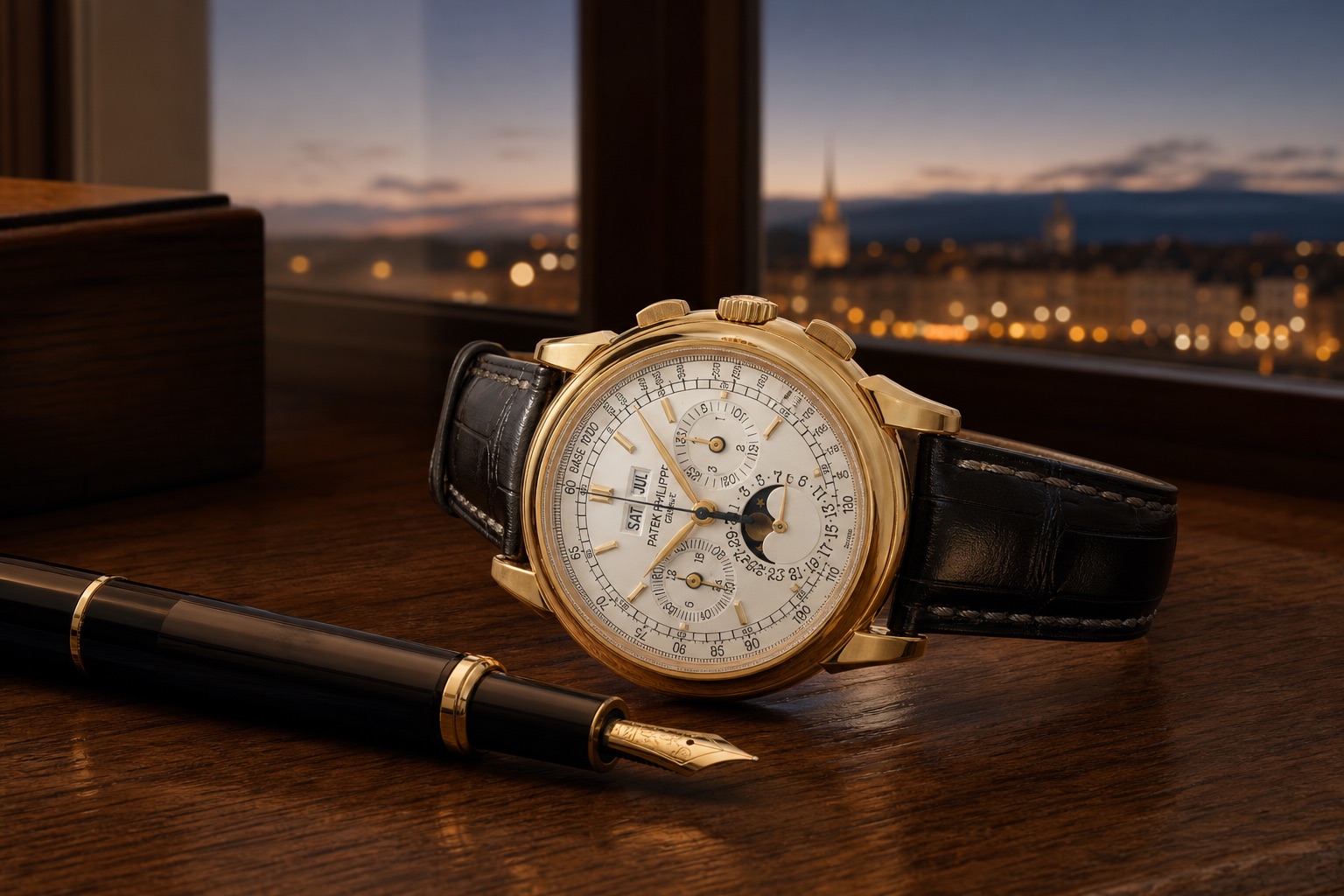
AI-generated illustration.
Patek Philippe has made a perpetual calendar chronograph wristwatch in series since the reference 1518 of 1941, which Phillips calls the first of its kind anywhere. The line has had very few references since. The 1518 gave way to the 2499, the 2499 to the 3970 in 1986, and in 2004 the 3970 handed over to the Patek Philippe Perpetual Calendar Chronograph 5970.
The 5970 is the reference where that line changed its proportions and then ran out of road on its old movement. It grew the case from 36 to 40 mm, brought back the square chronograph pushers of the earliest 2499s, and kept the Lemania-based calibre the 3970 had introduced. It was the last of the family built that way. SJX calls it the last perpetual calendar chronograph with an outsourced movement, and when the 5270 replaced it in 2011, Patek's own movement went inside. Phillips also credits the 5970 as "the first wristwatch designed and developed by Thierry Stern", who became Patek's president in 2009.
It was made for about seven years, in four metals, in a quantity one reference author puts at around 2,800. That short run, a handful of special-order dials, and one famous guitarist explain most of what has happened to it since.
Where it came from
The family history matters here, because the 5970 is defined by what it kept and what it changed. Phillips' collector's guide to the 3970 sets out the lineage: the 1518 of 1941, the 2499 that followed it, and the 3970, "Introduced in 1986" and made until 2004. Phillips' own 5970 guide gives slightly different spans, with the 1518 from 1940 and the 3970 from 1987 (Phillips, Fine Print). The difference between a launch year and a first-delivery year probably accounts for both, and it doesn't change the story.
The 3970 brought two things the 5970 inherited. It was the first Patek perpetual chronograph on a Lemania-based movement, the calibre CH 27-70 Q, and it added a leap-year indicator and a 24-hour display to the layout. Its dial put twin apertures for day and month at 12 o'clock, sub-dials at 3, 6 and 9, and the moon phase at 6 (Phillips, 3970 guide). It kept the 36 mm case size of the older references.
So the 5970's job was a careful one: keep the movement, the layout and the 1940s character, and make the watch fit the 2000s. Phillips says it "was released in 2004 as the direct successor of the reference 3970". The earliest documented watch I found is a white gold 5970G dated 2004, sold by Phillips with a Certificate of Origin dated December 18, 2004 (Phillips, lot 114). One Phillips Hong Kong essay says the reference arrived at "the Basel Fair in 2005" (Phillips, lot 143), but a watch already sold in 2004 makes that hard to accept. Dealer guides say it debuted at Baselworld 2004. That's plausible, and I couldn't confirm it from a source I'd rely on, nor could I find the launch price.
Who designed it
Phillips gives the design to Thierry Stern twice. Its guide says the 5970 was "the first wristwatch designed and developed by Thierry Stern", and one lot essay goes further, calling it "the first model developed and designed by Thierry Stern upon his accession as president of the company". The second version can't be right as written. Stern was appointed head of Patek's Creation department in 1998 and took over the presidency at the end of August 2009, by which point the 5970 was nearly finished (WorldTempus, 2009).
My read is that the attribution holds and the job title is wrong. In 2004 Stern ran the department that designed Patek's watches, so "his first design" is a reasonable thing to say about a reference that left that department in 2004. You'll also see dealer copy frame the 5970 as a challenge or a test set by his father, Philippe Stern. I found that story only on dealer pages, so I'd file it with the folklore. No source I read names a case or dial designer below Stern.
The watch
No Patek specification sheet for the 5970 was reachable for this piece: Patek's press archive refused the request and its website no longer lists the reference. The table below comes from auction-house catalogues, which describe these watches in hand. Where they don't agree or don't say, I've left the cell out.
| Spec | Value |
|---|---|
| Case diameter | 40 mm, as catalogued (no source says whether that includes the crown) |
| Case metals | 18k white gold (5970G), pink gold (5970R), yellow gold (5970J), platinum (5970P) |
| Pushers | Square |
| Case back | Screw-down sapphire display back; a solid back supplied with many examples |
| Movement | Calibre CH 27-70 Q, manual winding, Lemania-based, 24 jewels |
| Hallmark | Geneva Seal |
| Functions | Chronograph with tachymeter; perpetual calendar with day and month apertures, date, moon phases, leap-year indicator and 24-hour indicator |
| Strap | Leather, with a folding or deployant clasp in the case metal |
Sources: Phillips Fine Print; Phillips lot 114; Sotheby's 5970G-001; Bonhams lot 64.
Thickness, lug width, water resistance, power reserve and frequency are all missing from that table on purpose. Dealer review videos put the case at about 13.1 to 13.3 mm thick, and a watch wiki gives the movement figures, but none of it comes from Patek or an auction catalogue. If you need those numbers, ask for them in writing from whoever is selling the watch.
The four extra millimetres are the headline. Phillips' 3970 guide notes that "the 5970 grew to 40mm, and the 5270 to 41mm", and that jump from 36 is the bigger of the two steps. It's the change that let a 1940s dial layout sit on a 2000s wrist.
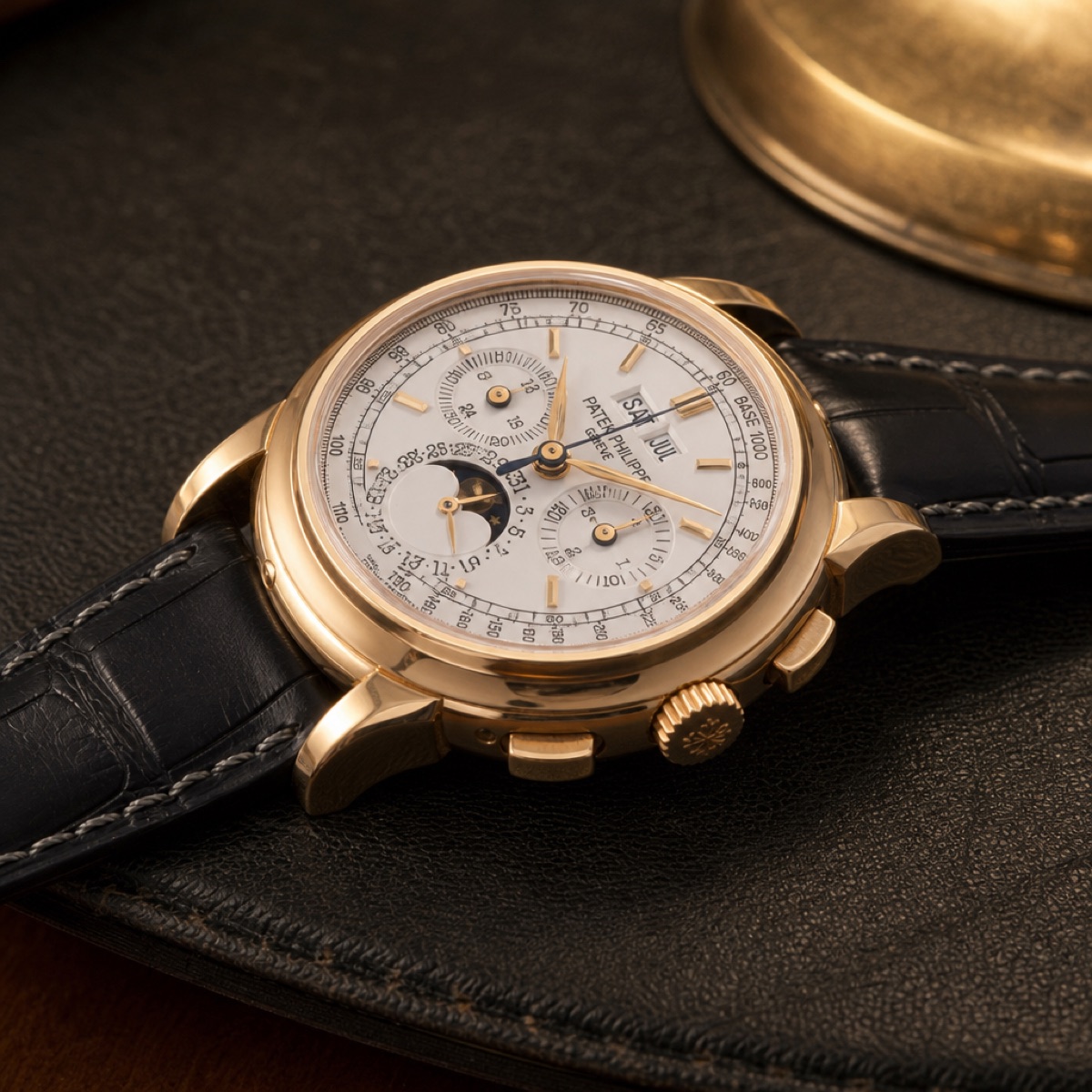
The case is where the design history shows. Phillips says "the 5970 incorporated square pushers as opposed to round", and ties them, together with the sculpted lugs, to the 2499. Square pushers belong to the first series of the 2499 from the early 1950s; the later 2499s and the whole 3970 run used round ones. Another Phillips essay calls the lugs faceted and says they "definitely set this model in the 21st century". I think that combination is the whole idea of the watch. Old details, chosen deliberately, at a new size.
AI-generated illustration.
The dial keeps the 3970's arrangement and tidies it. Phillips describes a tachymeter that "seamlessly encircles the day and month windows", "1940s-inspired chemin-de-fer minute divisions", and three sub-dials "perfectly aligned" with the outer dial. That's a lot of information on 40 mm, and it still reads cleanly.
Inside is the CH 27-70 Q, which Phillips describes as "a heavily modified Lemania-based caliber similar to the reference 3970". It's hand-wound, and Phillips catalogues name a Lemania 2310 ébauche as the base (Phillips, lot 114). The movement also carries a small piece of Patek history. Sotheby's notes that the 5970 "is the last perpetual calendar chronograph of the company featuring the Geneva seal on the movement", because "Since 2009, Patek Philippe has replaced the Geneva Seal with a higher-standard seal of its own." Late platinum watches from 2009 and about 2010 are still catalogued with the Geneva Seal, so the seal ran to the end of the reference even after Patek introduced its own.
How it changed
The 5970 barely changed during its run. Bonhams says it had "no major design amendments during its short 7 year production period", and nothing I read contradicts it. What changed was the metal, and each metal had its own window and its own dial.
| Years | Reference | Case | Dial | Estimated production |
|---|---|---|---|---|
| 2004 on (end undocumented) | 5970G | White gold | Silvered, applied baton indexes | About 1,000–1,250 |
| 2004–2009 | 5970R | Pink gold | Silvered, pink gold and blued steel leaf hands | About 1,000–1,250 |
| A year or two in the late 2000s | 5970J | Yellow gold | Silvered | Fewer than 300 |
| 2009–2010, or 2008 to early 2011 | 5970P | Platinum, diamond at 6 o'clock | Black, "120" on the tachymeter | 300–500 |
Production years and estimates are Phillips' (Fine Print; platinum range also from Phillips lot 79). They are estimates, and Patek doesn't publish production numbers.
White and pink gold came first, and they're the bulk of the run. The lot 114 essay says the reference launched in white gold before pink gold followed, though the two show up from 2004 together. Pink gold ran until 2009. Yellow gold came late and briefly: Phillips says only "a year or two in the late 2000s", and a 2008 yellow gold watch it sold was, by its count, "only the 33rd ref. 5970 in yellow gold to appear on the market". Platinum closed the run.
The total is the number you'll see quoted most, and it has a single origin. Phillips writes that John Reardon "has estimated that around 2,800 examples of the 5970 were produced across all four metals". Sotheby's repeats the same figure in its own catalogue (Sotheby's, lot 105). The split by metal is softer. A collector's guide from the dealer Collectability gives a different breakdown, with more yellow gold and platinum and less of the other two (Collectability). Read the per-metal figures as rough proportions and the 2,800 as an informed estimate.
The end date has the same kind of wobble. Phillips says the 5970 "has been confirmed by Patek to have been produced from 2004 through 2010", "with some end-of-series examples being sold in 2011". That explains why other catalogues say 2011 and why Sotheby's calls it six years. Its successor, the 41 mm 5270 with Patek's in-house CH 29-535 PS Q, followed in 2011.
The variations that matter
Case
Every 5970 has the same case shape, so the case tells you the metal and not much else. The useful details are the square pushers, which separate it from a 3970 at a glance, and the case back. The standard back is a screw-down sapphire display back, and many examples were sold with a solid back as well (Phillips, lot 193). A watch still carrying both backs is a better-kept watch.
The platinum case has one more mark. Phillips describes "the subtle diamond between the lugs at 6 o'clock", and Sotheby's catalogues a "diamond to the band at 6" (Sotheby's, lot 171). It's a single small stone set in the case band, and it's the quickest way to tell a platinum 5970 from a white gold one when the dial is out of sight.
Dials
The gold watches share a silvered dial. Pink gold examples carry applied baton indexes and what Sotheby's calls "pink gold and blue steel Feuille hands". White gold has baton markers and polished leaf hands (Bonhams). I couldn't find a catalogue that describes the hands on a standard yellow gold or platinum watch closely enough to repeat.
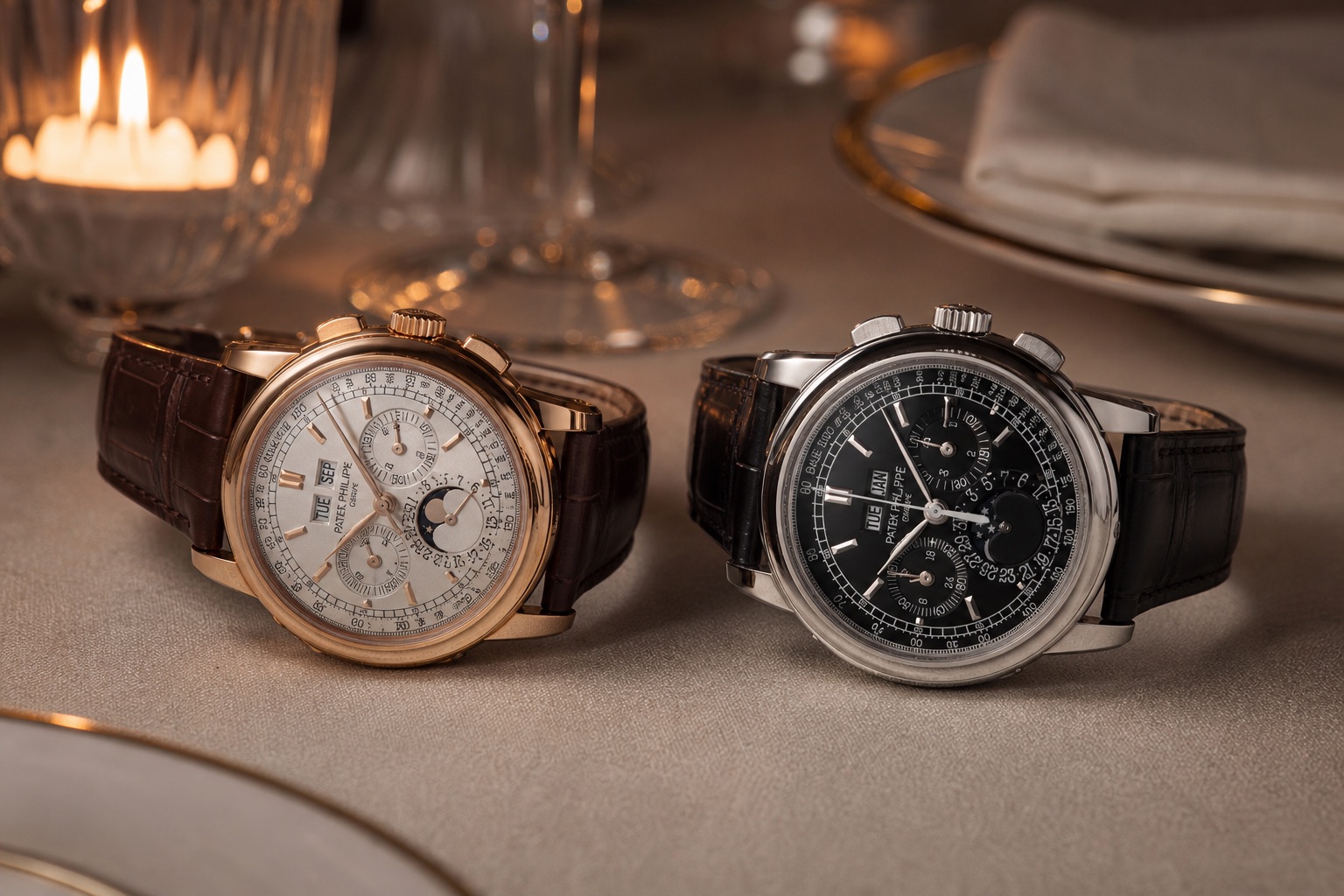
Black belongs to platinum. Phillips says "The 5970P is notably the only standard production version of the watch with a black dial", with the caveat that "a few 5970R examples are also known to feature a black dial". Those black pink gold watches are special orders, covered below.
The platinum dial also has a small printing difference that I find more interesting than the colour. Phillips points to "the addition of '120' on the tachymeter scale" and "the relocation of the 'SWISS' indication below six o'clock on the dial", and reads them as a sign that the platinum watches were among the last made. That's an inference, but a reasonable one, and it's the closest thing the 5970 has to a dial change during the run.
AI-generated illustration.
Co-branded, commissioned and error dials
For a reference this short-lived, the 5970 has a surprising number of special dials, and they account for nearly every headline price. They fall into four groups: retailer dials, one celebrity commission, boutique sets, and a late batch made after regular production ended.
Tiffany & Co.
Tiffany is the only retailer I could document on a 5970 dial. Phillips sold a 2006 white gold watch with a Tiffany signature on the dial and a Certificate of Origin naming Tiffany as the retailer, and described it as "the first white gold Tiffany-signed example of ref. 5970 to appear at auction and the second overall". The first was a pink gold watch sold in 2009. The white gold one made CHF 225,000.
Sotheby's later offered a platinum 5970 from about 2010 with the Tiffany signature beneath the moon phase, which it called the first platinum example to appear at auction with that signature (Sotheby's, lot 105). Phillips records a Tiffany-stamped 5970P selling for USD 441,000 in New York in December 2022 (Phillips, Fine Print). The month and city match the Sotheby's sale, so it's very likely the same watch, but the Sotheby's result is behind a login and I can't prove it.
To identify one, look for the small Tiffany & Co. signature at 6 o'clock under the moon phase, and then look at the paperwork. Phillips' white gold watch came with a Certificate of Origin naming Tiffany as the retailer, and that's the document I'd want to see.
Eric Clapton's Breguet-numeral watches
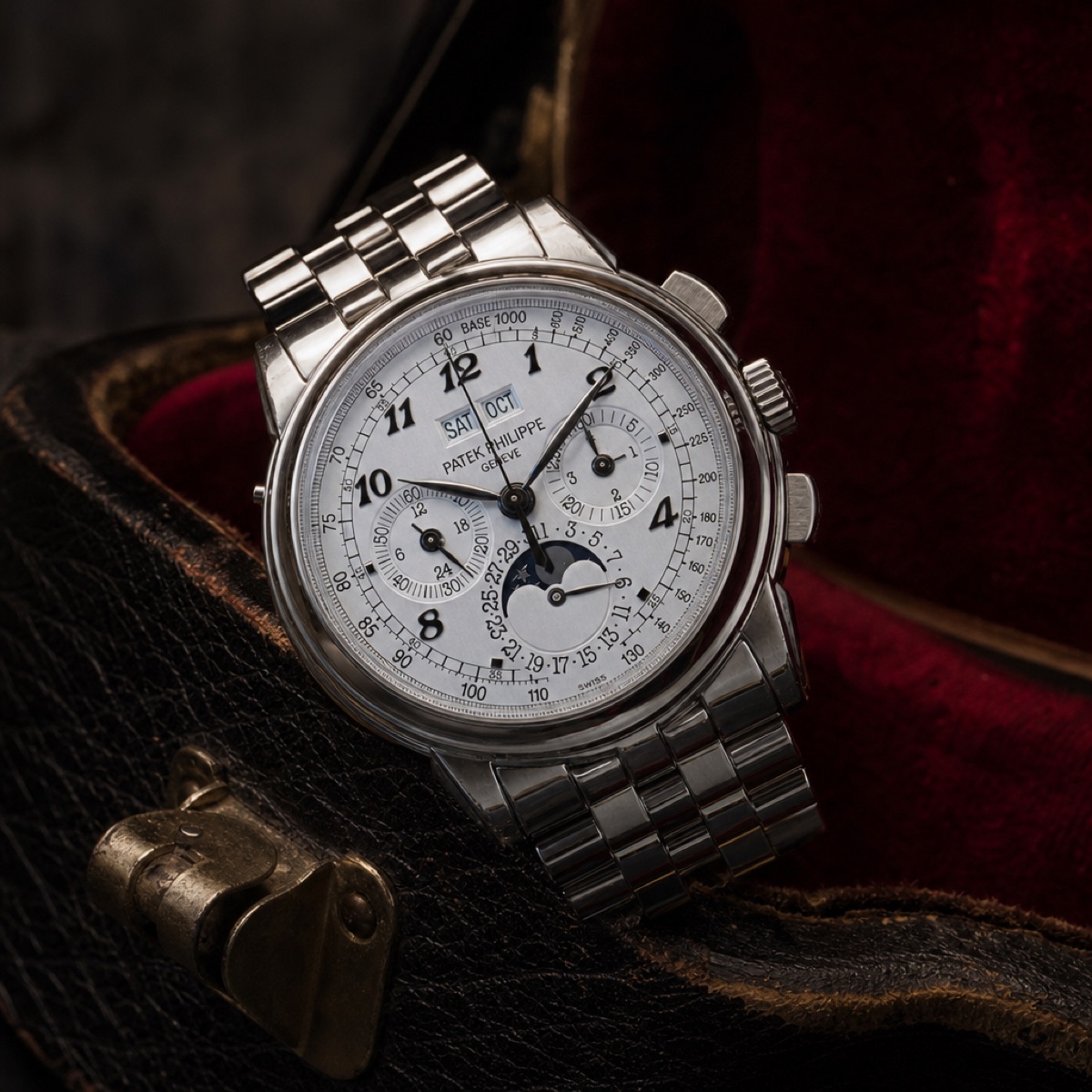
Eric Clapton ordered four 5970s, delivered in 2006, "each with a different case metal and dial colour". SJX's hands-on with one of them says "The only change from a stock dial are the Breguet numerals for the hours", and that the white gold watch was reputedly one of Clapton's favourites, with photos of him wearing what appears to be it.
Two have come to auction. The pink gold watch, on a gold brick bracelet, sold at Sotheby's Geneva in May 2015 for CHF 406,000 against an estimate of CHF 120,000–220,000, and Sotheby's said it was "the first time a 5970 with this configuration was offered at auction". The white gold 5970/1G, on a polished five-link bracelet, went to Sotheby's Hong Kong in April 2018 with an estimate of HK$2.4–4.0 million (SJX), and SJX later put its price at around US$630,000 all-in (SJX). It was offered again in 2021 at HK$4–8 million. Phillips lists an ex-Clapton Breguet-numeral 5970G at HKD 7,435,000 as the white gold record, without a date. I haven't been able to match that figure to a sale.

AI-generated illustration.
Boutique sets and special orders
Near the end of the run Patek made matched sets of four. SJX reported in 2014 that "Patek Philippe created a four-piece set of the 5970 in the three colours of gold as well as platinum", sold "via its Geneva boutique to special clients", and that "several such sets were made, but the total number remains unknown". The pair SJX handled were a platinum watch with a pale copper, salmon-coloured dial and a rose gold watch with a deep black one. Christie's had sold the yellow gold watch from a set, with a champagne dial, in December 2013 for US$353,000.
Phillips describes a 2011 set with a Roman numeral at 12 and applied dots: "5970G with salmon dial, 5970P with blue dial, 5970J with doré dial and 5970R with black dial". Its blue platinum 5970P-018 sold for HK$10,414,000 against an estimate of HK$3.5–7 million. So the platinum member of the set is salmon in one account and blue in the other. Given SJX's "several such sets", both may be right, and I'd want to see the Extract before believing either for a particular watch.
Other one-offs exist. Phillips sold a platinum 5970P-013 it called "a possibly unique special order" for HK$10,130,000. It also sold a 5970R-019 dated 2015, with a black dial and pink gold indexes, that was "only available upon special request", for US$825,500. Those are the black pink gold watches Phillips' guide mentions, and the 2015 date means some were made years after regular production stopped.
The Saatchi edition and the salmon 5970G
The last batch came in 2015. For its Watch Art Grand Exhibition at the Saatchi Gallery in London that year, Patek made small runs of older references, including the 5970G-019 and 5970J-014 (Phillips). Phillips says Patek explained the choice as "the result of a surplus of unused cases", that the watches went only to "Patek Philippe's most trusted and exclusive clientele", and that each of the four 3970 and 5970 references "is believed to have been limited to five examples each". The 5970G-019 has a salmon dial; the 5970J-014 has a brown one.
Salmon white gold is where the money has gone. Sotheby's sold a salmon-dial 5970G made around 2014 for "$1.3 million" in 2022, "650 percent of the initial high estimate". Its specialist Leigh Zagoory says that commission "paved the way for Patek Philippe to create five editions of the reference 5970G". That fits Phillips' five Saatchi watches, though the Sotheby's piece never uses the Saatchi name, so I'm joining those dots myself. A 5970J "Saatchi" made HKD 5,040,000 in Hong Kong in May 2023 (Phillips, Fine Print).
What I couldn't confirm
A dealer's collector guide and a dealer listing describe a platinum 5970 with a blue sunburst dial and "TWGH" on the back, made for a Tung Wah Group charity sale at Sotheby's in Hong Kong in March 2009 (Collectability). I couldn't find the Sotheby's lot, so I'm reporting it as a claim. I also found no Only Watch 5970, no co-signed dial from any retailer other than Tiffany, and no factory error or misprint that collectors have named. If you have paperwork for any of those, I'd like to see it.
Why it matters
The 5970 sits at a hinge in Patek's history. It's the last perpetual chronograph on a bought-in movement and the last with the Geneva Seal, and it's the reference that took the 1940s layout to a modern size without losing it. The 5270 that followed is a different kind of watch. SJX describes it as "more modern in style", with an in-house movement that moved the counters lower on the dial, and you can argue about whether that's progress.
The market has made its own argument. Phillips' records for standard dials, set in 2022, are CHF 207,900 for pink gold and CHF 264,600 for white gold at Phillips Geneva, HKD 1,890,000 for yellow gold and HKD 2,394,000 for platinum in Hong Kong (Phillips, Fine Print). Phillips leaves Tiffany pieces and special provenance out of its averages as outliers, which tells you how far above the series they trade.
The fair objection is that some of the 5970's reputation is borrowed. Its movement came from Lemania, its design leans on the 2499, and its rarity rests on one author's estimate. I think that's fair as far as it goes. My answer is that the 5970 is where Patek got the proportions of this watch right, and that its rarity comes from a short run more than from limited editions. I haven't owned one, so weigh that accordingly.
What I'd check before buying one
- Paperwork: The Certificate of Origin names the retailer, which matters for any Tiffany claim, and records special-order dials (Phillips, lot 14). An Extract from the Archives confirms the production year and first sale date (Phillips, lot 132).
- Metal against dial: A black dial means platinum, unless the papers show a pink gold special order. Look for the diamond at 6 o'clock on platinum.
- Movement: CH 27-70 Q, 24 jewels and the Geneva Seal, seen through the sapphire back.
- Accessories: The solid case back and a clasp in the case metal. Collectability warns that a bracelet on a watch whose papers list a strap was probably added later, and that blackened hands often oxidise on the gold watches (Collectability).
- Special dials: Salmon, blue, champagne and Breguet-numeral 5970s all sell at multiples of standard watches. Buy the paperwork first, then the watch.
Sources
- Phillips: The Fine Print: Twenty Years of the Patek Philippe Ref. 5970, Logan Baker, July 2024; A Collector's Guide to the Ref. 3970, Logan Baker, April 2025; What Makes the "Saatchi" Edition Watches So Special, Logan Baker, April 2024
- Phillips lots: 114, 5970G 2004; 206, 5970J 2008; 143, 5970P c.2009; 193, 5970P 2009; 79, 5970P 2009; 132, Tiffany 5970G 2006; 924, 5970P-018 2011; 933, 5970P-013; 14, 5970R-019 2015
- Sotheby's: 5970G-001; 5970R 2005, lot 279; 5970P c.2010, lot 171; Tiffany 5970P, lot 105; The Rosy Appeal of Salmon-Dial Watches, Suzy Katz, June 2024
- Bonhams, 5970G c.2007, lot 64
- SJX: Two very special 5970s, May 2014; Eric Clapton's Breguet-numeral 5970/1G, March 2018; Clapton and Fujiwara at Sotheby's, September 2021
- Artdaily, Clapton 5970 at Sotheby's Geneva, May 2015
- WorldTempus, Thierry Stern appointed president, October 2009
- Collectability, A Collector's Guide to the Ref. 5970
- Research dossier:
~/Projects/notebook/personal/research/watches/2026-10-29-patek-philippe-5970-dossier.md