Seiko
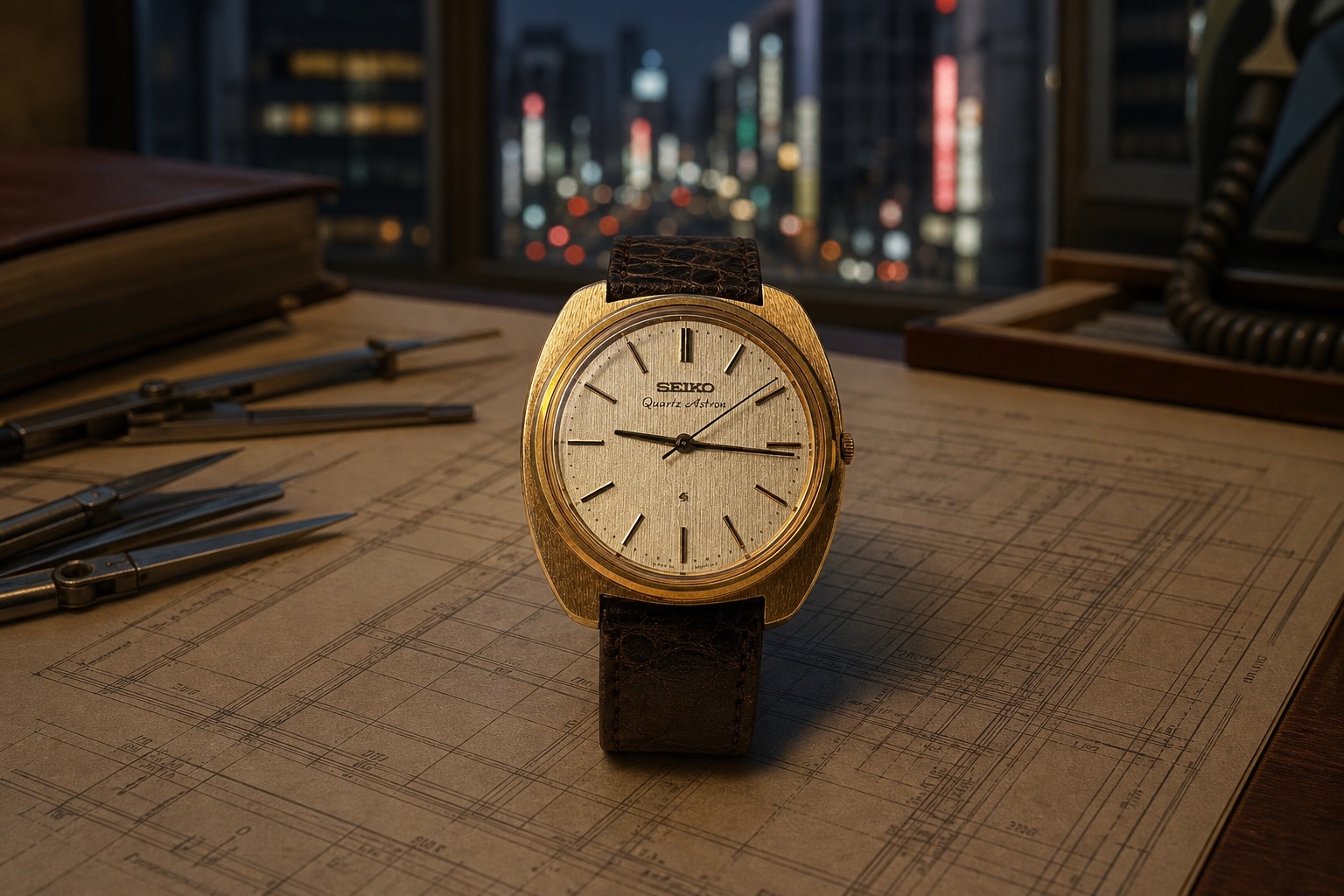
AI-generated illustration.
The watch that did the most damage to the Swiss watch industry was sold on Christmas Day 1969, in Tokyo, for the price of a Toyota Corolla. Seiko made about a hundred of them. The Smithsonian, which holds one, calls the Quartz Astron 35SQ "the first quartz wristwatch on the market" (Smithsonian), and the IEEE put a plaque on it in 2004 (IEEE). Within a decade Swiss watchmaking employment had fallen from almost 90,000 in 1970 to fewer than 47,000 in 1980 (Donzé).
That's the story everyone knows, and the historian who has done the most archive work on Seiko thinks it's the wrong story. Pierre-Yves Donzé argues that the Astron's launch "n'est pas le reflet d'une avancée technologique mais le fruit d'une stratégie": a bid for the image of technical leader, not proof of it. Quartz was 1.4% of Seiko's output between 1971 and 1974, and it only overtook mechanical production at Seiko in 1979 (Donzé, Le Temps). What beat the Swiss, in his reading, was Seiko's production system, and that system was a century in the making.
So this is the history of a company that started as a shop. Its founder wasn't a watchmaker. He was a Tokyo merchant who learned to repair clocks, imported them, then built a factory because he was tired of being refused machines. His company copied Swiss and American designs until it could better them, split itself into rival factories to keep itself honest, and bought or built every part of the chain from alloys to retail. Seiko's own history pages tell most of this well. They skip the five years of losses in the 1990s, the end of family leadership in 2001, the boardroom coup that brought it back in 2010, and the fact that the company that makes Spring Drive is a separate listed business. Those parts are here.
Timeline
These are the best-supported dates I found. Where sources split, the era sections say so.
| Year | Event |
|---|---|
| 1881 | Kintaro Hattori, aged 21, opens K. Hattori in Kyobashi, Tokyo, selling and repairing imported clocks |
| 1892 | The Seikosha factory opens in Honjo with engineer Tsuruhiko Yoshikawa; first wall clock two months later |
| 1895 | First pocket watch, the Timekeeper; exports begin |
| 1913 | The Laurel, which Seiko calls Japan's first wristwatch |
| 1923 | The Great Kanto Earthquake destroys the factory; Seiko replaces about 1,500 customers' watches left for repair |
| 1924 | The first watch with "Seiko" on the dial |
| 1937 | The watch division becomes Daini Seikosha, in Kameido |
| 1942 | Daiwa Kogyo founded at Lake Suwa, the seed of Suwa Seikosha and Seiko Epson |
| 1956 | The Marvel, Seiko's first movement designed in-house |
| 1959 | Suwa Seikosha incorporated; the Magic Lever winding system |
| 1960 | The first Grand Seiko |
| 1964 | Official timer of the Tokyo Olympics |
| 1967–68 | Seiko places second and third as a maker at Neuchâtel, then fourth to tenth at Geneva behind Swiss quartz prototypes |
| 1969 | The 6139 automatic chronograph in May; the Quartz Astron on 25 December |
| 1975 | The Professional Diver's 600m, the first titanium diver's watch |
| 1983 | K. Hattori & Co. becomes Hattori Seiko; the 7A28 analogue quartz chronograph |
| 1988 | Kinetic (then AGS) launches; Grand Seiko returns as a quartz watch |
| 1996 | Fifth consecutive net loss |
| 1999 | Spring Drive, 21 years after the first patent |
| 2001 | Seiko Watch Corporation spun off; the Hattori family leaves the top job |
| 2010 | Shinji Hattori becomes president after a boardroom fight |
| 2017 | Grand Seiko separated as its own brand |
| 2022 | Seiko Holdings becomes Seiko Group Corporation |
A shop in Kyobashi and a factory in Honjo, 1881–1923
Kintaro Hattori was born in 1860 in Uneme-cho, in the Kyobashi district of what is now Ginza (NDL). At eleven he was apprenticed to a haberdashery wholesaler, at thirteen he decided to become a clockmaker, and he learned the trade at the Kameda and Sakata clock shops before putting a "Hattori Clock Repairer" sign on his own house in 1877 (Seiko Museum). The company counts from 1881, when, in the museum's words, "the 21-year-old Kintaro established 'K. Hattori & Co.' in Uneme-cho, Kyobashi, Tokyo, close to his house" (Seiko Museum). It was a shop. It sold and repaired imported and second-hand clocks and watches.
What set it apart, by Hattori's own account, was that he paid his bills. Foreign trading houses in Yokohama wanted payment within thirty days and most Tokyo retailers paid twice a year. "Why did foreign companies come to my small shop first? Because I never fell behind in my bills," he wrote later (Seiko Museum). He moved to the main street of Ginza in 1887 and in 1894 bought the corner of Ginza 4-chome where the clock tower still stands; the current building, with its German clock and Belgian glass dials, opened on 10 June 1932 (Plus9Time).
The factory came in 1892. Hattori, 31, and a 28-year-old engineer named Tsuruhiko Yoshikawa started making wall clocks in a disused saltpetre works in Ishiwara-cho, Honjo, with about a dozen staff. The first eight-day clock came two months later, and the works moved to Yanagijima in 1893 with a five-horsepower steam engine (Seiko Museum). Wall clocks came first because they were easier than watches and because a Japanese rival had already shown they could undercut imports. Seikosha wasn't an early entrant: the museum itself says Japan's clock industry had started around 1877, fifteen years earlier (Seiko Museum).
Pocket watches followed in 1895 with the Timekeeper, which had a cylinder escapement and was, in the museum's words, made "using designs modeled after leading countries in watchmaking such as Switzerland and the USA" (Seiko Museum). The pocket-watch business lost money for years. Hattori kept at it, and the thing that turned it was machinery. Donzé's 2010 paper, written from the Seiko Institute of Horology archive, records that when Hattori toured Waltham and Elgin in 1899 both "refused to sell him machines." He got two from Brown & Sharpe in 1902, bought a bankrupt Japanese rival's Swiss machine tools in 1901, and when he went back to Waltham in 1906 as one of its biggest Japanese importers, it sold to him (Donzé). Yoshikawa built the company's first pinion-cutting machine in 1909 from a catalogue and what he'd seen on that trip, and he ran Seikosha's internal machine-building shop until 1932. The Empire pocket watch of 1909, with a lever escapement, became the mass-market product and ran until 1934.
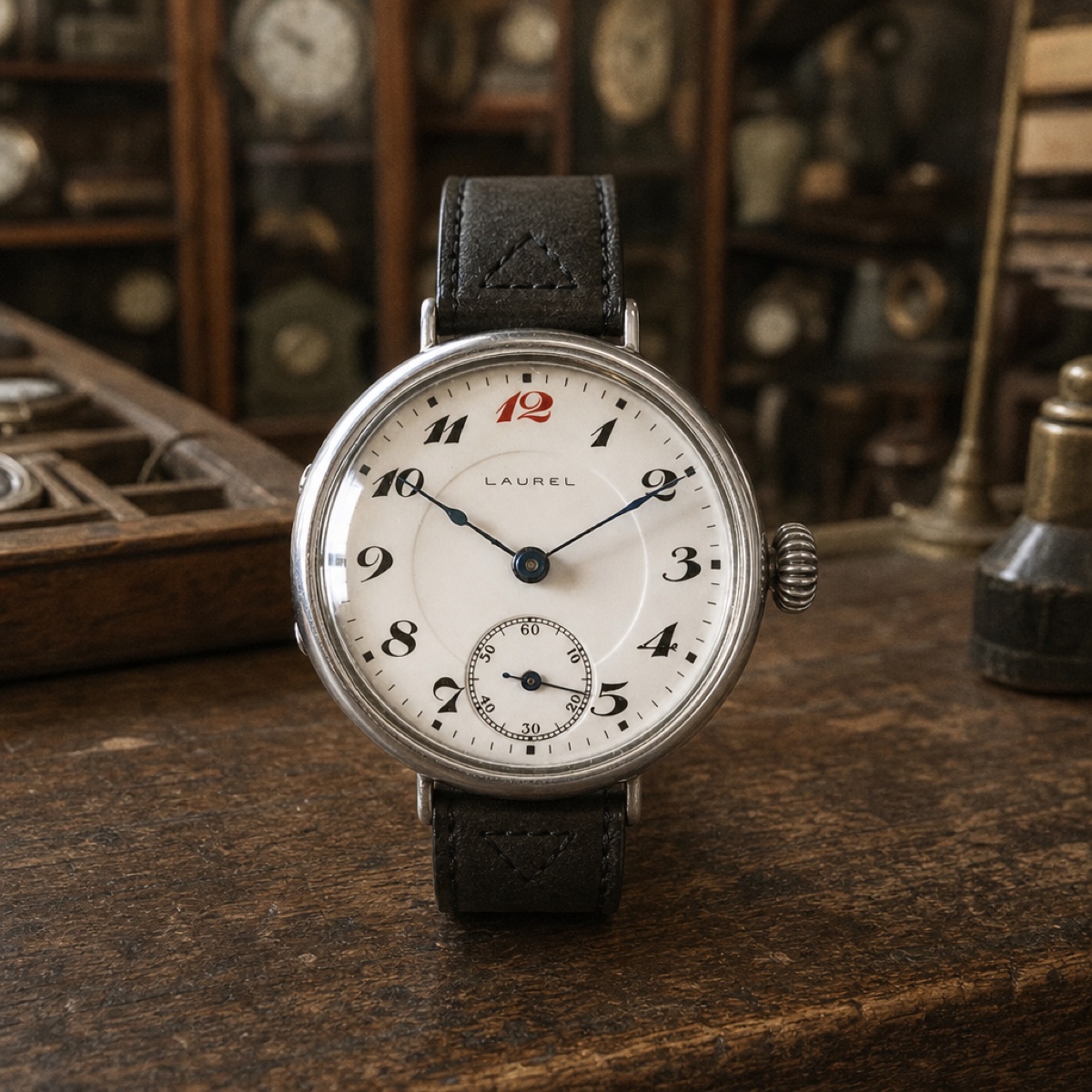
AI-generated illustration.
Donzé's table gives the scale. Between 1905 and 1915 Hattori's factory made 96.8% of Japan's watches, and it had no Japanese watch competitor until Citizen was founded in 1930 (Donzé). The Laurel of 1913, a 12-ligne wristwatch of 26.65 mm whose movement the museum says "is thought to have been based on a structure made in Switzerland," is the watch Seiko counts its watchmaking anniversaries from, and the Japan Society of Mechanical Engineers listed it as Japan's first wristwatch in 2014 (JSME). One collector-researcher, working from a 1913 price list and a 1915 catalogue, argues a 16-ligne Empire wristwatch came first and the Laurel wristwatch dates to 1915. I haven't seen the catalogues and the claim has no backing beyond that blog, so I'll leave it at: Seiko and the JSME say 1913.
Hattori's slogan turns out to be documented in his own words: "Merchants must stay a step ahead of the rest, but just one step. If they stay too many steps ahead they will be seen as prophets, too far removed from reality" (Seiko Museum). Read the next century with that in mind. Seiko was rarely first to an idea. It was usually first to sell it.
The earthquake and the two factories, 1923–1945
On 1 September 1923 the Great Kanto Earthquake and its fires destroyed the Seikosha factory, Hattori's house, and the temporary office he'd rented while the Ginza store was rebuilt. The only thing left standing at the works was a steel water tower. Hattori was 62. Four days later he announced he would rebuild; the sales side was wholesaling imports again by mid-October and trading from a temporary store in November (Seiko Museum). The story Seiko tells most often is that about 1,500 customers' clocks and watches, left for repair, had burned, and that Hattori advertised in the newspapers and replaced them with new ones free. Every version of that story comes from Seiko. The museum exhibits the announcement without transcribing it, and I found no period source, so I'd file it as company lore until a 1923 newspaper turns up.
The brand came out of the rubble. Seikosha had sold watches under various names before 1923. In December that year it began making wristwatches under a single new name, Seiko, chosen over "Glory"; the museum says the first prototype had been finished the day before the earthquake and survived the fire (Seiko Museum). The word is the "seiko" of Seikosha, 精工, precision manufacture, and a homophone of 成功, success (Seiko). The first Seiko-dialled watch went on sale in 1924.
Hattori died in March 1934, a member of the House of Peers and the biggest name in Japanese clocks. Three years later the company split for the first time. In September 1937 the watch division was spun out of Seikosha as Daini Seikosha, "second Seikosha," in Kameido, Tokyo (Seiko Group). Clocks stayed at Seikosha. The second split was forced by the war. In May 1942 a former Hattori apprentice named Hisao Yamazaki founded Daiwa Kogyo in a converted miso warehouse on the shore of Lake Suwa in Nagano, with nine employees, backed by Shoji Hattori of Daini (Epson). Daini also evacuated its own plant to Suwa, in 1943 or 1944 depending on the source.
Donzé's abstract of his later paper makes a point worth holding onto: for all the imported machines, Hattori's parts "were not interchangeable, as a result of which assembly continued along traditional lines until the end of the Second World War" (Donzé). The company that would later beat Switzerland on process hadn't solved the basic process problem by 1945. Civilian output was, in the museum's words, "virtually suspended" by the war's end, the Kameido plant was destroyed by bombing, and production restarted in evacuation plants at Kiryu, Toyama, Sendai and Suwa. At the end of 1949 all of them but Suwa were closed to pay for rebuilding Kameido (Seiko Museum).
Rebuilding, and setting the brothers against each other, 1945–1960
The postwar company was run by Shoji Hattori, the founder's second son, president from 1946 to his death in 1974. It had three legs: K. Hattori & Co. in Ginza, which sold; Daini Seikosha in Kameido, which made watches; and the Suwa plant in Nagano, kept alive, says Beyond the Dial, because Yamazaki "convinced the Hattori family to retain the factory in Nagano" in 1949 (Beyond the Dial). The three were legally separate companies with common Hattori ownership, and that structure lasted, in one form or another, until 2009.
The decision that shaped the next thirty years was to make Daini and Suwa compete. The usual telling dates it to 1959, when Daiwa Kogyo absorbed Daini's Suwa plant and was renamed Suwa Seikosha (Seiko Group). Beyond the Dial, drawing on Seiko Epson's Hirokazu Imai, puts the real decision in 1953, when Genzo Hattori "decided to install different management groups for the Kameido and Nagano factories and have them perform their research and development independently." Imai describes the arrangement as a family, "with the Hattoris as the parents, K. Hattori & Co. the first son, Daini the second son and Suwa the third son," competing for the parents' favour. Worn & Wound's version has the two factories "not sharing parts, movements, or any design information" (Worn & Wound). Imai says otherwise: Diashock and the Magic Lever were Suwa inventions shared with Daini at once, and the movements both factories sent to Neuchâtel carried Daini mainsprings. I'd take the insider's account.
Suwa drew first blood. Its Marvel of 1956 was, by Seiko's own description, the first Seiko movement that didn't adopt "the mechanisms of overseas watches," designed by a 33-year-old engineer named Tsuneya Nakamura (Seiko Museum). It won the trade ministry's accuracy competition and a prize from the Japanese branch of the American Watchmakers Institute. Daini's answer, the Cronos of 1958, came two years later. In 1959 Suwa scaled the Marvel up into the Crown, with an involute gear train and the Diashock shock protection, and in the same year built the Gyro Marvel around a new winding system, the Magic Lever, a pawl mechanism that winds in both rotor directions with very few parts. Seiko still uses it (Seiko Museum).
Catching Switzerland in public, 1960–1969
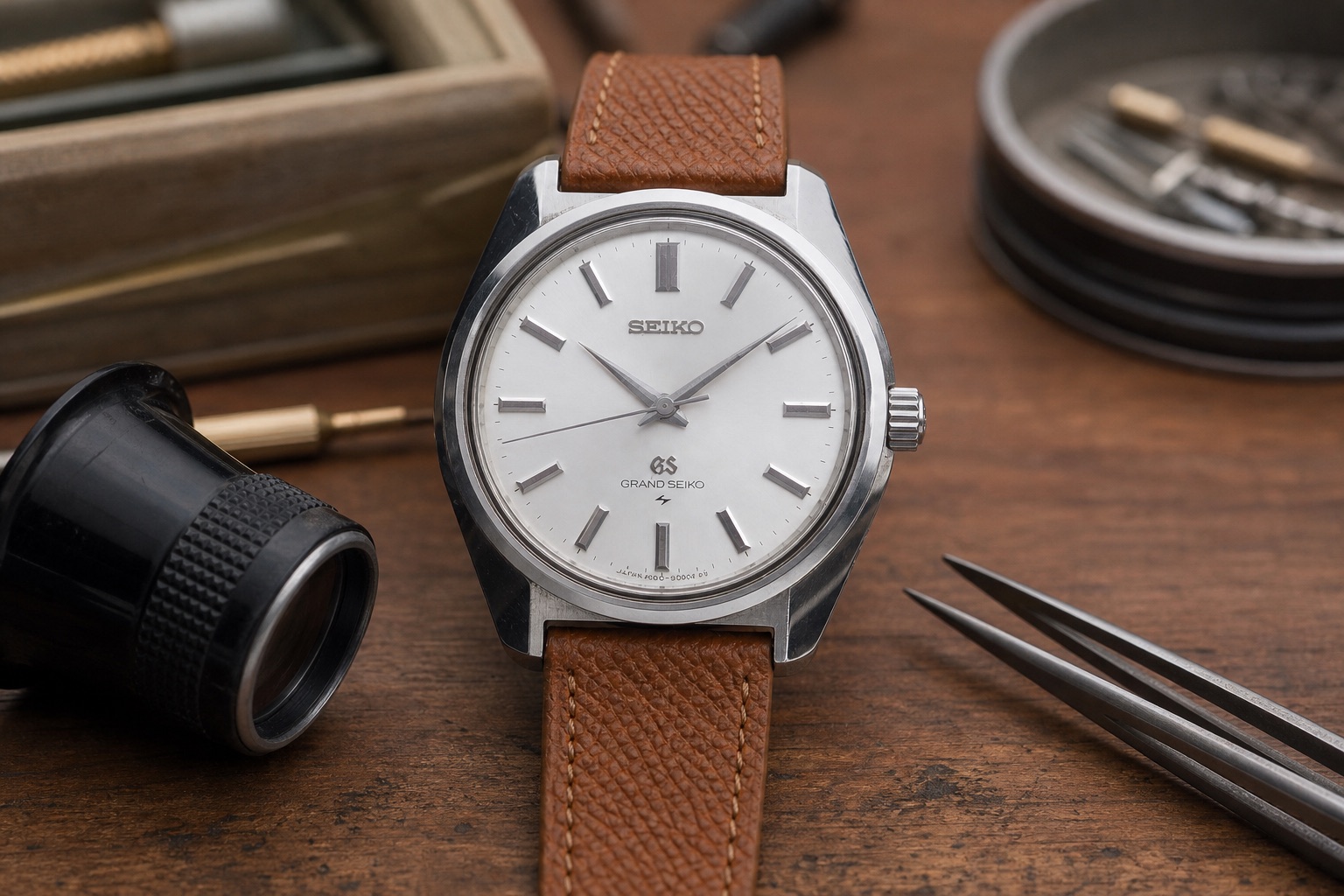
The Crown became the first Grand Seiko in 1960, a Suwa watch with the manual calibre 3180, certified in-house to what Grand Seiko says was the "superior grade" of the Swiss chronometer bureaux (Grand Seiko). Daini got King Seiko in 1961, priced at ¥12,000 to ¥15,000, about a graduate's starting salary (Seiko). The names tell you who was winning: Imai says Daini's proposal was first "Champion Seiko," then "King of Seiko," slotted below Suwa's Grand.
AI-generated illustration.
Seiko then set out to prove itself in the two public arenas the Swiss owned: sports timing and the observatory trials. In 1960 Shoji Hattori telegraphed his Daini design chief: "Intend to handle official timing duties. Go to Rome Olympics in August and observe timing procedures" (The Olympians). Omega and Longines had timed every Games since 1932. The work was split across the three companies, the stopwatch passed Britain's National Physical Laboratory in May 1963, and the organising committee chose Seiko that month. Seiko's count is 1,278 instruments of 36 types and 172 staff; the Official Report's lender table lists 1,280 sport watches of 40 kinds and says 1,115 stopwatches were used (Official Report). Suwa's contribution was the Crystal Chronometer QC-951, a portable quartz clock accurate to 0.2 seconds a day, and the printing timer built for the Games grew into Epson's printer business.
The observatory trials went worse before they went better. Seiko's first mechanical wristwatches at Neuchâtel in 1964 placed 144th and 153rd; the hairsprings had been magnetised on the flight (Plus9Time). By 1967 Daini's calibre 052 was fourth of 62 qualifying movements and, as makers, Daini and Suwa placed second and third behind Omega (SJX). Seiko's pages compress that to "second and third places," which is true of the manufacturer ranking and flattering about the watches. In 1968 Neuchâtel cancelled its wristwatch class. The official reason, given in a 1970 press release, was the arrival of electronic watches. Donzé found the observatory's own 1967 internal report, which names "le succès grandissant des concurrents japonais" and warns that dropping only the mechanical class would look like "une manœuvre trop manifeste et facile pour supprimer la concurrence japonaise" (Donzé, SSC). Seiko went to Geneva instead that year and took fourth to tenth, behind three Swiss quartz prototypes. Geneva stopped its trials too. When Neuchâtel relaunched an anonymised contest in 1970, Seiko was refused entry over a Thai advert claiming it had invented the 36,000 vph movement.
The hardware of that decade is the backbone of Seiko collecting. Taro Tanaka, hired in 1959 as the company's first trained designer, laid down the flat, distortion-free, mirror-polished case rules that Grand Seiko now calls the "Grammar of Design," first fully realised in Daini's 44GS of 1967 (Worn & Wound). No period document of those rules has surfaced; the four tenets are later summaries from Seiko and from interviews. The hi-beat calibres came in 1967 and 1968, the 61GS and 45GS at 36,000 vph, and the V.F.A. versions of 1969 were rated to a minute a month. The 226 Astronomical Observatory Chronometers Seiko certified at Neuchâtel and sold in 1969 and 1970 at ¥180,000 are the rarest of all; Phillips sold one for CHF 101,600 in November 2025 (Phillips).
The divers started in 1965 with the 62MAS, reference 6217-8000, rated to 150 m when Seiko's previous best was 50 m (Fratello). The 300 m one-piece 6215 followed in 1967 and the hi-beat 6159 in 1968. And in 1963 the Sportsmatic 5 put an automatic, a day-date in one window, water resistance and a recessed crown into a cheap watch. Seiko's museum says, with its own hedge, that the number of Fives exported in 1966 "reportedly exceeded the total number of self-winding watches in all of Switzerland" (Seiko Museum). By 1970 Seiko made 14 million watches a year (Donzé, Le Temps), and the Smithsonian says it made more mechanical watches than any firm in the world.
Two firsts in one year, and the quartz decade, 1969–1983
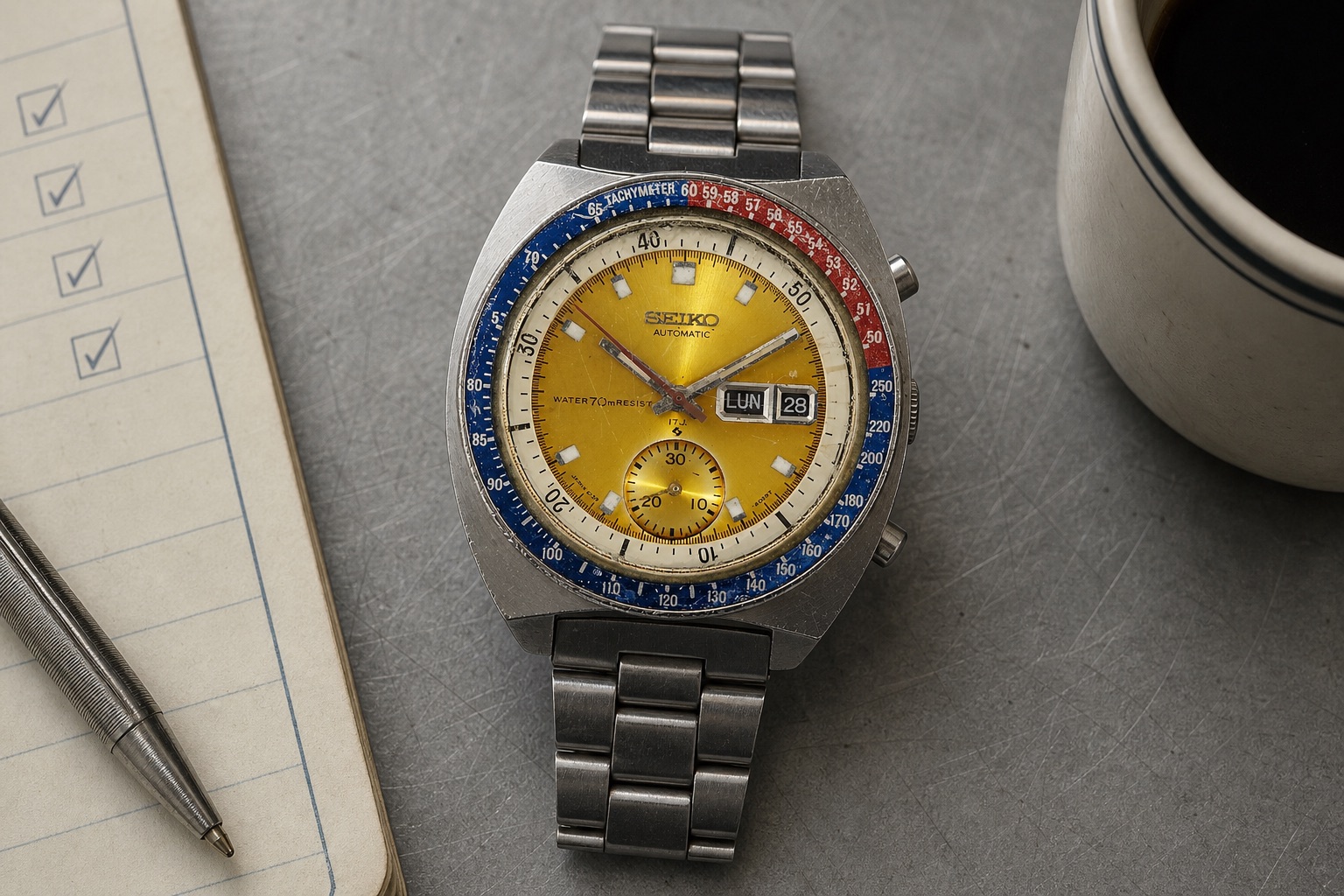
Seiko's two most-argued firsts both landed in 1969. The chronograph came first. Zenith announced the El Primero on 10 January; the Heuer-Breitling-Hamilton group announced the Chronomatic on 3 March and showed it at Basel in April; Suwa's 6139, with a column wheel and a vertical clutch, had been in production since October 1968, and Suwa's internal report for May 1969 says the new model "would be released in stores on the 21st of May" (Plus9Time). The Chronomatic reached shops in the summer and Zenith's watch in the autumn. Phillips now calls the 6139 the watch "believed to be the first automatic chronograph wristwatch sold to the public" (Phillips); Seiko itself only ever claims the first "with a column wheel and vertical clutch." That modesty is deliberate. Jack Heuer recalled Shoji Hattori congratulating him at Basel in April 1969 without a word about the 6139 Seiko was showing at the same fair (WatchTime).
AI-generated illustration.
The quartz watch is the better-documented first because two independent institutions have ruled on it. Suwa's quartz work began in 1959 under Nakamura, the Marvel's designer, and the Olympics gave it a product, the QC-951 clock. At Neuchâtel in 1967 the Swiss CEH's Beta 1 and Beta 2 prototypes took the top ten quartz places and Seiko's prototypes came eleventh and thirteenth (Stephens and Dennis). Then, in Seiko's account, Shoji Hattori shut down the parallel tuning-fork project in 1968 and gave the team a year to sell something (Seiko). The Astron 35SQ went on sale on 25 December 1969 at ¥450,000 in 18k gold: an 8,192 Hz tuning-fork crystal, a hybrid circuit of 76 transistors hand-soldered at 128 points, an open stepping motor, and ±5 seconds a month. Carlene Stephens and Maggie Dennis, writing in the British Journal for the History of Science, call it "the first quartz watch ever sold anywhere in the world," and note that Seiko officials said the plan was never more than 200 pieces (Stephens and Dennis). The Swiss Beta 21 reached shops on 10 April 1970 under sixteen brand names (IEEE). So the Swiss had the better prototype and Seiko had the first sale. Both are true, and Seiko's museum admits "This was a victory, but only by a small margin."
Seiko says it then opened its quartz patents to the world, having watched Bulova's closed Accutron fail to spread (Seiko Museum). I couldn't find an independent record of the licence terms, so I'll leave that as Seiko's account. What Donzé documents is the opposite flow: the early CMOS circuits were designed with Intersil in the United States, and in 1968 the trade ministry funded Daini and Suwa to build automated assembly lines, "System A," that could turn out 100,000 pieces a month (Donzé, Watchonista). That is the process innovation he credits for the crisis. Seiko quartz output went from 3,000 pieces in 1971 to 658,000 in 1974, 25.5 million in 1980 and 118.6 million in 1990. Japan's total output passed Switzerland's in 1980, on Seiko's count (Seiko Museum). Swiss exports peaked at 84.4 million in 1974 and averaged 31.3 million in 1982–84.
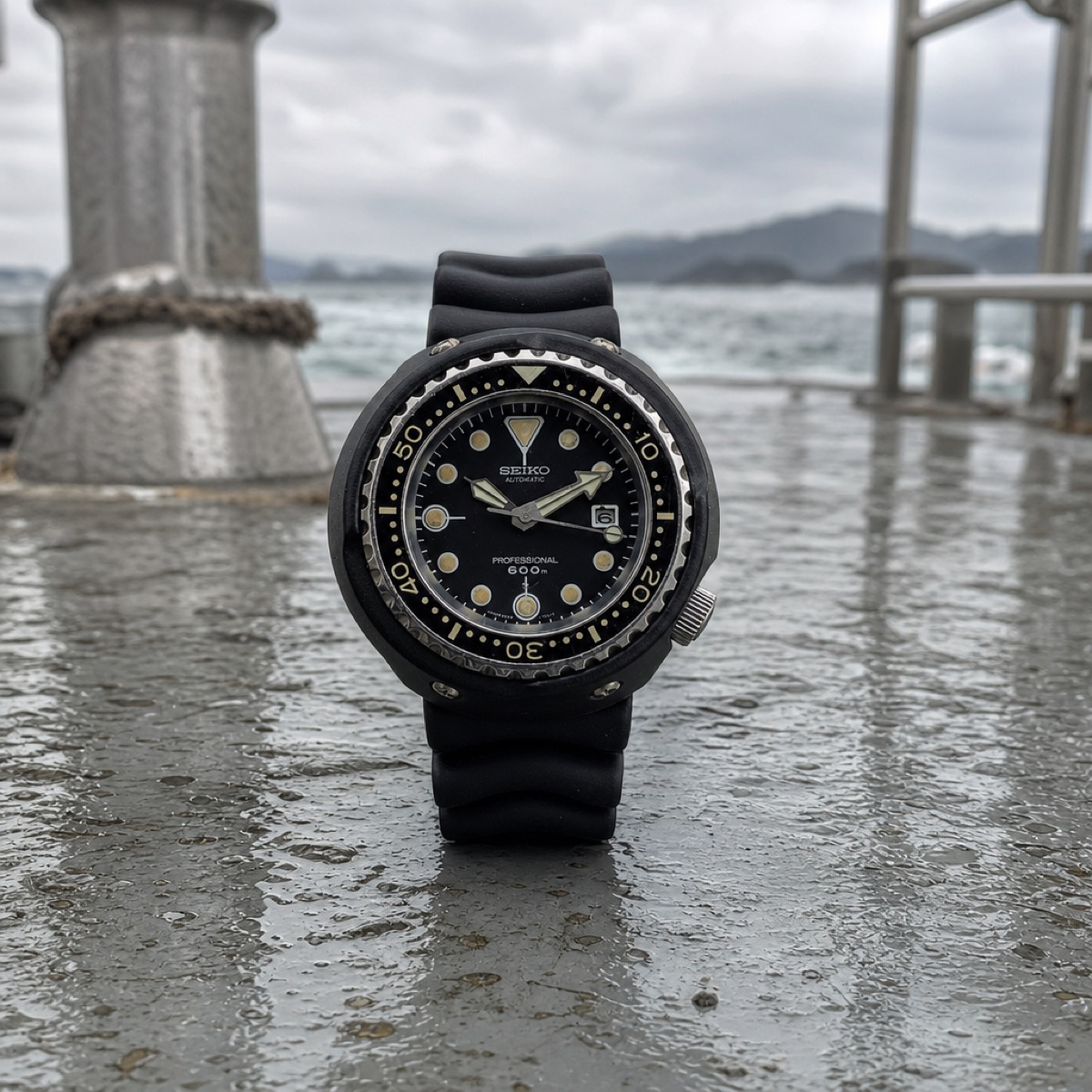
The 06LC of October 1973 was the first six-digit LCD watch and the 0634 of 1975 the first digital chronograph, both on Seiko's own account (Seiko Museum). The watch I'd pick from the decade is the Professional Diver's 600m of June 1975, the 6159-7010 that collectors call the Tuna. Seiko's museum reproduces designer Taro Tanaka's 2009 account: a 1968 letter from a saturation diver named Yo Oshima, working off a rig at Kure in Hiroshima, whose watches kept flooding with helium and losing their crystals. The answer was a titanium one-piece case, a ceramic shroud and an L-shaped gasket; it took twenty patents and sold for ¥89,000 (Seiko Museum). Seiko engineer Ikuo Tokunaga later said the gasket and one-piece case cut helium ingress "by about 1/100" against a conventional case, which is why the watch needs no escape valve (Monochrome). It was the first titanium diver's watch; Citizen's X-8 of 1970 was the first titanium watch of any kind (Monochrome).
Seiko also bought the cheap end. It took over the Pulsar name in 1978 from the remains of the Hamilton digital-watch business, launched Alba in 1979, and put a Seiko on Roger Moore's wrist in five Bond films from 1977 to 1985 (Fratello). In 1983 the 7A28, the first analogue quartz chronograph, arrived in Giorgetto Giugiaro's asymmetric cases, one of which Sigourney Weaver wore in Aliens three years later by what Worn & Wound calls "a happy accident" (Worn & Wound).
AI-generated illustration.
Three companies, five losses and a mechanical revival, 1983–2010
The names changed in the 1980s. K. Hattori & Co. became Hattori Seiko in August 1983; Daini Seikosha became Seiko Instruments & Electronics the same year and Seiko Instruments in 1997; Suwa Seikosha merged with its printer offshoot in 1985 to form Seiko Epson (Seiko Group, Epson). Hattori Seiko became Seiko Corporation in July 1997, according to the securities filing and the group's own chronology (EDINET). The International Directory of Company Histories says June 1990; my guess is that was an English trading name. The Hattoris ran all of it: Kentaro from 1974, his brother Reijiro from 1983, until Shiro Yoshimura became the first non-family president in 1987 (Encyclopedia.com).
The decade's lasting product was Kinetic: a 1986 quartz watch charged by winding the crown, then in April 1988 the rotor-driven version, first called AGS, which Seiko says sold eight million by 2007 (Seiko). Grand Seiko came back in September 1988 as a quartz watch, the 95GS (Plus9Time), and mechanical Grand Seiko only returned in 1998 with the 9S55 (Phillips).
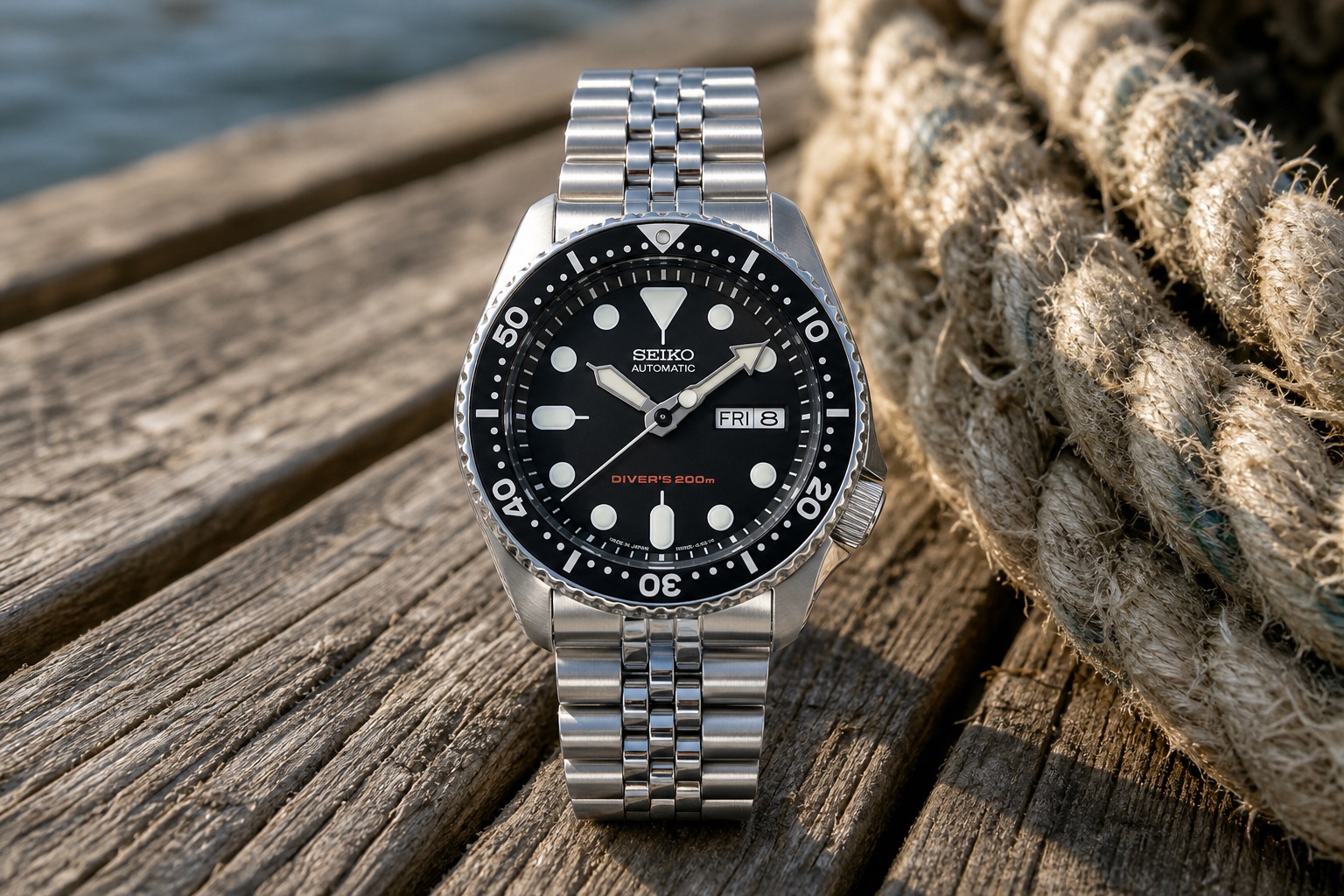
Behind that, the company was in trouble. Casio's share of Japanese watch output went from 2.2% in 1976 to 18.7% in 1985 and 28.7% in 1992 (Donzé, Watchonista). Seiko's sales fell from ¥428 billion in 1992 to ¥331 billion in 1995, and it "posted five consecutive full-year net losses, culminating in a ¥11.15 billion loss in 1996"; it also lost the 1996 Atlanta Olympics timing contract to the Swiss (Encyclopedia.com). The watch that carried the brand through those years cost a few hundred dollars: the SKX007 of 1996, a 200 m ISO-rated diver on the 7S26, a movement that neither hacked nor hand-wound (Monochrome). Fratello ranks it the most important Seiko of all, and I think that's right, because it's the watch that brought most of a generation into mechanical watches (Fratello).
AI-generated illustration.
Spring Drive is the other half of the revival, and its chronology is longer and sadder than the marketing. Yoshikazu Akahane joined Suwa Seikosha in 1971 and filed the first patent for a spring-powered, quartz-regulated watch in 1978. The 1982 prototype ran for four hours and the team gave up in 1983. A second attempt with Seiko Instruments in 1993 produced watches that ran about a day and was abandoned in 1994. The third attempt, from 1997, needed a new integrated circuit about a hundred times more efficient than the 1982 one. The technology was shown at Basel in April 1998; Akahane died that August at 52; the first Spring Drive, calibre 7R68, went on sale on 11 December 1999 (Seiko Museum). Twenty-one years, not the 28 you'll sometimes read. The Credor Spring Drive Sonnerie of 2006 and the minute repeater of 2011, built in the Micro Artist Studio at Shiojiri with finishing advice from Philippe Dufour, were the first Seiko grand complications (SJX).
The corporate story in these years is the one Seiko's history page leaves out. In July 2001 the watch business was spun off as Seiko Watch Corporation and the parent became a holding company. The trade press reported it plainly: the move "will also see the end of the Hattori family's leadership," with Reijiro Hattori moved to honorary chairman and Koichi Murano, a company man, made president (JCK). The restructuring cost about $133 million that year. Seiko Holdings took its name in 2007 and absorbed Seiko Instruments in October 2009, which ended the three-company structure after seventy years. Then, in April 2010, after a second straight year of losses, the board dismissed Murano in what Family Business Magazine called a "dramatic boardroom showdown," removed the 89-year-old Reijiro from his executive duties, and made Shinji Hattori, the founder's great-grandson, president (Family Business Magazine). Shinji called removing his uncle "a heartbreaking decision." The family was back.
Going upmarket, 2010–2026
Shinji Hattori's strategy has been to pull Seiko up the price ladder. Grand Seiko launched internationally in 2010. At Baselworld on 23 March 2017 Hattori announced that from that day Grand Seiko "lives a truly independent life," with its own name at twelve o'clock and the Seiko logo gone from the dial (Seiko). A Grand Seiko Corporation of America followed in October 2018 under Akio Naito, who had been sent to New York in 2016 and who became president of Seiko Watch Corporation in April 2021. Naito told Revolution that Grand Seiko's sales there rose more than ten times in five years (Revolution), and told Hodinkee Japan in June 2026 that overseas sales were up more than fifteen times in ten years (Hodinkee Japan).
The Seiko brand was reorganised underneath. In 2019 the SKX was discontinued and Seiko 5 Sports relaunched in its place on the hacking, hand-winding 4R36 at $295 to $350 (SJX), and aBlogtoWatch reported that Seiko had "removed over 1,000 points of sale in the United States alone" (aBlogtoWatch). King Seiko returned in 2021, and Credor was separated in 2019 and showed at Watches and Wonders in 2026. Naito has been frank about the problem he inherited. "Seiko as a brand may not be clearly understood by everybody, because the brand spans a wide range of products and prices," he told SJX in 2021 (SJX), and in 2024 he admitted the regional and shop-specific limited editions "were the drivers for our growth" and said the company was now "trying to reduce the number of SKUs" (Time+Tide).
The enthusiast complaint is the mirror image. Fratello asked in 2024 whether Seiko was "slowly losing its value-for-money image" after a €3,400 Marinemaster, and noted the 6L35 in a €3,000 King Seiko is rated to +15/−10 seconds a day, "nowhere near the chronometer standards" of a Tudor or Longines at the price (Fratello). aBlogtoWatch dated the rises to "around 2021" and called them "price increases that weren't accompanied by any quality improvements" (aBlogtoWatch). My read is that both sides are right. Seiko's cheap watches were underpriced for what they were for twenty years, and Seiko has raised prices faster than it has raised the movements inside them. The company's own answer, from its November 2025 investor briefing, is that it raised Grand Seiko prices in the US by about 5% in July 2025 against Swiss rises it puts at 15%, and that its growth comes from "a renewed appreciation for mechanical watches and reduced competition in the mid-price segment" (Seiko Group).
The numbers back the strategy so far. Seiko Group's watch business sold ¥203.1 billion in the year to March 2026, up from ¥176.0 billion, at a 13.3% operating margin (Seiko Group). Monochrome reported that as a 27% rise; the ¥27.2 billion increase is 15.4%.
What Seiko gave watchmaking
The quartz watch, with the qualification above: the Swiss built the better prototype, Seiko sold first, and the industry adopted Seiko's tuning-fork crystal and open stepping motor. Suwa's 1970 patent for the layout is on Google Patents (US 3,800,523).
The Magic Lever of 1959, which is in most Seiko automatics sold today and in the NH35 and NH36 movements Seiko's Time Module subsidiary sells to microbrands. Nobody publishes how many of those it makes a year.
The vertical-clutch, column-wheel automatic chronograph of 1969, which is the architecture most high-end chronographs use today.
Spring Drive, 1999, protected by a Seiko Epson patent family from 1997 (US 6,041,021): a mainspring-driven watch whose glide-wheel is braked electromagnetically against a quartz reference, with no battery and no escapement. Twenty-six years on, nobody else makes one.
A list of smaller firsts in Seiko's own phrasing: the first titanium diver's watch (1975), the first six-digit LCD watch (1973), the first TV watch (1982), the first analogue quartz chronograph (1983), and the first GPS solar watch with automatic time-zone detection (2012; Citizen's 2011 Satellite Wave received satellite time but didn't detect zones). I've checked none of them against a rival claim beyond what I've noted.
The end of the observatory trials. Seiko never won Neuchâtel; it did well enough that, on the observatory's own internal account, the Swiss stopped holding the contest. And it has timed every World Athletics championship since 1985, on a contract renewed to 2029 (World Athletics).
And film: Roger Moore's Seikos, Martin Sheen's 6105-8110 in Apocalypse Now, Ripley's 7A28-7000, and the 6139-6005 that Colonel William Pogue bought for $64 at a base exchange and wore, unsanctioned, for 84 days on Skylab 4 in 1973 and 1974 (Beyond the Dial).
Significant references
Seiko's catalogue is enormous and most of it was cheap, so every list like this gets argued with. Grand Seiko references after 2017 belong to Grand Seiko's own article.
| Reference | Model | Years | Why it matters |
|---|---|---|---|
| Laurel | Laurel | 1913 | Japan's first wristwatch, on Seiko's and the JSME's account |
| 3180 | Grand Seiko "First" | 1960–64 | Japan's first watch certified to Swiss chronometer grade, in-house |
| 6217-8000/8001 | 62MAS | 1965–68 | Seiko's first diver's watch, 150 m; worn on Antarctic expeditions |
| 4420-9000 | Grand Seiko 44GS | 1967–c. 1969 | First full expression of Tanaka's design rules |
| 6139-6000 to -6005 | 5 Sports Speed-Timer, "Pogue" | 1969–78 | First automatic chronograph on sale, May 1969; flown on Skylab 4 |
| 35SQ | Quartz Astron | 1969–70 | The first quartz wristwatch sold, 25 December 1969 |
| 4520-8020 | Astronomical Observatory Chronometer | 1969–70 | 226 Neuchâtel-certified wristwatches, the only such commercial release |
| 6159-7010 | Professional Diver's 600m, "Tuna" | 1975 | First titanium diver's watch; the helium-tight design without a valve |
| 7A28-7000 | Speedmaster, Giugiaro, "Ripley" | 1983 | First analogue quartz chronograph movement; worn in Aliens |
| SKX007 | Diver's 200m | 1996–2019 | The entry mechanical diver of a generation; the base of the modding scene |
| 7R68 / SBWA001 | Spring Drive | 1999 | The first Spring Drive, 500 pieces |
I don't own a Seiko. The two on my list are a 6138 Bullhead and an SSC015 solar diver, which tells you where I think the value sits: in the 1970s chronographs and the cheap tool watches, and neither in gold.
Seiko today
As of 2026, Seiko Group Corporation, renamed from Seiko Holdings in October 2022, is listed on the Tokyo Stock Exchange and run by Shinji Hattori as chairman and group chief executive, with Shuji Takahashi as president (Seiko Group). Seiko Watch Corporation, the watch subsidiary, has Hattori as chairman and Akio Naito as president (Seiko Watch). The family still owns the largest block: as of March 2024 Sanko Kigyo, a Ginza property-and-securities company that Family Business Magazine describes as the Hattori family's asset-management firm, held 10.7%, Etsuko Hattori 8.7%, Shinji Hattori 5.5% and Hideo Hattori 3.9% (Seiko Group).
The brands are Grand Seiko and Credor above, and King Seiko, Prospex, Presage, Astron and Seiko 5 Sports under the Seiko name; the "Global Brands" make up about three-quarters of watch sales and the target is 85% (Seiko Group). Mechanical Grand Seikos, Credors and the higher-end mechanical Seikos are made at Morioka Seiko Instruments in Shizukuishi, Iwate, where a studio designed by Kengo Kuma opened in July 2020; entry and mid-range mechanical assembly happens at Ninohe nearby. Spring Drive, 9F quartz and the GPS Astron are made at Shiojiri in Nagano. That plant belongs to Seiko Epson, a separate company with its own listing and its own watch brand, Orient. Seiko's securities filing calls Epson "a key supplier of wristwatches" whose dealings are "indispensable for maintaining and expanding its Watches Business" (Seiko Group). The two share Hattori roots and small cross-holdings, and that is the whole relationship. Seiko publishes no unit production figures.
Sources
- Seiko Museum Ginza: Kintaro Hattori, Episodes 1–6, and Spirit of the Founder
- Seiko Museum Ginza: History of Seiko and Its Products, Stage 1 and Stage 3
- Seiko Museum Ginza: Milestones: Mechanical Engineering Heritage, Sportsmatic 5, Observatory trials, Professional Diver's 600m, Spring Drive
- Seiko Museum Ginza: The Quartz Crisis and Recovery of Swiss Watches and Multifunctionality of quartz timepieces
- Seiko Group: History, details; Corporate Profile; FY2023 Annual Securities Report; FY2025 results presentation; FY2025 Q2 briefing Q&A
- Seiko Holdings securities report, FY2015 (EDINET)
- Seiko Watch: 100 Stories; King Seiko history; The Story of 1969 Quartz Astron; Kinetic; Grand Seiko in 2017; Corporate Profile
- Grand Seiko: History
- Epson: 80-year journey and Company history
- National Diet Library: Hattori Kintaro
- JSME: Mechanical Engineering Heritage No. 66
- Pierre-Yves Donzé, "The Watchmaking Enterprises and the Growth of a Special-purpose Machine Tool Industry in Japan (1890–1960)", Osaka Economic Papers, 2010; "The Hybrid Production System…", Enterprise & Society, 2011; "Un nouveau concurrent: Seiko", Bulletin SSC 93, 2022; "La crise horlogère suisse de 1975-1985 revue et corrigée", Le Temps, 2011; "The Watchmaking Crisis of 1975–1985" (abstract); Watchonista, History of Quartz, parts 1 and 3
- Carlene Stephens and Maggie Dennis, "Engineering time: inventing the electronic wristwatch", BJHS 33 (2000)
- Smithsonian NMAH: Seiko Quartz Wristwatch
- IEEE Milestones: Electronic Quartz Wristwatch, 1969 and Pioneering Work on the Quartz Electronic Wristwatch, 1962–1967
- Google Patents: US 3,800,523 and US 6,041,021
- Tokyo 1964 Official Report, vol. 1 (LA84 Digital Library)
- World Athletics: Seiko partnership extended to 2029
- Phillips: The Evolution of Japanese Watchmaking, Decade One; Seiko 4520-8020 lot; Three brands that made Japanese watchmaking
- Plus9Time: The Wako clock tower; Seiko and the Neuchâtel competition; The 1964 Games and Seiko; 50th anniversary of the 6139; 1988 quartz Grand Seiko; The Seiko family companies
- SJX: Seiko's history in observatory trials; Credor Spring Drive Minute Repeater; New Seiko 5 Sports, 2019; Interview: Akio Naito, 2021
- Beyond the Dial: Daini, Suwa, fact and fiction and The Seiko Pogue at 50
- Worn & Wound: Daini Seikosha; Taro Tanaka and the Grammar of Design; Giugiaro "Ripley" review
- Fratello: Seiko 62MAS; Top 10 Seiko models of all time; Roger Moore's Bond watches; Is Seiko losing its value-for-money image?
- Monochrome: The SKX007 family and 55 years of Citizen titanium
- WatchTime: Chronomania, the history of the automatic chronograph
- The Olympians: Seiko at the 1964 Tokyo Olympics
- Encyclopedia.com: Seiko Corporation (International Directory of Company Histories)
- JCK: SCA's Mitome will head new Seiko Watch Corp., 2001
- Family Business Magazine: Seiko boardroom drama, 2010
- aBlogtoWatch: Seiko moves upmarket, 2019 and What happened to Seiko?, 2025
- Time+Tide: Akio Naito interview, 2024
- Hodinkee Japan: Akio Naito on Grand Seiko's third phase, 2026