Seiko Chronograph Automatic 6138-0049
- Make
- Seiko
- Reference
- 6138-0049
- Model
- Chronograph Automatic
- Variants
- 6138-0040
- Calibre
- 6138
- Case material
- Stainless steel
- Water resistance
- 30 m (98 ft)
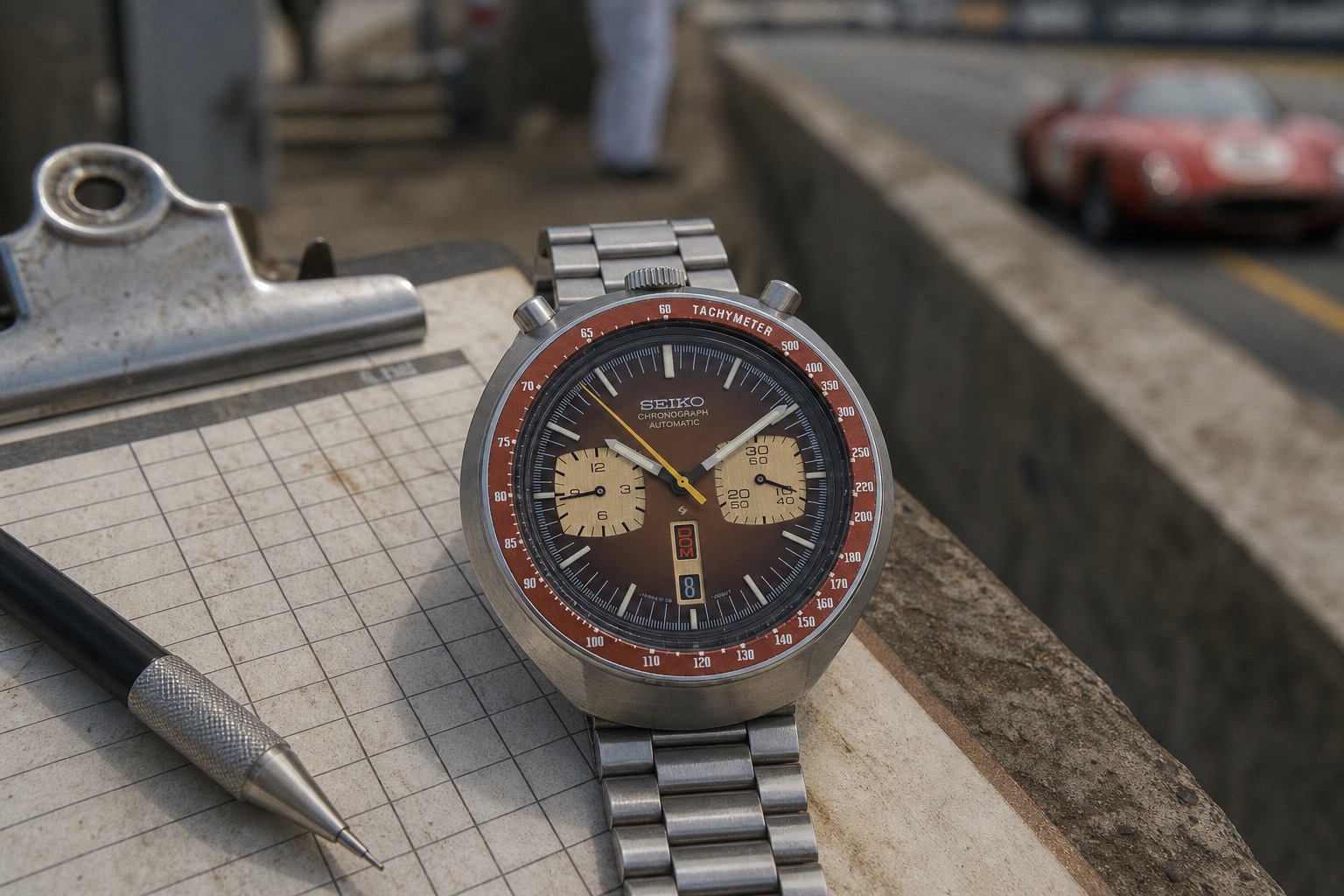
AI-generated illustration.
Seiko's own history of the automatic chronograph starts in 1969 with the calibre 6139, which the company calls "the world's first automatic chronograph with a column wheel and vertical clutch" (Seiko). The qualifiers matter, because 1969 was a race. Plus9Time's reading of Suwa Seikosha's own records puts the 6139 on sale on 21 May 1969, after the Heuer, Breitling and Hamilton group and Zenith had both announced their automatic chronographs and before either reached shops (Plus9Time). A year later Seiko followed it with the 6138, which added a 12-hour register and could be wound by hand.
The Seiko Chronograph Automatic 6138-0049 is a 6138 in the case collectors call the Bullhead, and it's the watch Seiko USA put on the front of its 1975 dealer catalogue. Open that catalogue and page one is about quartz, under the line "Changing the world's standard of accuracy." So a mechanical chronograph fronts a book that opens by selling the technology that would replace it. I find that a fitting place for a watch this odd-looking: the last generation of Seiko's first automatic chronograph line, in its loudest case, on the cover just as the company turned toward quartz.
I don't own one. I want one, and I'll say which I'd look for at the end. Everything here comes from the 1975 catalogue, Seiko's own history pages, and the collectors who've documented the Bullhead, and where they disagree I'll say so.
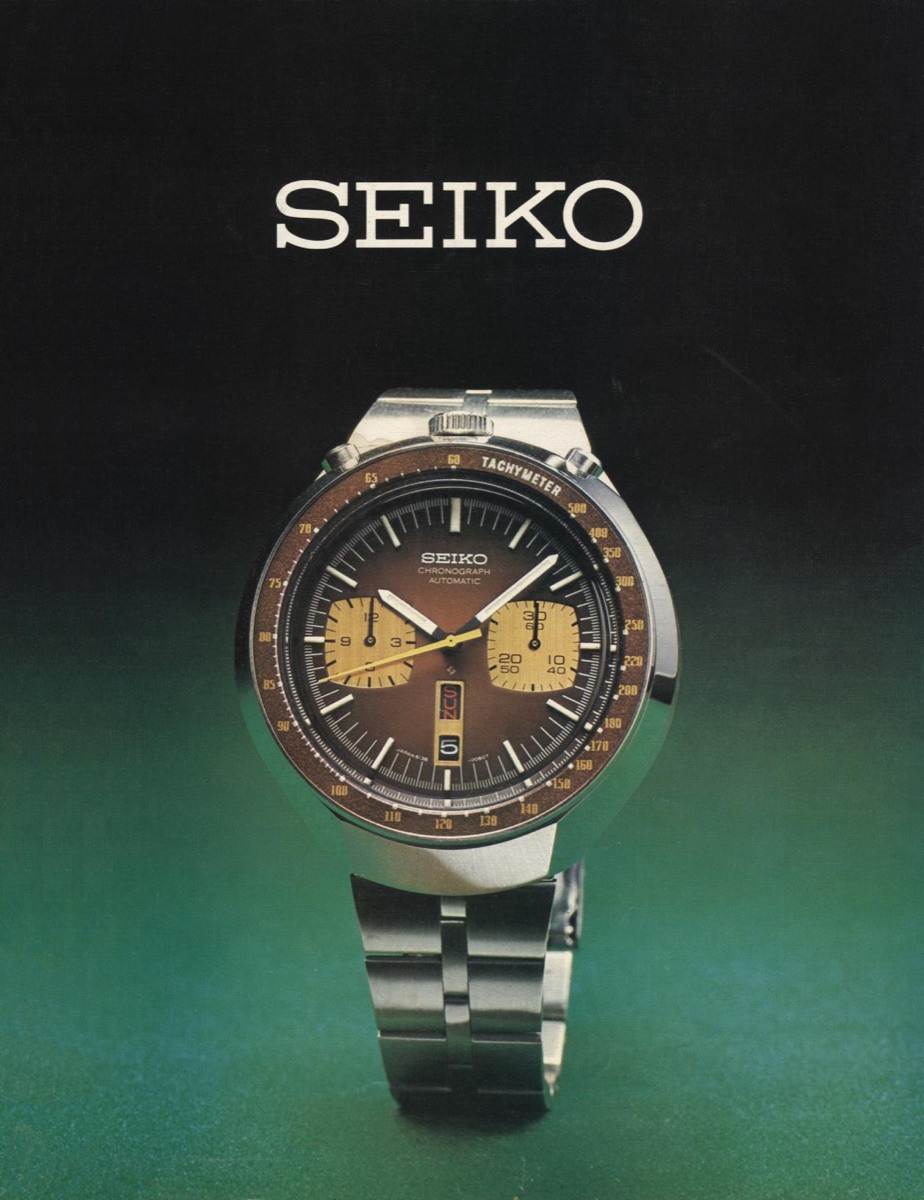
The cover of the 1975 Seiko USA dealer catalogue. Scan from Plus9Time's Seiko catalogue archive.
Where it came from
The 6139 was a Suwa Seikosha project. Seiko made watches in two separate companies then, Suwa and Daini, and Worn & Wound's history of Daini describes "Suwa's 6139 and later twin-register 6138" as one line, with Daini building its own, unrelated chronograph (Worn & Wound). The 6139 had one register, counting 30 minutes. In Japan it was sold as the Speed-Timer, a name Plus9Time traces to a June 1969 Suwa newsletter (Plus9Time).
The same Plus9Time article sets out the race in dates. Suwa began mass-producing 6139 movements and case parts in October 1968, and the earliest known watches date from January 1969. Zenith announced its automatic chronograph that January but didn't have it on sale until the third quarter. Heuer, Breitling and Hamilton announced their joint Chronomatic on 3 March 1969 and sold it from July. The 6139 went on sale on 21 May. Who was "first" depends on whether you count the announcement or the shop counter, and Seiko's own careful wording, first with a column wheel and vertical clutch, avoids the argument.
The 6138 arrived in Seiko's "1970 No. 2" catalogue as the twin-register version, with a 12-hour counter beside the minutes (Plus9Time). Fratello's Michael Stockton describes it as column-wheel and vertical-clutch equipped like its predecessor, and points out that it can be hand-wound, which the 6139 can't (Fratello). Seiko put the calibre in many different cases through the 1970s. The Bullhead came late in that run.
Nobody seems sure exactly when. The WatchUSeek collectors' buying guide, the most detailed public document on this watch, says its resident expert had never seen one made before 1974, until a member bought a black-dial example from its original owner that dated to November 1973 (WatchUSeek buying guide). Fratello puts its birth "in roughly 1973" (Fratello). Both have it running until the 6138 itself ended in 1978 or 1979. Dealer listings often give 1975 to 1978 for the 0049 specifically, but none says where that comes from, and the only date I can document for the 0049 itself is the 1975 catalogue.
That catalogue is the best primary source there is for this reference. It's a 48-page Seiko USA dealer book, and Plus9Time's Anthony Kable identified the cover watch as "the AV033M 6138-0049 brown bullhead chronograph" (Plus9Time). AV033M is Seiko's catalogue number, and the same AV033 code turns up against the 0049 in parts databases (The Seiko Guy). The catalogue gives no prices, so I don't have a launch price. I also found no source that names a designer. The Bullhead's design is, as far as any document I could find goes, uncredited.
One story to clear up: a Seiko automatic chronograph did go to space, on astronaut William Pogue's wrist aboard Skylab 4 in 1973 and 1974, but it was a 6139 (Beyond the Dial, Plus9Time). I found no source tying a 6138, let alone a Bullhead, to that flight.
The watch
Inside the catalogue, the AV033M sits on page 9 under the headline "The Self-Winding Chronograph," described simply as "Stainless steel, tachymeter timer, sable brown dial." The specification line above it covers the 6138 models on that page, and it's the most authoritative spec for the 0049 I found.
The facing page makes the comparison for you. It's headed with the same words, "The Self-Winding Chronograph," and shows six 6139 models with their own spec line: "17j" and a "30 minute recorder," with no mention of hand-winding. Side by side, the two pages show what the 6138 added in Seiko's own terms: four more jewels, a 12-hour recorder, and a crown you can wind. Page 9 also has two black-dial 6138s in other cases, the AV017M and the AV003M, so the Bullhead was one 6138 among several in the 1975 American range. It was the one on the cover.
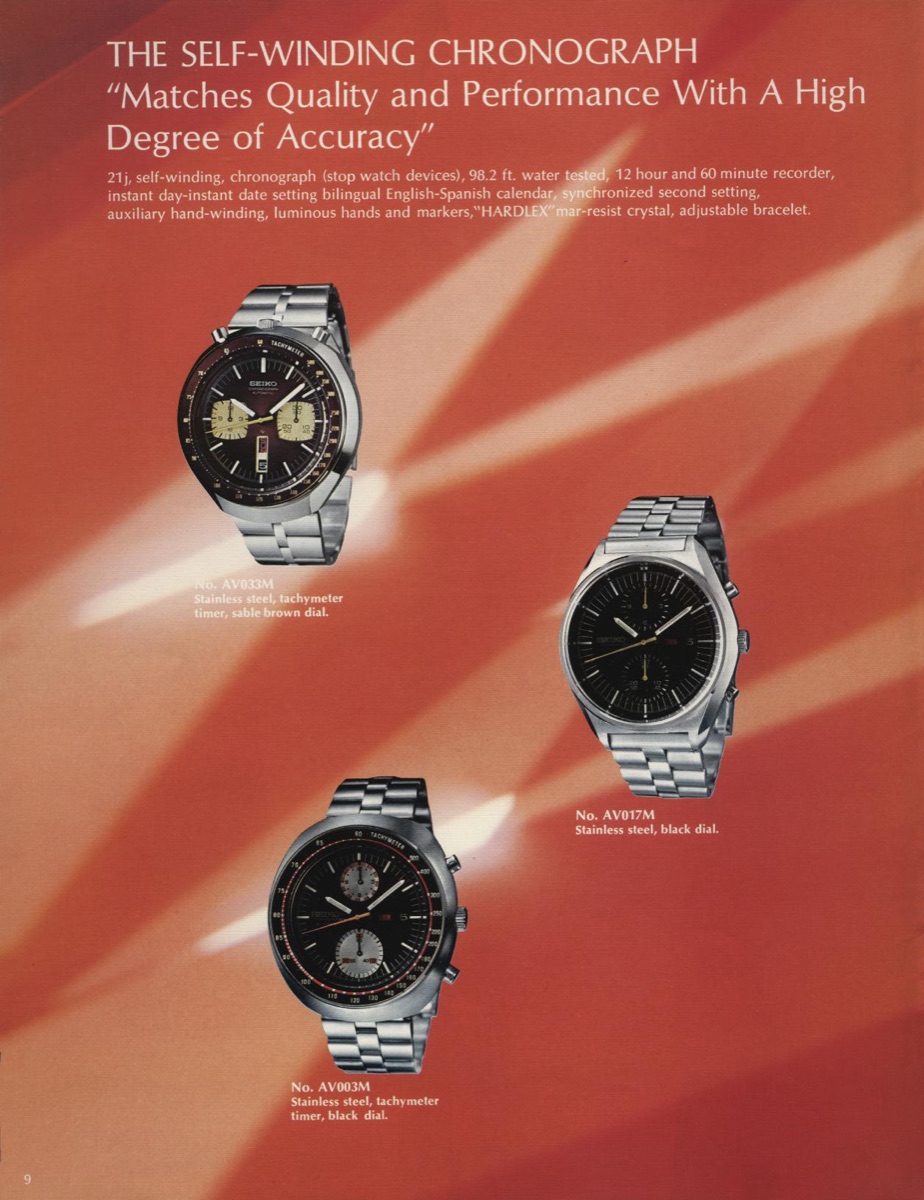
Page 9 of the 1975 Seiko USA dealer catalogue, with the AV033M at top left. Scan from Plus9Time's Seiko catalogue archive.
| Spec | Value |
|---|---|
| Catalogue number | AV033M (Seiko USA, 1975) |
| Calibre | 6138, automatic with hand-winding; the 0049s I've seen listed carry the later 6138B |
| Jewels | 21 (1975 catalogue) |
| Frequency | 21,600 vph (Vintage Watch Inc) |
| Functions | Hours, minutes, chronograph seconds, 60-minute and 12-hour registers, day and date |
| Chronograph | Column wheel, vertical clutch (Fratello) |
| Case | Stainless steel, about 44 mm (method unstated in every source), crown and pushers at the top |
| Lug width | 20 mm (WatchUSeek) |
| Crystal | Seiko Hardlex mineral glass, flat with a bevelled edge |
| Bezel | Fixed, with a brown tachymeter scale on the brown-dial watch |
| Water resistance | "98.2 ft. water tested" (30 m) |
| Calendar | Day and date, bilingual English and Spanish |
| Bracelet | Folded steel fishbone with a stamped folding clasp |
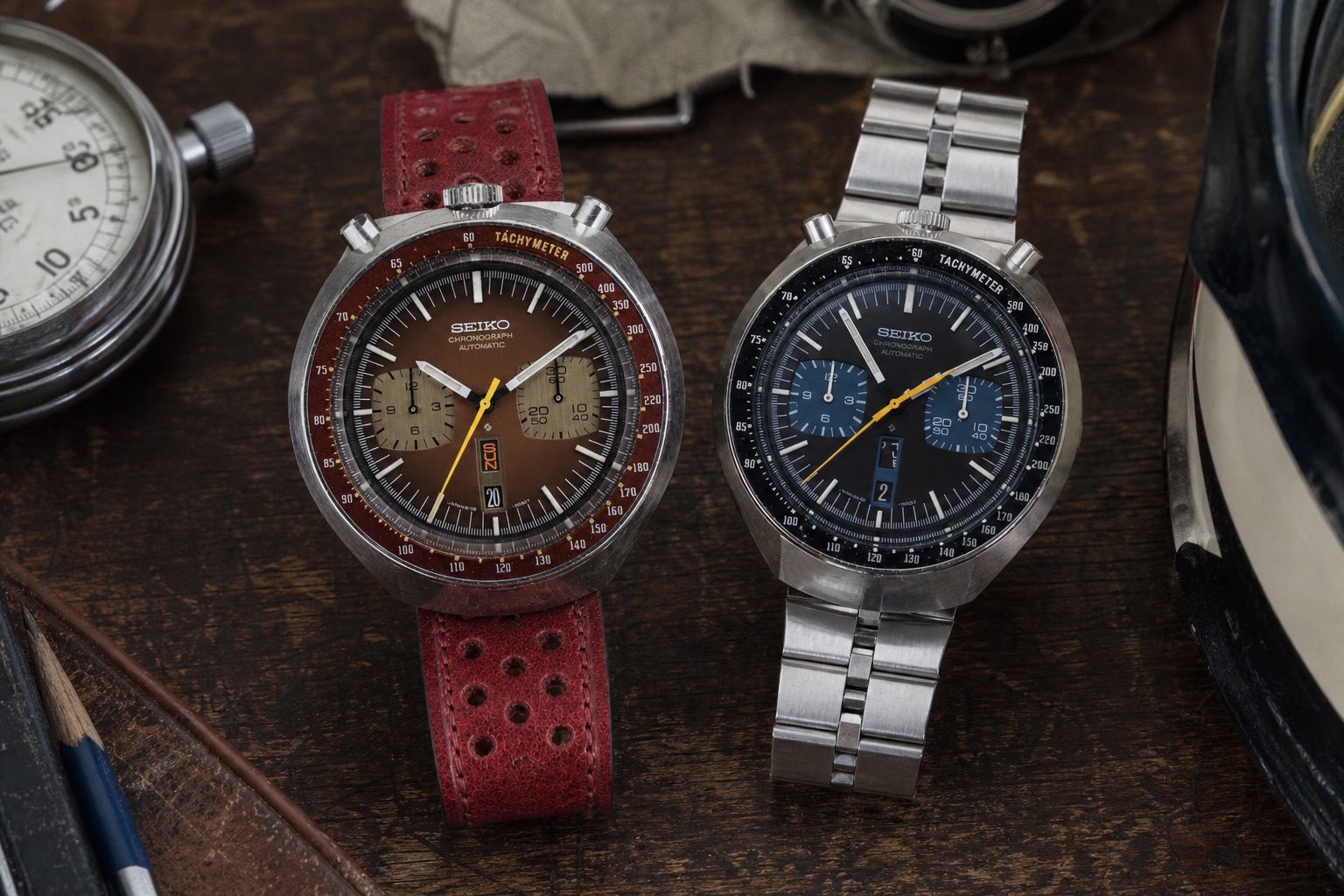
The case is the whole point. Seiko turned the movement through 90 degrees, so the crown sits at 12 o'clock with a pusher on either side, and the lugs hide under the body of the case. That arrangement is where the name comes from: a crown and two pushers on top read as a bull's head and horns (Fratello). Stockton gives the case as 44 by 45 mm. Dealers list 43.5 or 44 mm, and none says how they measured it. The buying guide calls it "one of the thickest 6138's but definitely not the biggest," and warns that it sits high on the wrist.
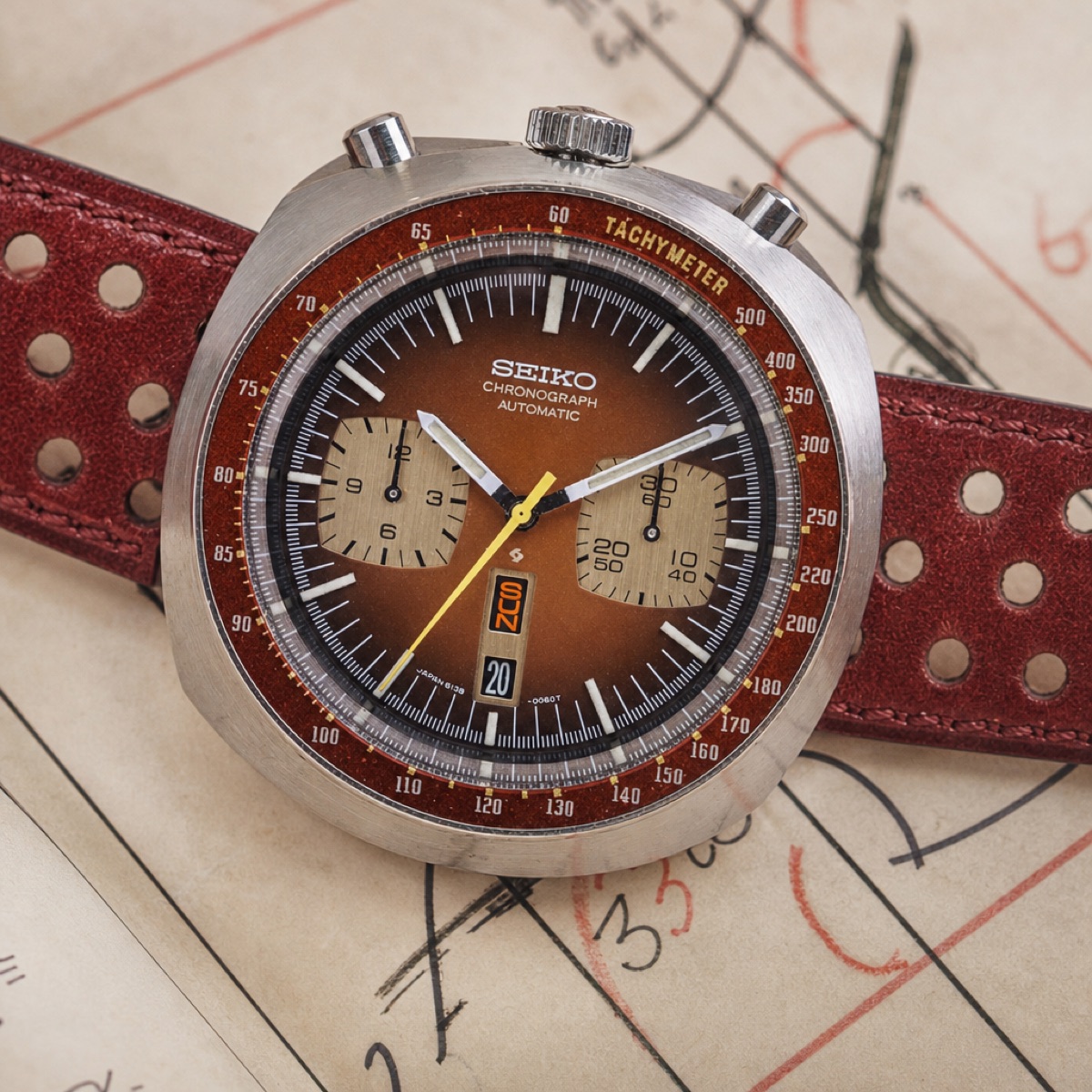
AI-generated illustration.
Two details from the spec line surprise people. There's no running seconds hand. When the chronograph is stopped, only the hour and minute hands move, and everything else sits at zero (WatchUSeek). And the catalogue's "auxiliary hand-winding" is the 6138's practical improvement over the 6139. The guide adds that the crown doesn't screw down, which matters on a watch whose crown points away from the hand and takes the knocks.
The water rating is modest. Seiko's own line says "98.2 ft. water tested," which is 30 metres, and the guide is blunt that after fifty years a Bullhead can be dust-sealed with new gaskets but probably not made waterproof again.
How it changed
The Bullhead didn't change much in the five or six years it was made, and nobody has published serial ranges for its changes. Seiko serials do date the watch, though: the first digit of the caseback serial is the last digit of the year and the second is the month, with 0, N and D for October, November and December (Plus9Time). A Bullhead made in July 1976, for example, should have a serial starting 67. Check that against the movement before you trust a seller's date. The dates below are approximate.
| When | What | Source |
|---|---|---|
| 1969 | Calibre 6139 on sale, single 30-minute register | Seiko, Plus9Time |
| 1970 | Calibre 6138 in the "1970 No. 2" catalogue, adding the 12-hour register and hand-winding | Plus9Time |
| November 1973 | Earliest dated Bullhead the buying guide's contributors had seen, a black-dial watch | WatchUSeek |
| 1975 | AV033M 6138-0049 on the cover of the Seiko USA catalogue | Seiko, Plus9Time |
| Later 1970s | 6138B replaces 6138A, with a "modified switching mechanism" | Vintage Watch Inc |
| 1978–79 | End of 6138 production, and of the Bullhead | WatchUSeek, Fratello |
The movement change is the only real one. Vintage Watch Inc says the later 6138B has a modified switching mechanism, and that the 6138A has 21 jewels while the 6138B has 21 or 23 depending on the model (Vintage Watch Inc). The 1975 catalogue's "21j" is the figure that applies to the 0049 as Seiko USA sold it. The 0049s I found in dealer listings carry the 6138B, one with a movement dated May 1977, but those are listings, and I wouldn't build a rule on them.
The variations that matter
0049 or 0040
The Bullhead comes with two caseback references, and the difference is where it was sold. The buying guide says the standard version, with "Chronograph Automatic" under the Seiko logo, "can be marked either as '6138-0049' or '6138-0040' (depending on what market the watch was originally sold in)" (WatchUSeek). The Japanese-market SpeedTimer versions are a different matter. The guide says they should all be marked 6138-0040, while admitting that this is "not confirmed."
I'd treat that as a strong rule of thumb. At least one dealer has listed a 0049 with a SpeedTimer dial, which is either the exception the guide allows for or a dial that came from another watch. The 1975 catalogue fits the pattern, at least: an American dealer book, with a "Chronograph Automatic" dial on a watch Plus9Time identifies as a 0049.
Dials
There are two colourways. The guide describes "a reddish brown version with gold sub-registers and a black version with steely blue sub-registers," and Fratello agrees (Fratello). Seiko's own name for the brown, in the 1975 catalogue, is "sable brown." On the cover, the dial fades from a lighter centre to a darker edge, and the two sub-registers are gold rectangles: the 12-hour counter on the left, the 60-minute counter on the right.
AI-generated illustration.
Every black Bullhead and the standard brown ones read "Chronograph Automatic." Only the brown came in the Japanese SpeedTimer versions, marked either "Seiko SpeedTimer" or "Seiko 5Sports SpeedTimer" at the top of the dial, and the guide says Seiko never made a black SpeedTimer.
The hands are where franken watches give themselves away, so the guide's list is worth having:
- Hour and minute hands are straight and white with a lume insert, except on brown SpeedTimers, which have none.
- Sub-register hands are black on brown dials and white on black dials, and neither they nor the register markers are lumed.
- The chronograph seconds hand is yellow on standard brown and black watches, and maroon on brown SpeedTimers.
- Day and date wheels read vertically. Most are English and Spanish, as the catalogue says, though English and Arabic exist too, and English and Kanji wheels belong to SpeedTimers only.
Bracelets
The standard bracelet is a folded steel fishbone with a stamped steel folding clasp. The guide warns against the straight expanding bracelets often fitted to these watches, and gives a simple test: every original Bullhead bracelet is wider at the top of the case than at the bottom. A symmetrical bracelet isn't original. SpeedTimers came on a folded oyster-style bracelet with a clasp signed for the model (WatchUSeek). The hidden lugs make finding a strap that looks right hard, which is one more reason an original bracelet matters.
Co-branded and special dials
I found none documented on the 0049: no retailer names, no commissioned dials, no named errors. That's absence of evidence, and it fits the watch. This was a catalogue chronograph sold through ordinary dealers, and the variations collectors care about are market ones (the SpeedTimer dials) and the two colours.
Why it matters
The Bullhead isn't rare. The buying guide says so directly, calling eBay claims of rarity "just not true," while noting high demand from collectors in Europe and North America. What makes it matter is where it sits in the line. It's the last and strangest case for the movement family Seiko built to compete in 1969, and Seiko USA thought it was striking enough to put on the cover of the catalogue that introduced its quartz range.
My read is that this is why it's collected. Seiko made plenty of handsome 6138s. The Bullhead is the one that looks like nothing else, in a way that's very much of the mid-1970s, and it was made by a company that, six years before that catalogue, had been racing Heuer, Breitling and Zenith to put an automatic chronograph on sale. If I buy one, it'll be a brown 0049 like the one on the cover.
What I'd check before buying one
The guide is a better checklist than anything I'd write from scratch, so these come from it unless I say otherwise.
- Dial and hands against the lists above: vintage Watch Inc calls the Bullhead "one of the most faked / franked models" (Vintage Watch Inc). Look for paint blobs where the hands meet their posts.
- Crown and stem: replacement crowns and broken stems are common because the crown sits on the outside of the wrist.
- Crystal: it should be a flat Hardlex that barely sits above the bezel. A domed acrylic or a crystal that stands proud is a replacement.
- Case finish: the original mixes brushed and polished surfaces with defined creases along the sides. Rounded creases mean it's been badly refinished.
- Caseback threads: look inside the case and at the caseback threads for corrosion. Too much pitting stops the caseback closing properly.
- Chronograph function: start, stop and reset every hand. Repairers on forums single out a worn vertical clutch in the 6138 and 6139 as a big potential problem, with parts hard to find (Watch Repair Talk).
- Bezel insert: expect scratches. The guide says perfect inserts are hard to find.
I've left prices out. The guide's figures are years old, and the dealer prices I found weren't dated.
Sources
- Seiko, 1975 Seiko USA dealer catalogue, cover and page 9 (scan hosted by Plus9Time)
- Seiko, Chronograph Historical Collection
- Anthony Kable, Plus9Time, 1975 Seiko USA Dealer Catalog
- Plus9Time, 50th anniversary of the first automatic chronograph
- Plus9Time, The true Seiko Pogue chronograph, 6139-6005
- WatchUSeek, How to buy a Seiko 6138-0040/0049 "Bullhead" chronograph: a collector's buying guide
- Michael Stockton, Fratello, #TBT The Seiko Bullhead 6138-0040, 1 December 2016
- Worn & Wound, Daini Seikosha
- Vintage Watch Inc, Seiko 6138 chronograph guide
- Beyond the Dial, Seiko Pogue
- The Seiko Guy, 6138-0049
- Watch Repair Talk, Chronograph not keeping good time thread