Ulysse Nardin Freak 010-88
- Make
- Ulysse Nardin
- Reference
- 010-88
- Model
- Freak
- Variants
- 016-88
- Production
- 2001–present (in production)
- Calibre
- UN 01
- Case material
- 18K white gold
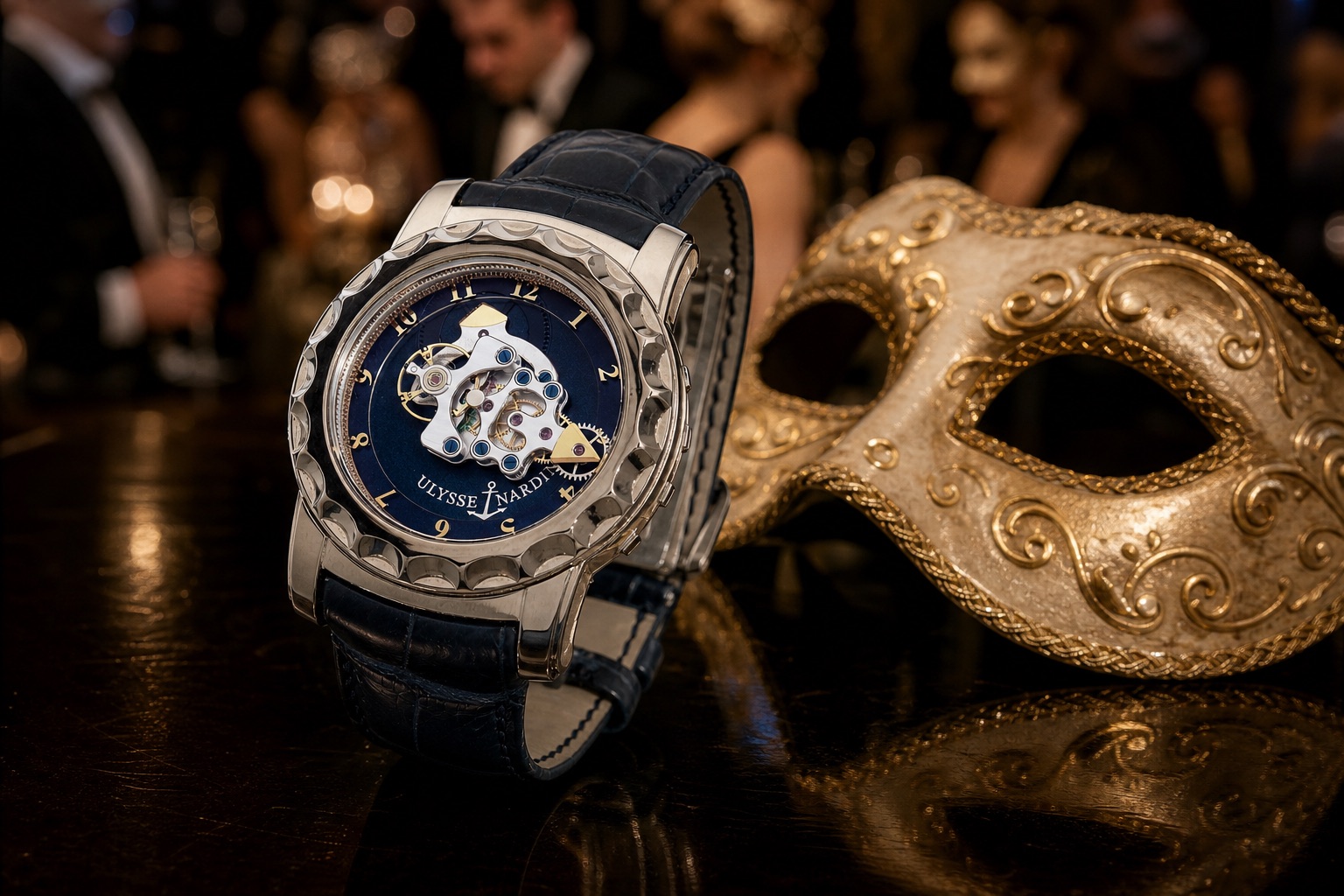
AI-generated illustration.
In 2001 Ulysse Nardin put a watch on the market with no hands and no crown. The Ulysse Nardin Freak 010-88 told the time by turning its whole movement around the case once an hour, so the movement itself was the minute hand. You wound it by turning the caseback and set it by turning the bezel. And at the centre of it, the brand says, were the first silicon escape wheels ever fitted to a mechanical watch (Ulysse Nardin). That's the claim the Freak lives on.
Rolf Schnyder had relaunched the brand in 1983, and its comeback was built on astronomical watches such as the 1985 Astrolabium Galileo Galilei (Time+Tide). The Freak pointed it somewhere else. In 2026, the Freak's 25th year and the brand's 180th (Haute Time), Ulysse Nardin counts "35 patents and 17 calibers" from the line (UN press release, via Europa Star). The line runs from a titanium model that launched at US$21,000 to a white gold double tourbillon at CHF 320,000. This article starts with the 010-88, because every Freak since is a variation on what it did, then walks the family out to both ends.
Where it came from
Who gets credit for the Freak depends on who you ask, and the three answers don't fully agree.
Ulysse Nardin's own 2026 release says the Freak was "conceived by Dr. Ludwig Oechslin in 2001" (Europa Star). Phillips tells a longer story. One of its catalogue essays says the Freak was "envisioned by Rolf Schnyder", and that "the concept of awarded watchmaker Carole Forestier-Kasapi was transformed into reality" through Oechslin's hands (Phillips). Another essay says plainly that the Freak "was designed by Carole Forestier Kasapi and executed by" Oechslin (Phillips). SJX traces Forestier-Kasapi's part to the original revolving-movement concept, which won her the 1997 Prix de la Fondation Abraham-Louis Breguet (SJX).
I read those as compatible more than contradictory. Schnyder, whom the brand credits with driving the project (Ulysse Nardin), wanted the watch. Forestier-Kasapi's prize-winning concept gave it its shape. Oechslin turned the concept into a movement that worked, including the escapement that made it famous. But the brand now names one man, and the auction houses name three people. If you repeat any single version as settled, someone will correct you.
The escapement and the silicon
The heart of the 010-88 is Oechslin's Dual Direct escapement. Two escape wheels give impulse directly to the balance, an idea in the line of Breguet's échappement naturel (SJX). Ulysse Nardin credits Pierre Gygax with proposing that the two wheels be made of silicon (Ulysse Nardin). Phillips notes the silicon wheels ran without lubrication (Phillips). Antiquorum's cataloguers describe "two crystal silicon impulse wheels" (Antiquorum). An April 2008 history of the line says the original had "reliability problems" with its escapement, which led to the modifications that followed (Watchprozine).
The "first" needs some care. Ulysse Nardin says the Freak was "the first mechanical watch in history with silicon escapement wheels" (Ulysse Nardin). Phillips goes further: "at the time it was the first wristwatch to incorporate silicon components" (Phillips). Both are the brand's story, and the brand and the auction house have reasons to tell it well. No source I read disputes it, so I'd repeat it with the qualifier attached.
The launch
The Freak was shown at the Basel fair in 2001 (Ulysse Nardin, Phillips). One Antiquorum essay dates the escapement's introduction to 2000 (Antiquorum), but every other source I read says 2001. Time+Tide has the best story from the launch: Schnyder and Oechslin went on stage in carnival masks (Time+Tide). Only that one source tells it, so treat it as a good anecdote and not as history. The same piece says many collectors and journalists thought the watch ugly but were impressed by what it did. That still describes most first reactions to a Freak.
It wasn't cheap. A 2008 history gives the original's retail price as $26,800, "a formidable sum" (Watchprozine). That's the only launch price I found, and I couldn't find a Swiss franc figure.
The watch
The 010-88 is the first-generation Freak in 18K white gold. The specification below comes from auction catalogues, because no 2001 press kit was reachable.
| Spec | Value |
|---|---|
| Reference | 010-88 (18K white gold) |
| Launched | 2001, Basel |
| Case diameter | 43 mm (Phillips) or 42 mm (Phillips); see below |
| Case | Three-body, 18K white gold, sapphire crystal and sapphire display back |
| Calibre | UN 01, manual winding, 32 jewels |
| Frequency | 21,600 vph (3 Hz) in the first series |
| Power reserve | About seven days |
| Regulator | One-hour carrousel: the whole movement turns once an hour |
| Escapement | Dual Direct, with two silicon escape wheels |
| Display | Movement bridge as minute hand; lower bridge points to the hour |
| Winding | Turn the caseback |
| Setting | Turn the notched bezel |
| Strap | Crocodile, with an 18K white gold deployant clasp |
| Water resistance | Not stated in any source I read |
The display takes a minute to read. The baguette-shaped movement sits on top of the dial plate and turns once an hour, carrying the balance and escapement round with it. Its tip is the minute hand. A lower bridge points to the hour. Phillips puts it this way: "time is indicated by the rotation of the movement, with the lower bridge indicating the hour", and the watch "is wound by rotating the case back, while time-setting is accomplished through the bezel" (Phillips). Under the movement, the mainspring spans nearly the full width of the case. That's how a manually wound watch from 2001 got a week of running.
The carrousel is why the watch is more than a curiosity. The idea is the tourbillon's: keep the regulating organ turning so its errors in different positions even out. Here the cage is the entire movement. Antiquorum calls it a "60-minute flying tourbillon/carrousel" (Antiquorum). I think that's the clearest way to describe what you're looking at.
The case size question
Two Phillips catalogues describe the same reference and disagree on its size. Lot 898, a 010-88 dated circa 2001 with case number 208, says "43mm diameter". Lot 56, a 010-88 dated circa 2003 with case number 165, says "42mm Diameter". Antiquorum also gives 43 mm for both the white gold 010-88 and the pink gold 016-88. I've used 43 mm, but measuring method could explain the gap. I found no factory figure. Thickness is also missing for the 010-88. Antiquorum gives 11 mm for a pink gold 016-88 (Antiquorum).
Sister references
The first generation came in more than one metal. The pink gold version is reference 016-88, documented by Antiquorum with a 43 mm case and the same seven-day movement (Antiquorum). The platinum 029-80 is the Diamond Heart, an edition of 99 that I cover below. Antiquorum mentions a plain platinum version, but I couldn't find its reference.
How it changed
The Freak never stood still for long. This table covers the main generations whose details I could confirm. Prices are launch prices in the currency the source gave, so they don't convert cleanly into one another.
| Year | Model | Calibre | Case | What changed | Launch price |
|---|---|---|---|---|---|
| 2001 | Freak (010-88) | UN 01, manual | 43 mm 18K white gold | The original: rotating movement, silicon escape wheels | $26,800 |
| 2005 | Second series | Not stated | Not stated | Balance raised to 28,800 vph | Not found |
| 2005 | Diamond Heart (029-80) | Not stated | Platinum | Synthetic diamond escapement parts; edition of 99 | Not found |
| 2007 | DIAMonSIL | Not stated | Not stated | Diamond-coated silicon | Not found |
| 2010 | Diavolo (2080-115) | Manual, 184 h | 45 mm white gold | Adds a flying tourbillon | CHF 138,000 |
| 2013 | Cruiser | UN-205, manual | 43 mm rose or white gold | Maritime styling; the UN-205 | Not found |
| 2015 | FreakLab | Not stated, 8 days | 45 mm white gold | Oscillator moved to the centre | Under CHF 100,000 |
| 2018 | Freak Vision (2505-250) | UN-250, automatic | 45 mm platinum | First automatic Freak | CHF 95,000 or 98,000 |
| 2018 | Freak Out | UN-205, manual, 7 days | 45 mm titanium | Cheapest Freak yet | CHF 48,000 |
| 2019 | Freak X | UN-230, automatic, 72 h | 43 mm | Adds a crown | From US$21,000 |
| 2022 | Freak S | UN-251, 72 h | 45 mm rose gold, ceramic, titanium | Twin balances joined by a differential; 75 pieces | US$137,000 |
| 2023 | Freak ONE | UN-240, automatic | 44 mm DLC titanium | DIAMonSIL escapement, automatic | CHF 65,000 |
| 2026 | Freak X (41 mm) | UN-232, automatic, 72 h | 41 mm steel or rose gold | Smaller case, 100 m | CHF 33,500 to 52,000 |
| 2026 | Super Freak | UN-252, automatic | 44 mm white gold | Two flying tourbillons; 50 pieces | CHF 320,000 |
Sources: Ulysse Nardin, Phillips, GPHG, Haute Time, Monochrome, SJX, Monochrome, SJX, SJX, Monochrome, Revolution, Revolution.
For the first decade the Freak changed through its materials. In 2005 a second series sped the balance up to 28,800 vph (Phillips). The same year came the Diamond Heart, whose escapement parts were made in synthetic diamond (Watchonista, Haute Time). By 2008, Watchprozine reported that "the price point of the marvelous diamond escape wheels on the Diamond Heart was just too prohibitive", and they were dropped. In 2007 DIAMonSIL followed, silicon coated in diamond, which Ulysse Nardin still uses (Ulysse Nardin).
The Diavolo of 2010 added a flying tourbillon inside the rotating carrousel, with more than eight days of power reserve and a 28,800 vph balance (GPHG). A couple of trade pieces date it 2011, but the GPHG record and Ulysse Nardin's own timeline both say 2010. The Cruiser of 2013 used the UN-205 (Haute Time), the calibre that would carry a much cheaper Freak five years later.
The second decade is about two things: getting the price down and making the watch automatic. The InnoVision 2 concept shown at SIHH 2017 carried ten patents (Revolution), and its self-winding "Grinder" system and all-silicon anchor escapement went straight into the Freak Vision a year later, the first automatic Freak (SJX). The Freak Out of 2018 put the simpler UN-205 in a titanium case at CHF 48,000. Monochrome called it "the most affordable version so far" (Monochrome). Then the Freak X broke the rule the original was built on.
The cheap end
The cheapest Freak ever, by launch price, is the 2019 Freak X. SJX gave the four launch references and their prices before tax: Ti Blue 2303-270/03 and Ti Black 2303-270/BLACK at US$21,000, Carbonium 2303-270/CARB at US$24,000, and rose gold 2305-270/02 at US$30,000. As SJX put it, "Last year's Freak Out was announced as the entry-level model to the Freak range, but it didn't hold the title for long" (SJX).
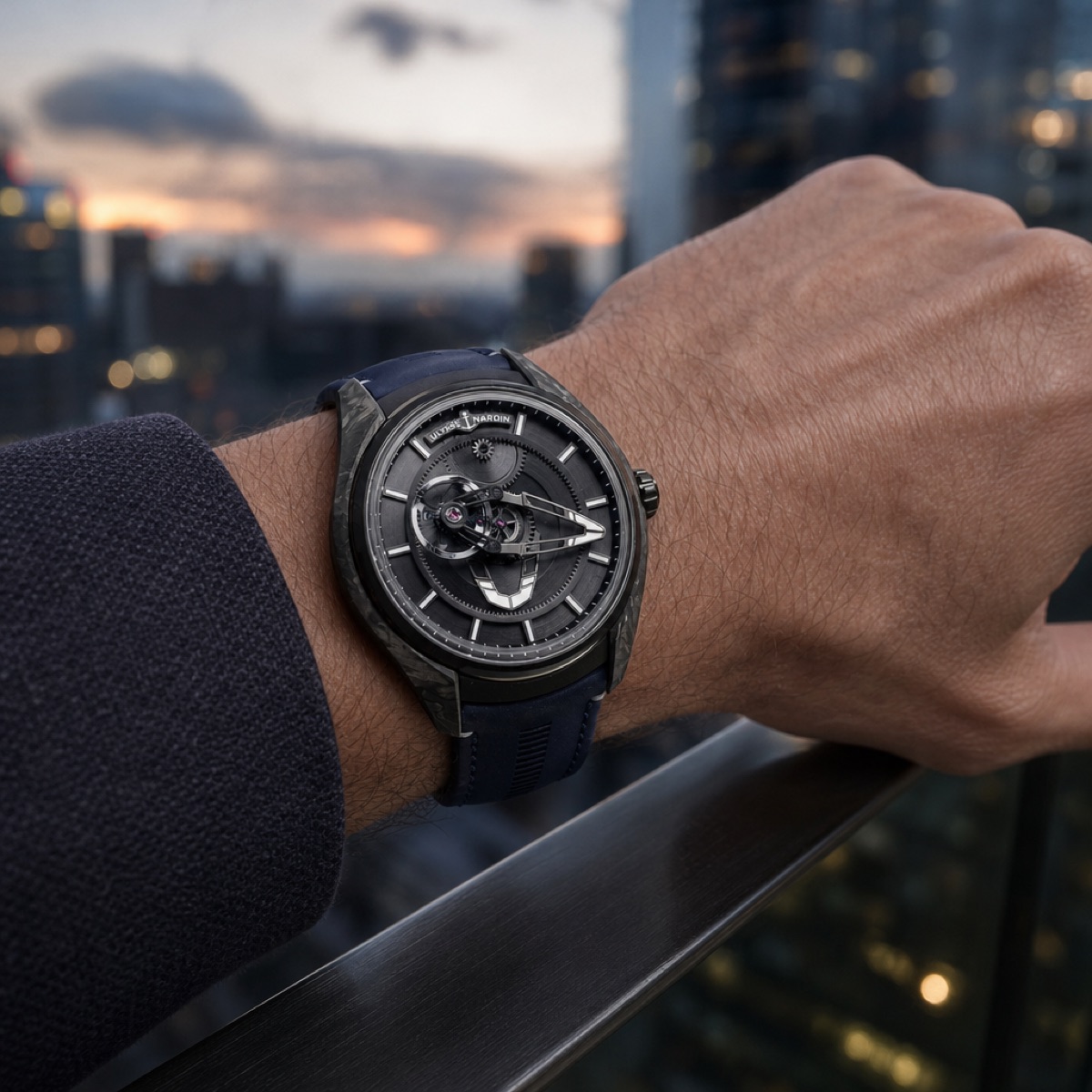
AI-generated illustration.
What you gave up for that price is a list of the things that made the original strange. The Freak X "now has a crown for time setting", and because the crown only sets the time, the watch can't be wound by hand: it's automatic only. "Unusually for a Freak, it has a short, 72-hour power reserve, instead of the one-week that was typical of earlier models" (all SJX). Monochrome adds that the UN-230 drops the anchor escapement, the Grinder and the silicon gear train, though it keeps a silicon balance (Monochrome). The movement still turns to show the minutes.
My read is that the crown is the honest compromise. A Freak you can set without a manual is a Freak people will actually wear, and I'd rather have one on a wrist than in a safe. A purist would say the opposite, that a crown on a Freak misses the point. Both views hold up.
The 2026 Freak X sits at the bottom of the current range. It shrinks the case from 43 to 41 mm, brings lug-to-lug down from 49.6 to 47.3 mm and adds 100 m of water resistance, with the new UN-232 at 3 Hz and 72 hours (Europa Star). Revolution gave Swiss prices including VAT of CHF 33,500 for the grey, CHF 34,500 for the blue on an integrated steel bracelet and CHF 52,000 in gold (Revolution). So the cheapest new Freak costs more than the 2019 one did. I'd guess seven years of inflation and a new movement account for most of the gap, but nobody has broken it down.
The cheapest way into a Freak may be the secondary market. A brand new Freak X made in 50 pieces for the Japanese retailer Yoshida sold at Antiquorum Geneva in May 2026 for CHF 20,000 (Antiquorum). The original costs less than you might think too. Phillips sold a white gold 010-88, circa 2003, for CHF 22,860 in spring 2024 (Phillips), and Oracle of Time put a pre-owned original at "around £18,000" in April 2026 (Oracle of Time). By those numbers the watch that started it all sells for less than a new 41 mm Freak X.
The far end
At the other end, the Freak became the brand's way of showing what it could build, and the prices went with it.
The Freak S of 2022 had two silicon balances, and SJX explains that "the vertical differential allows the two balance wheels to beat at slightly different rates". It came in a 45 mm case of rose gold, ceramic and titanium, limited to 75 pieces at US$137,000 (SJX).
The Super Freak of 2026 takes that further and puts each balance in its own flying tourbillon. Revolution describes "twin titanium flying tourbillons" that "rest at a 10-degree incline, and rotate in opposite directions", joined by a differential it calls "the world's smallest at 5mm". The calibre is the UN-252, "the result of four years of R&D", and the movement has 511 parts. It sits in a 44 mm white gold case 16.54 mm thick, with 30 m of water resistance. Revolution lists it at CHF 320,000, "limited to 50 pieces" (Revolution). A Blog To Watch gives a US price of US$393,600, though the same article states the edition as both 25 and 50 (A Blog To Watch), so I've gone with Revolution's 50. Revolution calls it the "world's first-ever automatic double tourbillon (and a carousel to boot)", and A Blog To Watch reports the brand's claim that it's the most complicated time-only watch ever made. Nobody I read has tested either claim.
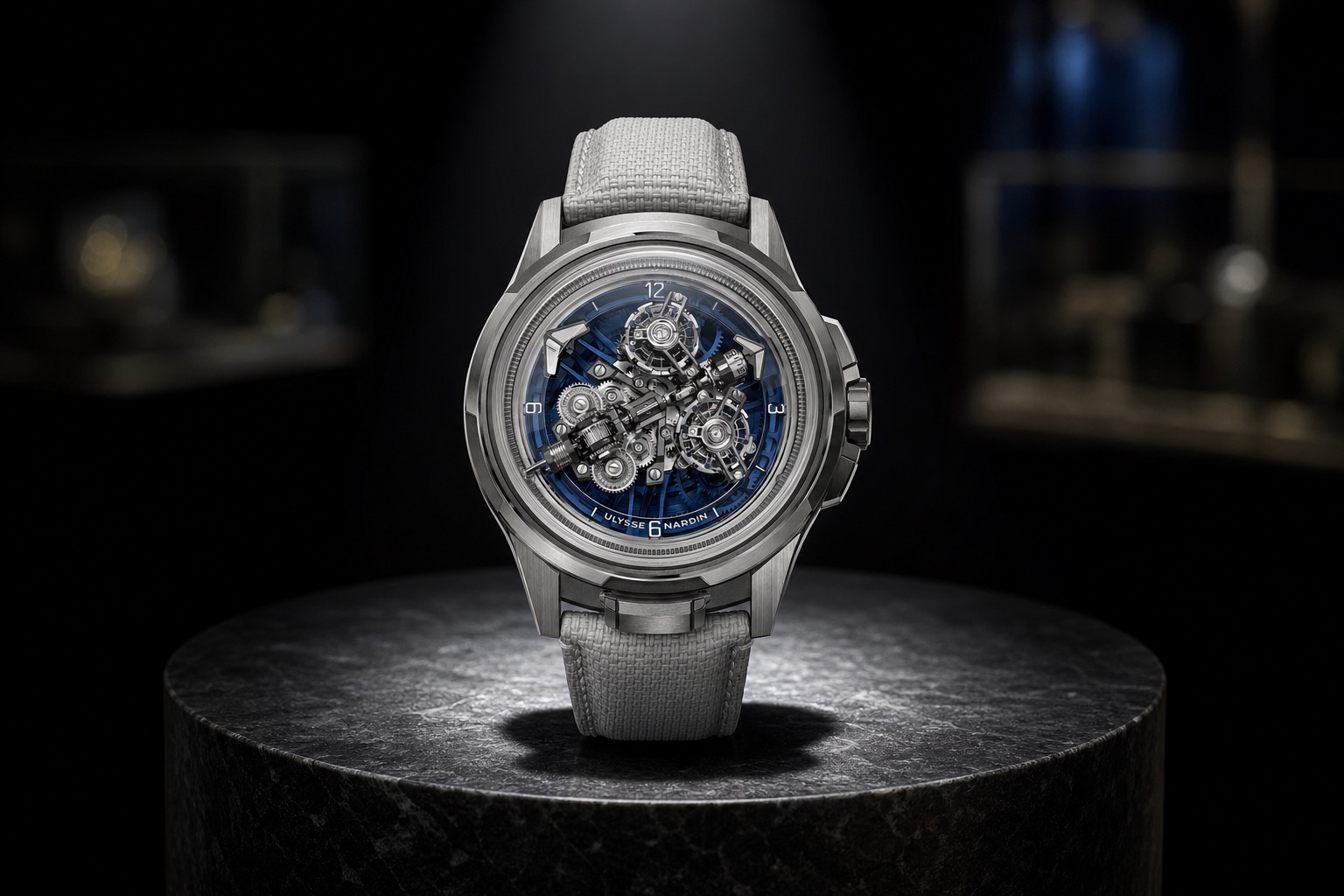
AI-generated illustration.
I'd question whether the Super Freak is a better watch than the original, though. Its job is to show what Ulysse Nardin can do in its 25th year with the Freak, and it does that. But the original 010-88 changed how the industry made escapements. The Super Freak is a very good watch that only 50 people will own, and on a list of the line's most important models I'd put it below the 2001 watch.
Unique pieces and the Only Watch Freaks
The Freak has gone to the Only Watch charity auction more than once. In Monaco in 2009, the unique "Freak Carrousel Tourbillon", known as the Freak Black Out, hammered at €87,000 (WatchTime). In 2011 Ulysse Nardin sent a unique steel Freak Diavolo with a flying tourbillon regulator and eight days of reserve, estimated at €75,000 to €100,000 (Antiquorum). I found a result for it only in a search snippet I couldn't confirm, so I've left it out.
At auction
The most interesting Freak auction result is also the least expensive watch on paper. At Phillips' Geneva Watch Auction XIV, lot 224 was reference 016-88, case number P001, described as "the prototype P001 of this disruptive and historically relevant piece". It came with a letter from Ulysse Nardin calling it the very first Freak prototype in pink gold. The estimate was CHF 15,000 to 30,000 and it sold for CHF 126,000 (Phillips). The page doesn't say whether that includes the buyer's premium. That's more than four times the top estimate. My read is that bidders paid for being first, and that tells you what people value in a Freak.
The other results are less dramatic. A white gold Diavolo, reference 2080-115, sold for HKD 300,000 at Antiquorum Hong Kong on 31 May 2026, against an estimate of HKD 120,000 to 220,000 (Antiquorum). Sotheby's has offered a 010-88 at US$18,000 to 24,000 and a 020-88 at US$20,000 to 40,000 (Sotheby's, Sotheby's), but its results sit behind a login, so I can't report them.
What I'd check before buying one
- Which generation it is. The reference decides the escapement, the frequency and whether it has a crown. A 010-88 and a 2019 Freak X are very different watches that share a name.
- The escapement's history. The original's escapement had reliability problems (Watchprozine). Ask for service records, and ask what was replaced.
- Who serviced it. A rotating movement with silicon parts is no job for a general watchmaker. I couldn't find a reliable service cost, so get a quote from Ulysse Nardin before you buy.
- The papers. For a first-generation watch, the case number and any brand letter are what separate a prototype from a production piece, as P001 showed.
- The case size you're expecting. If a listing gives 42 mm and another 43 mm for the same reference, that's the catalogues disagreeing, as Phillips's own two lots do.
Sources
- Ulysse Nardin, Freak history
- Ulysse Nardin, Freak 2001
- Ulysse Nardin press release, via Europa Star (2026)
- Phillips, ref. 010-88, case 208
- Phillips, ref. 010-88, case 165, Geneva Sessions Spring 2024 lot 56
- Phillips, ref. 016-88 prototype P001, Geneva Watch Auction XIV lot 224
- Antiquorum, ref. 010-88, lot 353
- Antiquorum, ref. 016-88, lot 274
- Antiquorum, Freak Diavolo Only Watch 2011, lot 35
- Antiquorum, ref. 2080-115, Hong Kong May 2026 lot 285
- Antiquorum, Freak X Yoshida edition, Geneva May 2026 lot 478
- GPHG, Freak Diavolo
- SJX, The Ulysse Nardin Freak saga, Part I (2024)
- SJX, Freak Vision (2018)
- SJX, Freak X (2019)
- SJX, Freak S (2022)
- Monochrome, Freak Out (2018)
- Monochrome, Freak X (2019)
- Monochrome, FreakLab (2015)
- Monochrome, Freak ONE (2023)
- Revolution, InnoVision 2 (2017)
- Revolution, the 41 mm Freak X (2026)
- Revolution, Ulysse Nardin at Watches and Wonders 2026
- A Blog To Watch, Super Freak (2026)
- Haute Time, Freak Cruiser (2013)
- Haute Time, The Future Is Freaky
- Watchonista, 25 years of the Freak
- Watchprozine, Freak history (April 2008)
- Time+Tide, Freak interview
- WatchTime, Only Watch 2009 result (2009)
- Oracle of Time, the 2001 Freak (2026)
- FashionUnited, Kering buys Ulysse Nardin (2014)
- Time+Tide, The Freak: the icons
- Haute Time, 25 years of the Freak (2026)
- Sotheby's, ref. 010-88, Fine Watches lot 298
- Sotheby's, ref. 020-88, Fine Watches lot 213