Breguet
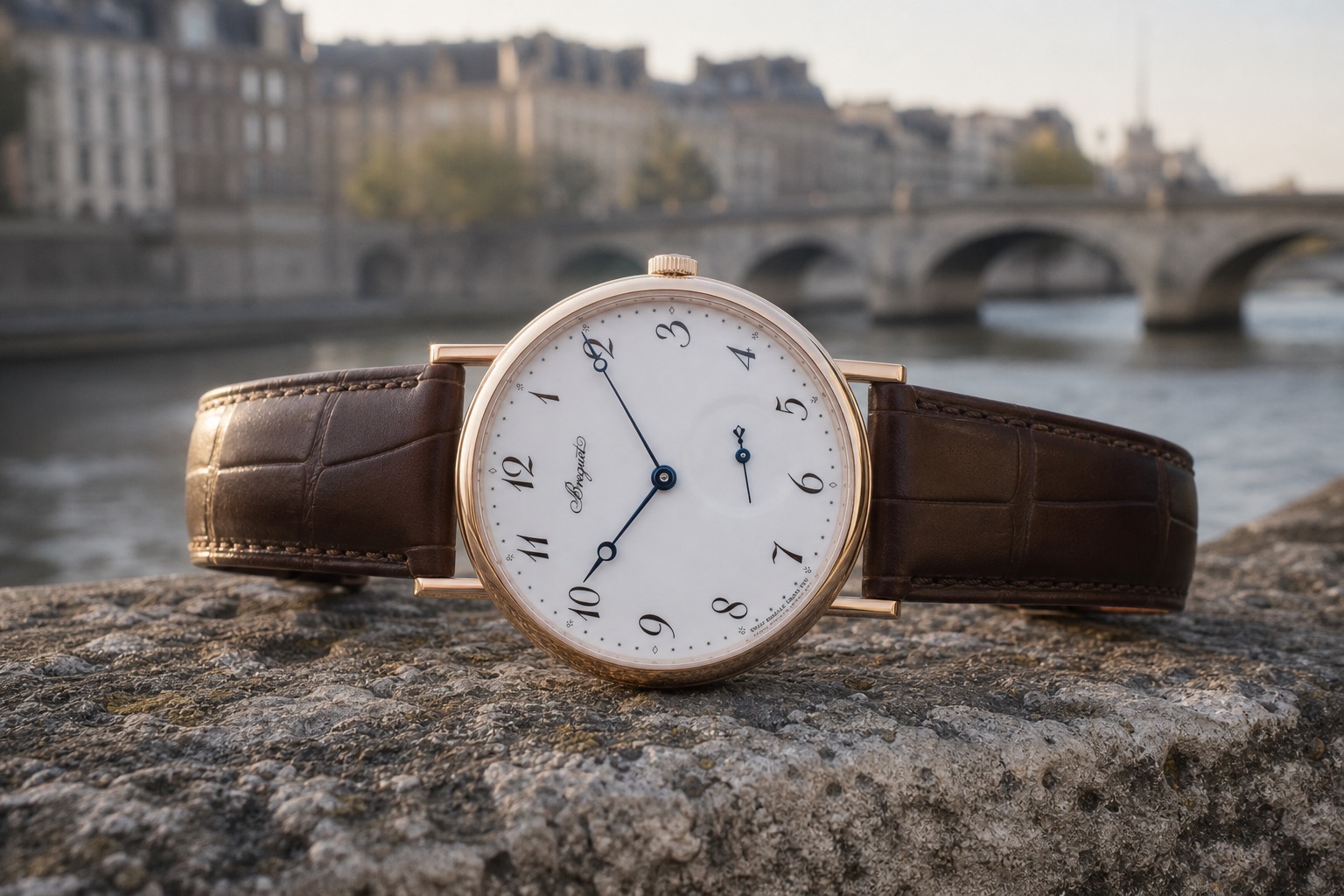
AI-generated illustration.
When Pushkin needed a word for a watch that chimes the hour, he wrote "брегет", lower case, and his readers knew what he meant (Wikisource). That was the 1820s, and Abraham-Louis Breguet had only just died. Two hundred years later his name is still a common noun in the trade: Breguet hands, Breguet numerals, the Breguet overcoil on a balance spring. Breguet itself says that between 1880 and 1910 other makers engraved "Spiral Breguet" on the covers of their movements as a selling point (Breguet).
The company that carries the name is a separate story. It left the family in 1870, when the founder's grandson sold the watch business to his workshop manager so he could concentrate on telegraphs (Louvre). It then spent a hundred years as a small Paris house, selling a few hundred watches a year at its best and a handful at its worst, before passing to a jeweller in 1970, a Bahraini investment firm in 1987 and Swatch Group in 1999. Every Breguet made since 1976 has been made in Switzerland.
So this is a history of a name, and of what each owner did with it. The founder's inventions are documented; the stories around him are thinner than they look. The 1783 order-book entry for the most famous watch he ever started reads "No. 160, Montre d'Or" and nothing more, with no queen and no count attached (SJX). The founding year, 1775, is the year he married and took rooms on the Quai de l'Horloge; Sir David Salomons, who owned more Breguets than anyone alive in 1921, wrote that the date "cannot be accurately fixed" (Salomons). My read is that the modern company's best asset is its archive, and that the archive is more interesting than the legend. This is that history, the thin century included.
Timeline
These are the best-supported dates I found. Where sources split on a year, the era sections say so.
| Year | Event |
|---|---|
| 1747 | Abraham-Louis Breguet born in Neuchâtel, 10 January |
| 1775 | Marries Cécile L'Huillier and sets up on the Quai de l'Horloge, Paris |
| 1783 | Gong spring for repeaters; Breguet hands and numerals; "No. 160, Montre d'Or" entered in the order book |
| 1793–1795 | Leaves Paris for Switzerland in August 1793; back in May 1795 |
| 1796 | First souscription watch, No. 96, delivered |
| 1801 | Tourbillon patent granted, 26 June (7 Messidor An IX) |
| 1810–1812 | Oval repeater No. 2639, made to be worn on the wrist, for Caroline Murat, Queen of Naples |
| 1823 | Breguet dies, 17 September; his son Antoine-Louis takes over |
| 1827 | No. 160 completed under Antoine-Louis |
| 1833 | Firm sold to Breguet, Neveu et Cie, under grandson Louis-Clément, for 270,000 francs |
| 1870 | Louis-Clément sells the watch business to his workshop manager Edward Brown |
| 1933 | The shop moves to the Place Vendôme corner of the rue de la Paix |
| 1954–1960 | Type 20 chronographs delivered to the French armed forces |
| 1970 | George Brown sells to the jewellers Jacques and Pierre Chaumet |
| 1976 | Production moves to the Vallée de Joux |
| 1987 | Chaumet goes bankrupt; Investcorp buys Breguet |
| 1988 | First Breguet wrist tourbillon, reference 3350 |
| 1999 | Swatch Group buys Groupe Horloger Breguet, agreement announced 14 September |
| 2010 | Nicolas G. Hayek dies, 28 June; Marc A. Hayek takes over |
| 2024 | Gregory Kissling appointed CEO, 1 October |
| 2025 | 250th anniversary; the Classique Souscription wins the GPHG Aiguille d'Or |
The Quai de l'Horloge, 1775–1823
Breguet came to Paris as a teenager and stayed for the rest of his life. He was born in Neuchâtel on 10 January 1747; his father died in 1758, his mother married a watchmaker named Joseph Tattet, and Tattet took the boy to France in 1762 and apprenticed him to a Versailles watchmaker whose name nobody has recorded (Louvre, Antiquorum). In the evenings he studied mathematics at the Collège Mazarin under the Abbé Marie, who became his mentor and, by Antiquorum's account, his introduction to the court families who became his first clients.
In 1775, aged 28, he married Cécile Marie-Louise L'Huillier at Saint-Sulpice and rented part of a house on the Quai de l'Horloge, on the Île de la Cité, from the Duchesse de Polignac (Antiquorum). That is the founding. Breguet's own account says he "set up his own business in 1775, as he himself confirmed on several occasions", and that the date "must have closely coincided with the date of his wedding" (Breguet). No business record from that year survives. The company says its production registers begin in 1787 and that the earlier papers were lost when the workshop was pillaged in 1794 (WorldTempus). Antiquorum's biographer thinks the dowry "undoubtedly" provided much of the capital; no document is cited for that either.
The first watches that made his name were self-winding. Breguet says he sold a perpétuelle to the Duc d'Orléans in 1780 and that the earliest survivor, No. 1/8/82, was finished in 1782 (Breguet). He did not invent the type. George Daniels put it plainly in The Art of Breguet: "Breguet did not invent the perpetuelle but he certainly did perfect it" (Sotheby's). Who did invent it is still argued over: the historian Richard Watkins calls the usual Perrelet attribution a "myth" and credits the rotor to Hubert Sarton of Liège, on the strength of a 1778 report to the Académie des Sciences (Watkins). Breguet heard of Perrelet's watch in 1777, tried a more complex design, then settled on the side weight that made his version work. A perpétuelle cost more than 3,000 francs (Christie's).
The design language arrived early. In 1783 he replaced the bell in repeating watches with a coiled gong spring, which let the cases get thinner, and the same year is given for the hollowed "moon tip" hands and the slanted Arabic numerals that still carry his name (Louvre, Breguet). Engine-turned dials followed in 1786, the ratchet key and the natural escapement in 1789, and the pare-chute shock protection around 1790. The famous demonstration of the pare-chute, Breguet throwing his watch to the floor at Talleyrand's house and Talleyrand asking whether "this devil Breguet" always had to go one better, is told by the company itself as "a family tradition" (Breguet). I found no witness account of it.
He became a master of the clockmakers' guild in 1784 and was selling to the court by the middle of the decade (Louvre). Talleyrand, a client from 1787, bought more than thirty pieces over the years and let Breguet ship watches abroad in the Foreign Ministry's diplomatic bag (Antiquorum). From 1787 to September 1791 he traded as Breguet & Compagnie with the dealer Xavier Gide, a partnership the Louvre says ended over "political and business issues" (Louvre).
Then the Revolution caught up with him. Antiquorum's biography has him an early Jacobin who could not outrun his aristocratic client list; the house historian Emmanuel Breguet says there is "some evidence" of Jacobin membership (WorldTempus). He left Paris for Switzerland in August 1793 (Louvre). You will read that Marat got him his passport, and that Breguet had earlier smuggled Marat out of a mob disguised as an old woman. The earliest print of that story I could find is Salomons in 1921, with no source; Emmanuel Breguet says only that Marat's help is "likely", and the company's own page on 1793 leaves Marat out entirely (Breguet). What the archives do show is that Breguet bought watch hands from Marat's sister Albertine, mostly between 1818 and 1823.
The Paris workshop kept running under his foreman, was ransacked in 1794, and he ran a small shop in Le Locle while he waited. He was back in Paris in May 1795 (Louvre). The next six years were the most productive of his life. 1795 brought the overcoil balance spring, the ruby cylinder escapement and the first description of the sympathique, a clock that winds, sets and regulates a watch placed in its cradle overnight. He wrote to his son on 26 June 1795: "I have invented a means of setting a watch to time, and regulating it, without anyone having to do it… I expect from this, the greatest promotion of our fame and fortune" (Sotheby's). He sold five in his lifetime, all to kings or princes (Breguet).
The souscription watch was the commercial idea. A plain, large, single-hand watch, 61 mm across, sold by leaflet to subscribers who paid a quarter down; the first, No. 96, was delivered in 1796, and prices ran from 600 francs in silver to 800 or 900 in gold (Antiquorum, Christie's). Some 700 were made (Breguet). Antiquorum's reading of Breguet's own prospectus is that it rebuilt the business after the Revolution and paid for the research. The montre à tact of 1799 took the same movement and added a pointer on the outside of the case, so the hour could be read by touch in a pocket or in the dark; Joséphine Bonaparte bought No. 611 on 18 February 1800 for 3,000 francs (Christie's). Napoleon had bought three pieces himself in April 1798, a month before leaving for Egypt (Breguet).
The tourbillon came on 26 June 1801, or 7 Messidor of the year IX, as a ten-year patent for "a new type of regulator" that mounts the whole escapement in a cage that turns, so that the errors of each vertical position cancel over a rotation (Breguet, Louvre). The first was sold in 1805, and Breguet counts 35 sold between then and his death; its own magazine widens that to 40 tourbillon objects made between 1796 and 1829, plus nine never finished, and notes that more than half the survivors turn once every four or six minutes, where the patent describes one turn a minute (Breguet). No. 1176, a four-minute tourbillon, went to Count Potocki in St Petersburg on 12 February 1809 for 4,600 francs (Christie's). No. 1297 was sent to his London agent for George III on 29 June 1808, and sold at Sotheby's in 2020 for £1,575,000 (Sotheby's).
Sales peaked at 196 pieces in 1803 (Louvre). He opened a shop in St Petersburg in 1808 and closed it in 1811 after Russia banned French imports. His best client in those years was Caroline Murat, Napoleon's sister and Queen of Naples, who bought 34 clocks and watches between 1808 and 1814 (Breguet). One of them is the basis of a claim the company still makes. On 8 June 1810 she ordered, in the words of the register, "a repeater watch for bracelet for which we shall charge 5,000 Francs"; it was invoiced in December 1811, finished on 21 December 1812, came back for repair in 1849 and 1855, and then vanished (Breguet). Breguet calls No. 2639 the first wristwatch. Emmanuel Breguet himself acknowledges that Patek Philippe long claimed the first with an 1868 watch for Countess Koscowicz (WorldTempus); Patek now words its claim as "the first ever Swiss wristwatch" (Patek Philippe). The Patek watch exists and the Breguet watch is a ledger entry, which is why I'd call No. 2639 the earliest documented watch made for the wrist and leave "first" to the brands.
Honours came late and fast. He joined the Bureau des Longitudes in 1814, Louis XVIII named him watchmaker to the Royal Navy in 1815, and in 1816 a royal ordinance made him a member of the Académie des Sciences, twenty years after he had lost an election to it (Louvre). The firm sold 78 marine watches and chronometers between 1815 and 1823. Through all of it the operation stayed small. Salomons records Breguet saying he "could find only 15 to 20 workmen in Paris capable of carrying out his work properly" (Salomons). He died on the night of 16 to 17 September 1823, aged 76, leaving a firm valued at some 800,000 francs, more than half of it work in progress (Antiquorum). You will also read that he made 17,000 watches. I found no basis for the figure; the firm's own numbering had only reached the high 4,000s by 1830 (Breguet).
The family sells twice, 1823–1870
Antoine-Louis Breguet was 47 when he took over, and had been his father's partner since about 1807, when the firm became Breguet et Fils (Salomons). His decade is remembered for one watch. No. 160 was declared complete in 1827, 44 years after the order, by a team of about twenty under Michel Weber, at a documented cost of 17,070 francs (SJX, Breguet). It had every complication the workshop knew: self-winding, minute repeater, perpetual calendar, equation of time, power reserve, thermometer, independent seconds. Daniels, reading the workbooks, thought it was finished by 1820; the company says 1827.
Nobody bought it. Emmanuel Breguet, going through the ledgers, found no sale, and the 1833 inventory drawn up when Antoine-Louis retired leaves it out. The only trace is a repair entry of March 1838 in the name of "le marquis de La Groye, à Provins", and the one Marquis de la Groye in the Breguet records had died in October 1837 and lived somewhere else; Emmanuel Breguet calls the buyer "fictitious" (Breguet). The watch stayed on the Quai de l'Horloge for decades, went to the English collector Sir Spencer Brunton in 1887, and reached Salomons in 1917 (Science Museum). The Marie-Antoinette name first appears in print in Salomons's 1921 book, and SJX's 2026 reading of the provenance traces it to a label written in a London dealer's shop around 1920 (SJX). The company's page on the watch still opens with an officer of the Queen's Guards placing the order.
The business under Antoine-Louis leaned on marine chronometers, and the maker's own narrative admits sales had fallen below fifty a year by 1833 (Deployant). That year he sold. On 20 May 1833 a new company, Breguet, Neveu et Cie, bought the firm for 270,000 francs; the partners were his son Louis-Clément, a nephew of the founder, and the firm's accountant (Claude Breguet). Louis-Clément, born in 1804, standardised the product line, got output back to around 350 watches a year and opened a shop at 4 place de la Bourse in 1844 (Louvre).
He was a physicist at heart. He built electric clocks from 1839, a needle telegraph with Alphonse Foy in 1842 that earned him the Légion d'honneur in 1845, a network of 72 synchronised dials for Lyon in 1856 and, in 1876, a time-distribution service driven by the Paris Observatory's master clock (Dictionary of Scientific Biography, Claude Breguet). In 1870, aged 66, he sold the watch business to Edward Brown, the Englishman who ran his workshop, and kept the electrical firm (Louvre). Fratello gives the date as 8 May 1870. That electrical Maison Breguet took a Bell telephone licence in 1877 and became a public company in 1882; the family's great-great-grandson Louis Charles Breguet founded the aircraft maker Ateliers d'Aviation Louis Breguet in 1911 (Universalis). The aviation Breguet and the watch Breguet were separate companies from 1870 on, though the aircraft firm shows up in the watch ledgers from 1922 and its founder chaired the 1923 centenary committee (WorldTempus).
A hundred years of Browns, 1870–1970
Breguet's own summary of the next century is two sentences: the Browns "would take over for exactly one hundred years. Three generations and four owner-managers succeeded one another" (Breguet). Edward Brown ran it until his death in 1895. The middle of the succession is muddled, with the maker's narrative giving his son Edouard to 1912 and Henry to 1927 while WatchTime has Henry in charge from 1900. George Brown's dates are solid: he took over in 1927 and sold in 1970 (Sotheby's). The firm left the Quai de l'Horloge in 1870 for the rue de la Paix, moved to 2 rue Édouard VII in 1912, and in 1933 to the corner of the rue de la Paix and the Place Vendôme, where the Louvre's chronology puts it at 28 rue de la Paix and the company at 28 Place Vendôme, with the claim of being the first watch brand on the square (Breguet).
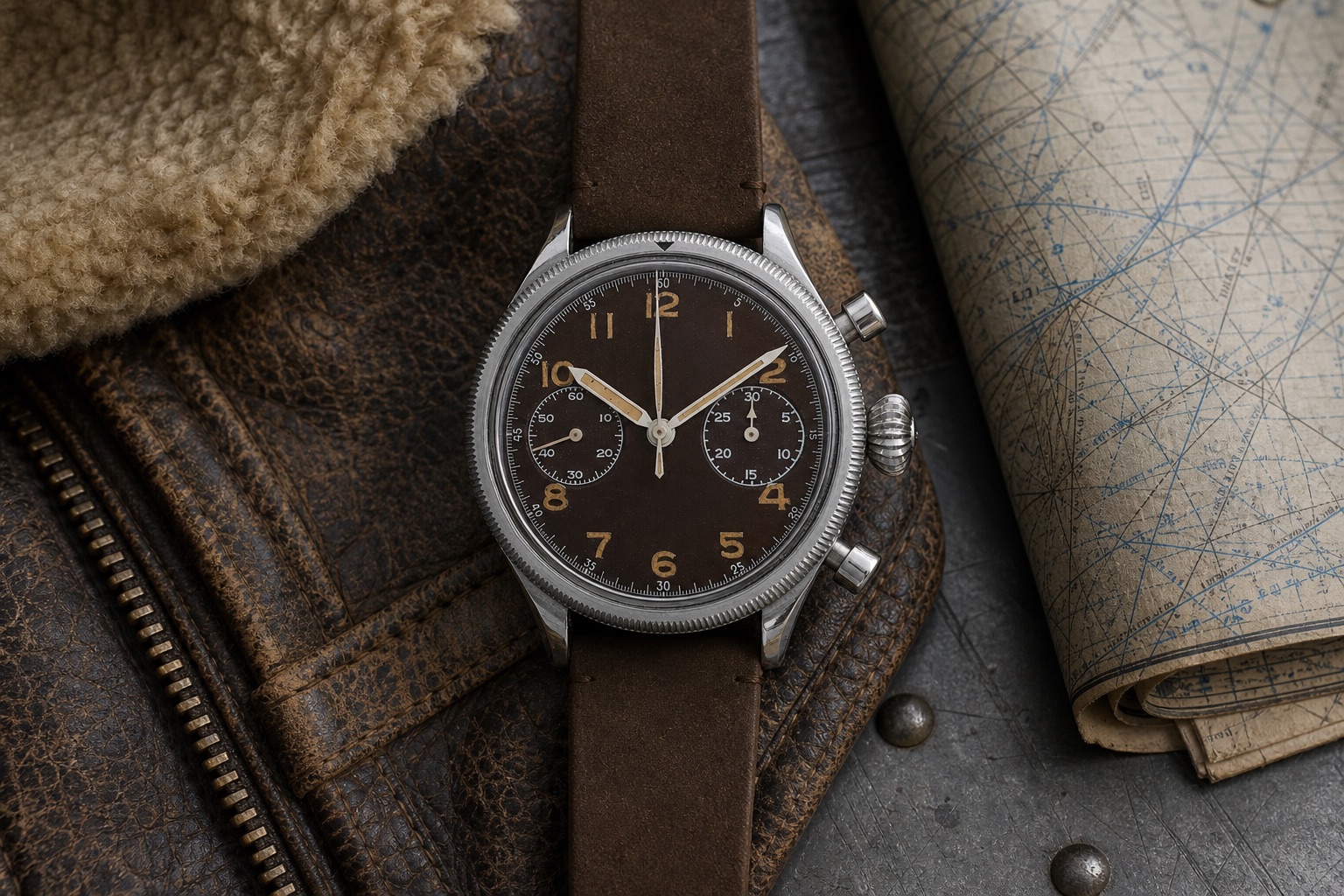
AI-generated illustration.
It was a small business. The maker's own history has sales dropping to around a hundred a year after 1870 and recovering to about 300 in the years before 1914, the products being thin simple watches, repeaters and carriage clocks (Deployant). Russia had been the biggest export market, and 1917 took it away. The clients who make the Brown years worth telling were English and musical. The Duke of Marlborough bought No. 765, a minute-repeating chronograph, in 1890; it passed to Winston Churchill, who had it serviced for the rest of his life, and in 1946 the ledgers record no charge for a repair, "as a tribute to his conduct during the war" (Breguet, WorldTempus). Arthur Rubinstein owned a small collection and called in whenever he passed through Paris. In 1932 Ettore Bugatti ordered a series of nine steering-wheel chronographs for the Type 41 Royale; Breguet bought one back at auction in 2016 for €78,000 (Breguet).
The founder's reputation was kept alive largely by a collector. Sir David Salomons bought No. 160 in 1917, published the first monograph on Breguet in 1921, and lent some 110 watches to the centenary exhibition at the Musée Galliera in 1923 (Breguet). George Brown was a watchmaker in his own right, with a 1926 French patent for a jumping-hour display on a revolving dial (Antiquorum), and the interwar ledgers show what the firm could still charge: No. 1626, a minute-repeating split-seconds perpetual calendar, went to a General Sherif Pasha in 1927 for 40,000 francs (Sotheby's). Quietly, production had already crossed the border: Phillips reads the French import marks on a 1963 watch as evidence that Breguet had been making its watches in Switzerland since the 1920s, and the company says it commissioned Vallée de Joux makers for its perpétuelles and tourbillons from that decade (Phillips).
The watch that defines the Brown era is a military one. The French Ministry of Defence wrote a specification for a pilot's flyback chronograph in the early 1950s; Breguet's prototypes went to the state test centre in July 1952, the name "Type 20" first appears in its registers in the spring of 1953, and the design was approved in 1954 (Breguet). Deliveries went to the Air Force from 1955 to 1959, to the flight test centre in 1956 and 1957, and to naval aviation in 1960, and the watches stayed state property (Breguet). The size of the first order is disputed: Swisswatches, working from the production books, gives 1,100 under order 5101/54, the number Swatch Group also uses; a Tier C site says 2,000 (Swisswatches, Swatch Group). The movement was a Valjoux 222, a Valjoux 22 with a flyback module, and the cases and assembly were subcontracted to Mathey-Tissot (Quill & Pad). Swisswatches puts Breguet's own staff at about ten people in those decades (Swisswatches). A civilian Type XX sold in 1960 for 490 francs (Phillips).
By the 1960s the Type 20 was most of the business. Phillips, cataloguing a 1963 triple calendar, says that "only a handful of non-military wristwatches were produced each year" (Phillips). George Daniels, who became the firm's London agent in those years, remembered George Brown numbering his two early clocks in the Breguet books and charging him for the privilege (Web of Stories). Daniels's The Art of Breguet came out in 1975, after a decade in the archives, and Phillips calls Breguet his "single most important influence" (Phillips). In 1970 Brown, at the end of a long career, wanted to sell to a neighbour on the Place Vendôme, and the Chaumet brothers bought the firm for what the man they put in charge later called "a modest sum" (Quill & Pad). No price has ever been published.
Chaumet and Daniel Roth, 1970–1987
Jacques and Pierre Chaumet handed Breguet to a Chaumet executive, François Bodet, and Bodet hired a young watchmaker from Audemars Piguet named Daniel Roth. Phillips has Roth ready "to lead Breguet's revival" by 1973; Revolution dates the hire to 1975; Roth himself spoke of fifteen years there, which ended in 1988 (Phillips, Revolution). His application, in the story every source repeats, was two pages: one of what he knew, one of what he still had to learn. In 1976 Breguet opened a workshop in the Vallée de Joux, which the company puts at Le Brassus and Le Sentier, and from then on everything was made in Switzerland (Breguet, Louvre). By July 1987 the Swiss press counted 14 employees there (Grail Watch).
What Roth and Bodet built with fourteen people is the modern Breguet look: engine-turned silver dials, blued Breguet hands, the fluted coin-edge case band and straight welded lugs, on thin movements bought in from Lemania and Frédéric Piguet and finished in-house (Phillips). The references that carried it were the 3050 perpetual calendar of 1976, which Phillips calls Roth's first major release, the 3130 with power reserve and moon phase, whose off-centre dial Phillips traces to the founder's perpétuelle No. 5, and the 3230 chronograph on the Lemania 2310 (Phillips). The 3350 tourbillon came to market in 1988, as the company was changing hands; Phillips calls it "only the second wristwatch tourbillon ever produced", after Audemars Piguet's 25643, while Sotheby's calls it the first serially produced one (Phillips, Sotheby's). I think the 1970s and 80s are the make's most interesting modern decade: the firm was tiny, and it got the design right.
Chaumet did not survive it. A provisional administrator was appointed on 19 May 1987 and filed the firm's bankruptcy at the Paris commercial court on 10 June, with liabilities above 1.5 billion francs, three times its turnover (Universalis). The brothers were taken into custody that week and, at trial in 1991, sentenced to eighteen and twelve months (Grail Watch). The assets of Chaumet and of Montres Breguet were sold together to Investcorp, a Bahrain-based investment firm, for 410 million francs, by the contemporary account in L'Impartial; what Breguet alone was worth in that deal has never been reported. Roth left the following year to start his own brand.
Investcorp builds a group, 1987–1999
Investcorp's twelve years get one paragraph on Breguet's history pages, but they are when the company became a manufacturer. In 1990 it launched the Marine, the first wristwatch line to carry that name (Breguet). In 1991, by Breguet's dating, Investcorp bought Nouvelle Lémania, the movement maker at L'Orient that supplied Breguet's chronographs and tourbillons, along with the components firm Valdar, and grouped the three as Groupe Horloger Breguet; a contemporary Le Temps report dates the Lemania purchase to 1992 (Breguet, Le Temps). In 1994 Breguet moved into a restored lakeside building at L'Abbaye that is still its head office (Breguet).
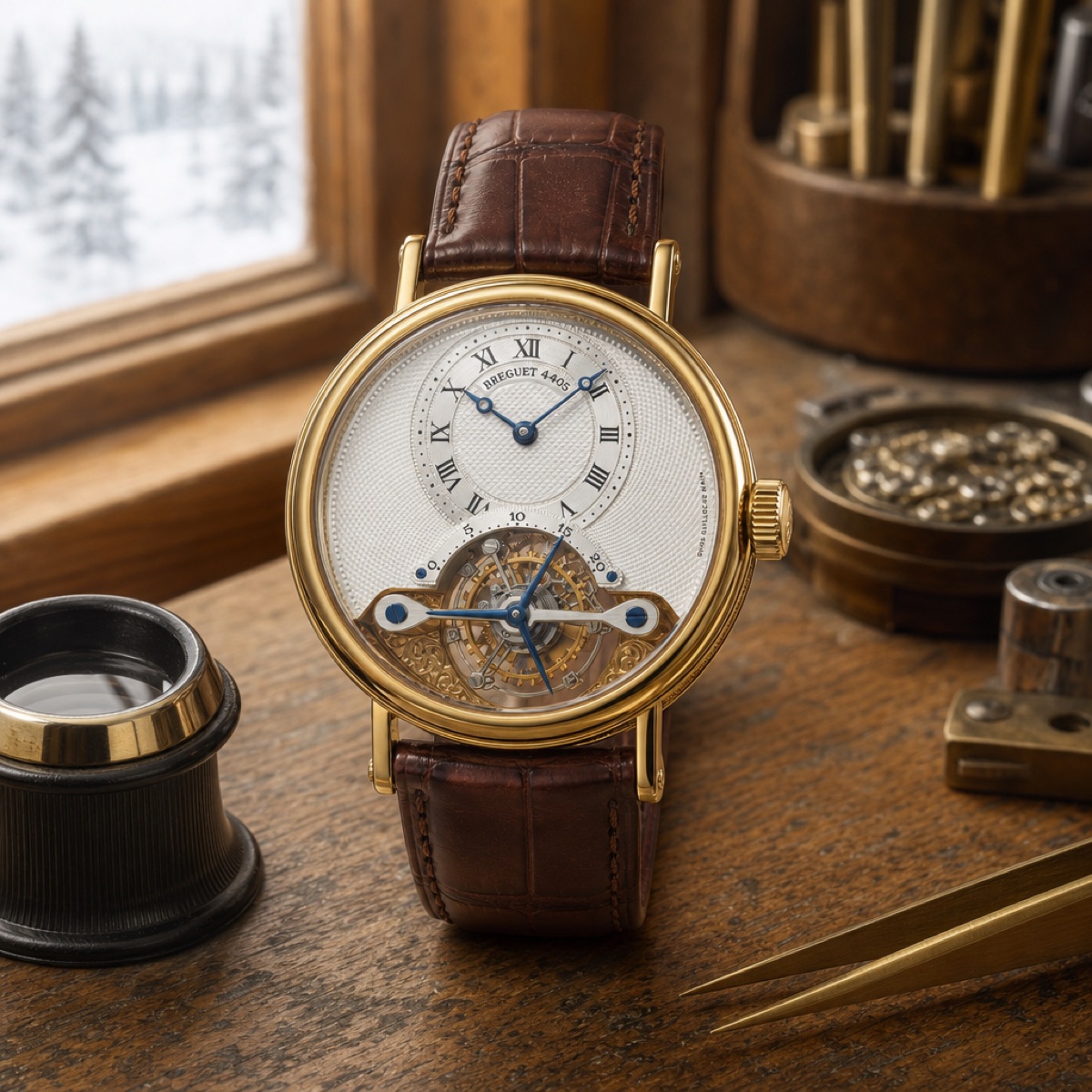
AI-generated illustration.
The catalogue grew around the Roth designs. The 3350 became the 3357 on the same Lemania-based calibre 558, a skeletonised 3355 followed in 1993, and the same year brought the 3637 minute repeater (Phillips). The Type XX returned in 1994 or 1995, depending on whether you read Phillips or WatchTime, as the reference 3800 Aéronavale, on a Lemania 1350 base with a flyback module (Phillips). Swatch Group's account of the period says unit sales grew "around ten times" under Investcorp and that the group employed about 460 people in 1999 (Swatch Group). Lemania alone had 343 staff at L'Orient that spring, and Investcorp had just frozen a plan to move most of them to Geneva after local protests (Le Temps).
Investcorp was selling. Le Temps reported that LVMH bid for the whole package of Breguet, Ebel and Chaumet, and that Investcorp wanted at least 470 to 500 million francs for the three, valuing Ebel at 220 to 250 million and Chaumet at 60 (Le Temps). Nicolas G. Hayek wanted only Breguet and Lemania. On 14 September 1999 Swatch Group announced it was taking over all the shares of Groupe Horloger Breguet, and added: "No disclosure is made about the transaction price" (Swatch Group). Europa Star later estimated 200 million francs. Hayek himself, ten years on, said "we purchased the two brands for approximately CHF 250 million, including their debt, without speaking of the recapitalization of the pension fund" (Europa Star).
Hayek's Breguet, 1999–2010
Hayek ran Breguet himself. He took the title of chairman and chief executive of the brand, opened a boutique on the Place Vendôme in October 2000 with a museum of forty-odd period watches in the basement, and told Europa Star in 2006 what had happened since: "In 2000, Breguet's turnover was about 40 million Swiss francs. Today, it is nearing 400 million!" Volume, by his count, had gone from 2,000 watches a year to 17,000 (Europa Star). Those are the owner's numbers and nobody audits them, but the direction is beyond doubt. The historian Pierre-Yves Donzé puts Breguet's turnover at 550 million francs in 2010, above Audemars Piguet and roughly level with Patek Philippe (Bilanz).
The factory was Lemania. Its L'Orient site was doubled with an extension in 2002, and Lemania was merged into Breguet as Manufacture Breguet, a change WorldTempus dates to 2003 and the company describes only as gradual (WorldTempus). By 2009 Hayek could say that, apart from hairsprings from Nivarox, cases, and "a few rare movements entrusted to Frédéric Piguet", everything was made in-house, and that Breguet had "more than CHF 500 million in sales every year" and made "more than 42,000 watches and movements per year" with 685 staff (Europa Star). Note the "and movements"; Lemania still sold calibres to others.
The product followed the archive. The Reine de Naples of 2002 is an oval ladies' watch built on the story of No. 2639 (Breguet). The Tradition of 2005, reference 7027, put a souscription-style movement on the dial side, barrel in the centre and the train arranged around it, and is the one modern Breguet design that owes nothing to Roth (Swisswatches). At Basel in 2006 Breguet showed silicon escape wheels, levers and flat balance springs in the Classique 5177, 5197 and 5837, among the first production watches to use the material (Breguet). Hayek also spent on the past: five million euros to restore the Petit Trianon at Versailles, an exhibition at the Louvre in 2009, and a record 2.3 million francs for Breguet documents at auction in May 2010 (Europa Star, swissinfo).
His showpiece was a watch that had been stolen. No. 160 disappeared from the L.A. Mayer Museum in Jerusalem in April 1983 along with about 105 other pieces from the Salomons collection (Smithsonian). In 2004 Hayek told his watchmakers to build it again from the archives and the surviving drawings; the result, reference 1160, with 823 parts and a box carved from a Versailles oak, was shown at Baselworld in 2008 (Breguet). By then the original had come back. In August 2006 a Tel Aviv lawyer offered the museum forty of the stolen clocks for an anonymous client, the museum paid $35,000, and when the story leaked in November 2007 the police traced the client to the widow of the thief, Na'aman Diller (Claims Journal). Ninety-six of the 106 pieces were eventually recovered. Hayek died at work in Biel on 28 June 2010, aged 82, and Swatch Group says the Breguet post was "immediately filled" by his grandson Marc A. Hayek (Swatch Group).
After Hayek, 2010–2026
The technical programme Hayek had started kept running. The Type XXII of June 2010 ran at 10 Hz with a silicon escapement; a patent for a magnetic balance pivot was filed in November 2010; and the Classique Chronométrie 7727 of March 2012 combined the two, a 10 Hz hand-wound watch whose balance staff is held by magnets, rated at minus one to plus three seconds a day (Google Patents, WorldTempus). It won the Aiguille d'Or in 2014. The museum kept buying: in May 2012 it paid 4,339,000 francs at Christie's for No. 2667, the founder's twin-movement resonance watch of 1814, a record for any Breguet (WorldTempus), and in 2014 it bought back the Potocki tourbillon No. 1176.
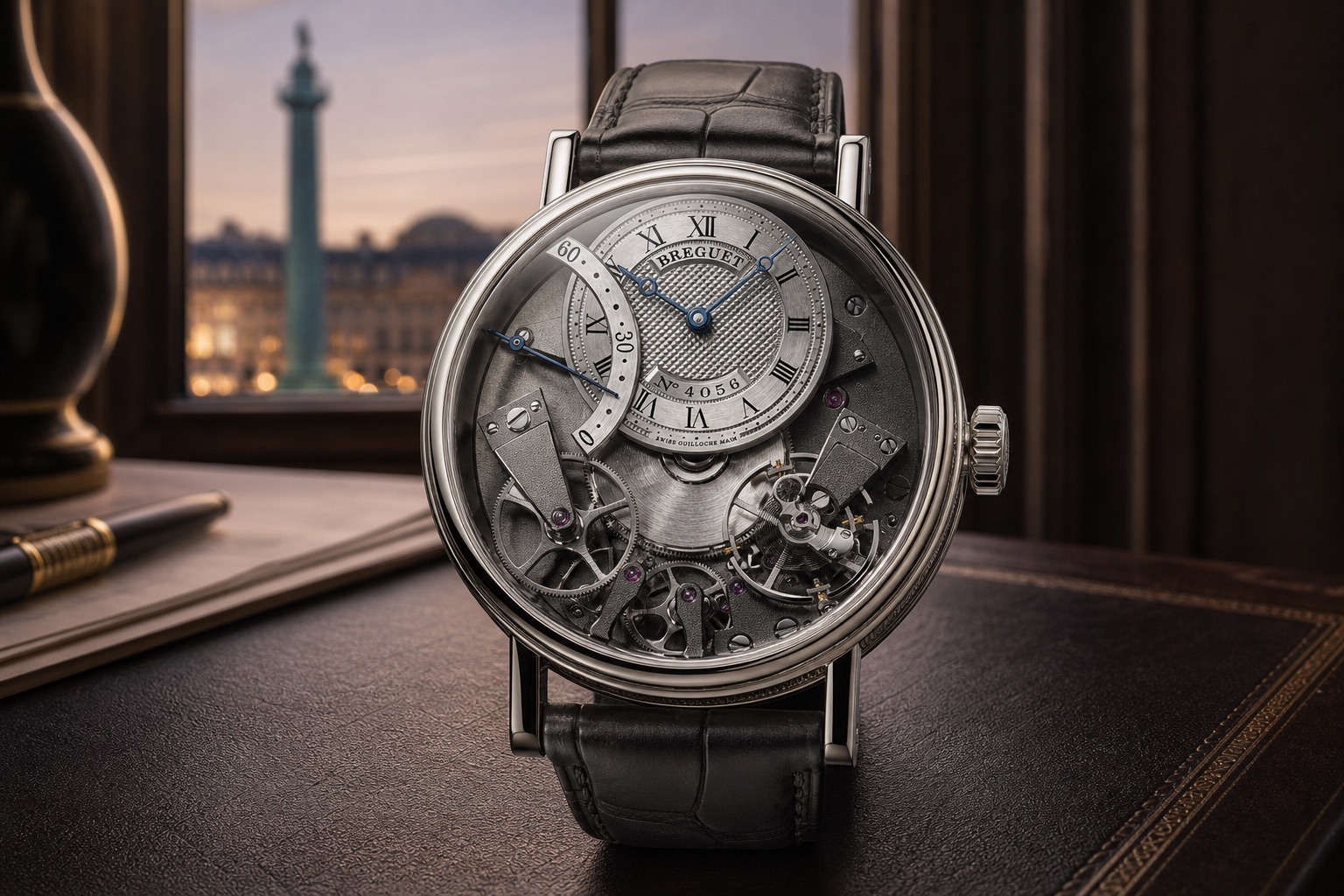
AI-generated illustration.
The catalogue widened in steady steps: the Tradition 7097 with retrograde seconds in 2015, the thin Classique 7147 in 2016, a redesigned Marine in 2017 and the three-hand 5517 in 2018 (Monochrome, Swisswatches). Leadership churned more than product. Marc Hayek ran the brand directly until he appointed Thierry Esslinger chief executive in September 2017; Esslinger was gone by about 2020, Hayek stepped back in, Lionel a Marca was named CEO in August 2021, and Gregory Kissling, from Omega's product side, took over on 1 October 2024 with Hayek as president (WorldTempus, Breguet). In June 2023, between those two appointments, the Type XX came back as the 2057 and 2067 on a new in-house chronograph calibre, the 728 (Swatch Group).
The business shrank while that happened, and nobody disputes the direction, only the numbers. Donzé's verdict is blunt: from 2010 "it went downhill", and he puts 2024 sales at an estimated 165 million francs, under a third of the 2010 figure (Bilanz). Morgan Stanley and LuxeConsult's annual estimates had Breguet at about 20,000 watches and 210 million francs in 2023 and 7,400 watches and 165 million in 2024 (The Hour Markers). Swatch Group's reply, in an open letter of 27 February 2026, is that the analysts had been assuming an average retail price of about 15,000 francs, doubled it to 32,500 when told it was wrong, left the turnover estimate alone and so "unit sales were simply more than halved from 20'000 to 7'400 – without any explanation" (Swatch Group). Swatch publishes no brand figures of its own. What it did say, reporting 2024, was that operating profit had fallen three quarters and that "prestige products were particularly affected" (swissinfo).
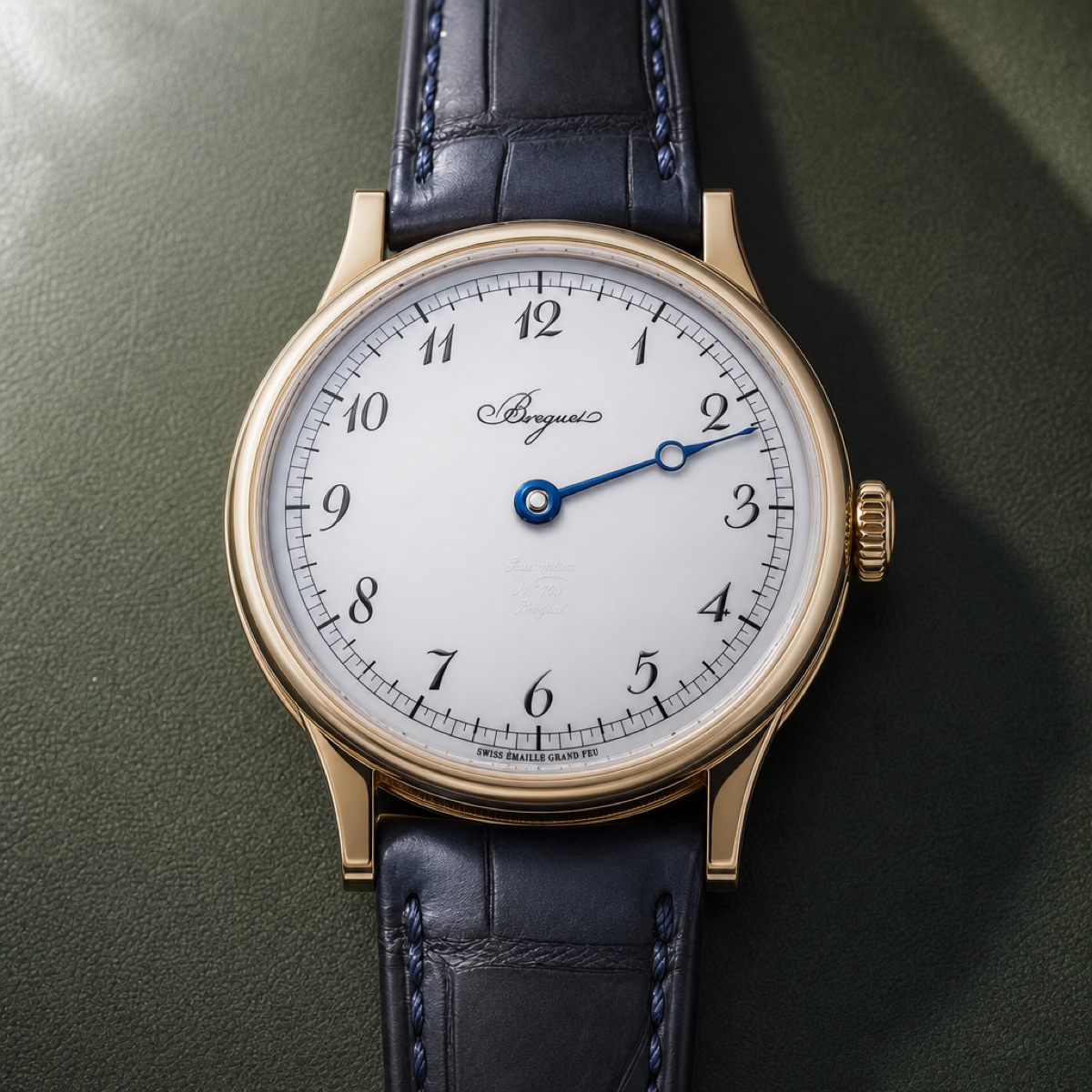
Kissling's answer was the anniversary. On 24 April 2025 in Paris, Breguet showed the Classique Souscription 2025: one hand, a white enamel dial, a 40 mm case in a new alloy it calls Breguet gold, and a new hand-wound calibre VS00 with four days of reserve, sold the way the founder sold them, on a deposit (Swatch Group). Launches followed in Shanghai, New York, Geneva, London, Seoul, Tokyo and Dubai: a Tradition in Breguet blue limited to 250, two hand-wound Type XX chronographs at 38 mm, the Tourbillon Sidéral on 26 June, the patent's anniversary, as the company's first flying tourbillon, and on 1 December the Expérimentale 1, 75 pieces with a magnetic constant-force escapement and a 10 Hz tourbillon (WorldTempus, SJX, SJX). The Souscription won the Aiguille d'Or at the GPHG on 13 November (WorldTempus). Four days earlier a Sotheby's sale of historic Breguets staged with the company had made more than 12 million francs against an estimate of about five (WorldTempus). WorldTempus reports the Souscription "tripled its most optimistic sales forecasts"; I haven't seen a number behind that, and I'd want one before calling the year a turnaround.
AI-generated illustration.
What Breguet gave watchmaking
The tourbillon is the one everyone knows, and the patent is the one Breguet claim with a document behind it: 26 June 1801, ten years, after which anyone could build one (Swatch Group). The thing to keep in mind is how small it was in his lifetime, 35 watches in eighteen years, and how long it stayed a curiosity afterwards; the first Breguet wristwatch with one came in 1988. The overcoil of 1795 had a far bigger effect on ordinary watches. Raising the last coil of the balance spring and tightening its curve lets the spring breathe concentrically, so the pivots see less side load and the rate holds better (SJX). It went generic within a century, which is why SJX can caption a Lange movement "an overcoil" without explaining the word.
Several of the inventions credited to him were improvements on other men's work. The self-winding watch belonged to Perrelet or Sarton before him, and the ruby cylinder was a refinement of an existing escapement. The échappement naturel of 1789, two escape wheels giving impulse directly to the balance without oil, he managed to put into only about twenty watches, and it took Daniels, Derek Pratt, François-Paul Journe and Laurent Ferrier to make it work in production two centuries later (SJX). The secret signature, two tiny engraved marks on the dial made with a pantograph, is real; Salomons could not date it in 1921, the Louvre's list of inventions leaves it out, and the 1795 that circulates is Breguet's own.
His commercial ideas lasted as well as his mechanical ones. The souscription was a product designed to a price, financed by its buyers in advance, and built in small series from a standard calibre. The à tact watch sold discretion: Wellington is said to have observed that young people used them to check the time without being seen to (Fondation Napoléon). And the archives themselves are a product: the company has kept a record of each numbered watch, its specification, its sale date and its buyer since the 1780s, and that is what makes a lot essay at Phillips or Christie's read like a provenance file.
The later contributions are narrower. The Type 20 is the French military's design, and its place in the story is that it kept the firm alive in the 1950s. Silicon in 2006, 10 Hz in 2010 and the magnetic pivot in 2012 were real engineering, done at a scale few brands could afford, and the 2025 Expérimentale 1 is the same programme a decade on. The literary footprint is the founder's. Dumas gave Danglars "one of Breguet's repeaters" in The Count of Monte Cristo and Balzac gave a character "the prettiest watch Breguet ever made" in Eugénie Grandet (Gutenberg, Gutenberg). Those were written in the 1830s and 40s, when the company was selling fifty watches a year. The name had already outgrown the firm.
Significant references
The first five rows are archive numbers, the way Breguet identified watches before it used references.
| Reference | Model | Years | Why it matters |
|---|---|---|---|
| No. 160 | Perpétuelle grande complication, "Marie-Antoinette" | 1783–1827 | Every complication the workshop knew; the legend outgrew the ledger |
| No. 5 | Perpétuelle | 1787–1794 | Self-winding repeater; its dial layout returned on the 3130 |
| No. 96 | Souscription | 1796 | First of some 700 one-hand watches sold on a quarter deposit |
| No. 1176 | Tourbillon | 1809 | His first four-minute tourbillon; bought back for the museum in 2014 |
| No. 2639 | Repeater for the wrist | 1810–1812 | Breguet's "first wristwatch"; the watch itself is lost |
| Type 20 | Military flyback chronograph | 1954–1960 | The French forces' contract; Valjoux 222; cased by Mathey-Tissot |
| 3050 | Classique perpetual calendar | 1976– | Roth's first major release; the modern Breguet look begins |
| 3350 / 3357 | Classique Tourbillon | 1988– | First Breguet wrist tourbillon, on the Lemania-based calibre 558 |
| 5817 | Marine | 2005– | First rubber strap at Breguet; the sports line goes modern |
| 7027 | Tradition | 2005– | Souscription movement turned dial-side; the Hayek-era original |
| 7727 | Classique Chronométrie | 2012– | 10 Hz and a magnetic pivot; Aiguille d'Or 2014 |
| 2025BH | Classique Souscription 2025 | 2025– | One hand, Breguet gold, calibre VS00; Aiguille d'Or 2025 |
Breguet today
As of November 2026, Breguet is Montres Breguet SA of L'Abbaye, a wholly owned Swatch Group company with 10 million francs of share capital, alongside a retail company at L'Abbaye and a French subsidiary in Paris (Swatch Group). The head office is the 1994 building at L'Abbaye; production is at L'Orient, in the commune of Le Chenit, in buildings put up on the old Lemania site between 2001 and 2014 (Breguet). Marc A. Hayek is president, Gregory Kissling has been chief executive since 1 October 2024, and Kissling told SJX in 2025 that Breguet makes movements, cases and dials in-house "but also thanks to the sister company of Swatch Group", which is the honest version of the manufacture claim (SJX).
The collections are Expérimentale, Tradition, Reine de Naples, Marine, Type XX, Classique and Héritage. The 2026 releases so far are a Tradition refresh in March, four tourbillons for the patent's 225th anniversary on 26 June, including a regular-production Classique Tourbillon 7357 that SJX reads as a return to the 3350, and a Marine 5517 and 5527 in September (Swatch Group, Swatch Group). A Breguet Hallmark, the company's own certification of components, performance and sourcing, has been applied since 2025. No production or revenue figure has been published since Hayek's 2009 interview; the only estimates are the disputed ones above, and the last headcount on record is 685, from 2009.
Sources
- Breguet, The House of Breguet timeline and era pages (Tier A, maker about itself): 1775 workshop; perpétuelles; gong spring, hands and numerals; pare-chute; balance spring; souscription; tact; sympathique; Napoleon; tourbillon patent; Caroline Murat; No. 2639; keyless winding; Edward Brown; Churchill; Bugatti; Place Vendôme; Type XX; Vallée de Joux; Investcorp; L'Abbaye; silicon; Reine de Naples; No. 1160
- Breguet magazine, "The 'Marie-Antoinette' watch No. 160", Emmanuel Breguet (Tier A)
- Breguet magazine, "The tourbillons of the inventor" (Tier A)
- Breguet magazine, "History of the Type XX, origins and first generation" (Tier A)
- Breguet magazine, "What is Marine?" (Tier A)
- Breguet, Gregory Kissling appointed CEO (Tier A)
- Louvre, Breguet exhibition mini-site: chronology, inventions and chapters (Tier A, museum; staged with Breguet)
- Sir David Salomons, Breguet 1747–1823, 1921 (Tier A)
- Claude Breguet, "La maison Breguet", reprinted 2009 (Tier A, family history)
- Complete Dictionary of Scientific Biography, Louis-Clément Breguet (Tier A)
- Encyclopædia Universalis, Louis Breguet and chronology, June 1987 (Tier A/B)
- Richard Watkins, The Origins of Self-Winding Watches 1773–1779 (Tier A)
- Antiquorum, 24 April 2004, lot 33, with biographical essay (Tier A)
- Antiquorum, 31 October 1998, lot 324 (Talleyrand) (Tier A)
- Antiquorum, The Art of Breguet 1991, lot 21 (souscription) (Tier A)
- Antiquorum, Hong Kong 2018, lot 235 (George Brown patent) (Tier A)
- Christie's, No. 1176 Potocki tourbillon, No. 611 for Joséphine, souscription No. 1602 and No. 217 story (Tier A)
- Sotheby's, Duc d'Orléans Sympathique, lot 124, 2012 (Tier A)
- Sotheby's, Masterworks of Time 2020, perpétuelle lot (Daniels quote) (Tier A)
- Sotheby's, The Complete Guide to Breguet Watch Collecting, 2025 (Tier A)
- Sotheby's, 2014 lot 203, No. 1675 and 2008 lot 18, No. 1626 (Tier A)
- Phillips, "Exploring Breguet in the Daniel Roth Era" (Tier A)
- Phillips, 1963 triple calendar, Type XX c.1960, Type XX 3800 and George Daniels (Tier A)
- Science Museum blog, the Marie Antoinette watch travels to London (Tier A)
- Fondation Napoléon, tact watch of Jérôme Bonaparte (Tier A)
- George Daniels, Web of Stories, becoming Breguet's London agent (Tier A, oral history)
- Swatch Group, acquisition of Groupe Horloger Breguet, 14 September 1999 (Tier A)
- Swatch Group, half-year report 2010, Breguet, inventor of the tourbillon, Type XX 2023, Classique Souscription 2025, 225 years of the tourbillon, Marine 5517 and 5527, open letter to Morgan Stanley and Annual Report 2025 (Tier A)
- Google Patents, US9030070B2, magnetic pivot (Tier A)
- Patek Philippe, bracelets and the first Swiss wristwatch (Tier A, maker about itself)
- Le Temps, 30 April 1999, Breguet keeps Nouvelle Lémania in the Vallée de Joux and September 1999, the redistribution of cards (Tier A, contemporary press)
- California Department of Insurance via Claims Journal, 2 March 2010 (Tier A, official statement)
- Wikisource, Евгений Онегин, chapter 1; Gutenberg, The Count of Monte Cristo; Gutenberg, Eugénie Grandet (Tier A, texts)
- SJX, "In Depth: Breguet No. 160 Montre d'Or", March 2026 (Tier B)
- SJX, "The Life and Times of Daniel Roth", the overcoil hairspring, the natural escapement, Tourbillon Sidéral 7255, Expérimentale 1 and interview with Gregory Kissling (Tier B)
- Europa Star, "Breguet at the summit", March 2006, "Breguet enjoying significant growth", November 2006 and "How the Tsar Nicolas G. Hayek has reawakened Breguet", March 2009 (Tier B)
- WorldTempus, Breguet's archives, Emmanuel Breguet interview, the first wristwatch, Louis Breguet, Churchill's No. 765, the Joux Valley workshops, Classique Chronométrie 7727, No. 2667 record, Thierry Esslinger, the 250th anniversary marathon, GPHG 2025 and Sotheby's 12 million (Tier B)
- Swisswatches, the ultimate guide to Breguet's Type XX, the history of Breguet pilot's watches, 250 years of Breguet and Marine 5517, Baselworld 2018 (Tier B)
- Quill & Pad, complete guide to Type 20 chronographs and review of Bodet's Breguet, Story of a Passion 1973–1987 (Tier B)
- Revolution, Daniel Roth retrospective (Tier B)
- Monochrome, Classique 7147 grand feu enamel (Tier B)
- Grail Watch, "House of Chaumet", reproducing 1987 press (Tier B)
- Bilanz, Swatch Group from boom to stagnation, Donzé, October 2025 (Tier B)
- swissinfo, Swatch profit plunges almost 75%, January 2025 and Breguet treasures break record at auction, May 2010 (Tier B)
- The Hour Markers, Morgan Stanley and LuxeConsult top 50 for 2024 (Tier B)
- Smithsonian, "The Time Thief Who Stole 106 Rare Clocks" (Tier B)
- Deployant, "The Story of Breguet, Part 2" (Tier C, but reproduces the maker's own history; used only as "Breguet says")