Audemars Piguet Royal Oak 15500ST
- Make
- Audemars Piguet
- Reference
- 15500ST
- Model
- Royal Oak
- Variants
- 15500OR
- Production
- 2019–present (in production)
- Case diameter
- 41 mm
- Calibre
- 4302
- Case material
- Stainless steel
- Water resistance
- 50 m (164 ft)
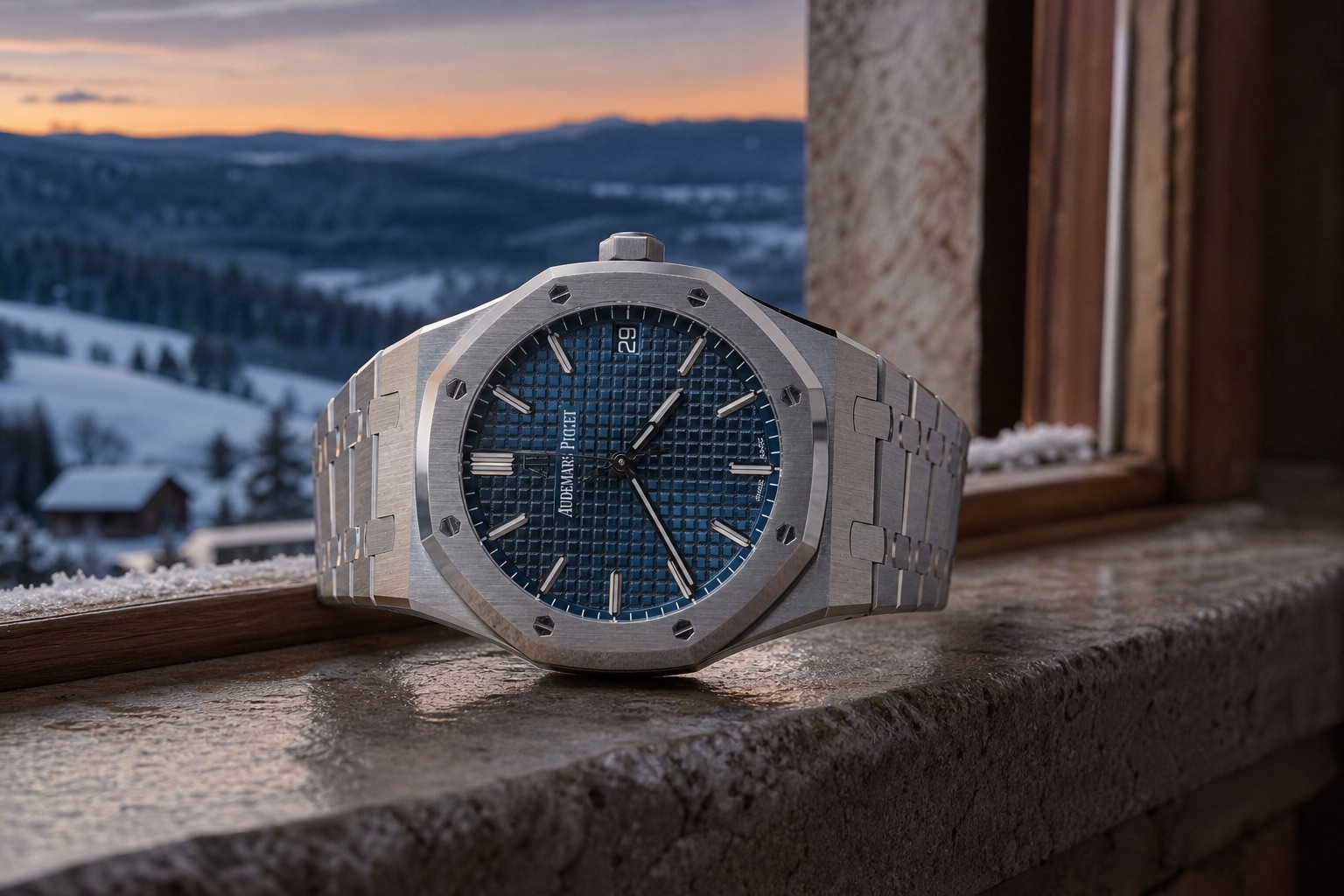
AI-generated illustration.
In 1972 Audemars Piguet sold a steel watch for more than it charged for a gold one. Its own archive puts the first Royal Oak at CHF 3,300, and the 1972 catalogue lists a yellow gold Model 5043 at CHF 2,990, which AP notes was "10% less than the Royal Oak in steel" (AP Chronicles). The advertising leaned into it: "Steel at the price of gold", "The costliest steel watch in the world". Everything AP has sold under the Royal Oak name since has been an argument that a steel sports watch can be a serious object.
The Audemars Piguet Royal Oak 15500ST is the everyday version of that argument. It's the 41 mm time-and-date Royal Oak on a steel bracelet, which AP sells as the Royal Oak Selfwinding, launched in January 2019 to replace the 15400 and replaced in turn by the 15510 in 2022. In AP's own words, the "15500 (equipped with Calibre 4302) succeeded it and confirmed this dimension" (AP Chronicles). The 15500 is the reference that brought AP's new in-house automatic calibre into the steel Royal Oak and fixed the two things owners had complained about on the 15400: a date floating too far into the dial, and a movement that looked lost behind the sapphire caseback. It ran for about three years, through the steel sports watch boom, and it's the Royal Oak I'd want: a modern movement in the last version of the case before the 50th-anniversary redesign.
Where it came from
The origin story is famous, and AP has published its own version of it from the company archive. In 1970, AP says, "three Audemars Piguet distributors made a specific request for a steel watch that was both sporty and elegant" (AP Chronicles). Georges Golay, who ran AP, rang the designer Gérald Genta the afternoon before the Basel fair opened on 11 April. Genta remembered the call this way: "Mr. Genta, we have a distribution company that has asked us for a steel sports watch that has never been done before – and I need the design sketch for tomorrow morning."
Genta also said he misheard. He thought Golay had asked for a watch "whose water-resistance has never been done before", and that sent him back to a childhood memory of a diver being fitted with a helmet on Geneva's Pont de la Machine: "I was very impressed when I saw the eight bolts and the rubber seal" (AP Chronicles). The octagonal bezel and its eight screws come from that helmet. It's a good story. Its only source is Genta himself, and AP repeats it without offering anything that corroborates it.
The overnight part is true of the sketch and nothing else. AP's archive shows a white gold prototype going to the distributors in April 1971, a year of further development that "was done without Gérald Genta", and an official launch at Basel on 15 April 1972. Whether the watch then sold slowly is disputed inside AP's own sources. The 40th-anniversary book by Martin Wehrli and Heinz Heimann says the first markets took three years to clear their quotas, while AP's Chronicles now call the commercial-failure story "a widespread misconception" and quote Golay calling it a best seller in 1973 (AP Chronicles). You'll also read that the first Royal Oak cost ten times a Submariner. AP's own evidence doesn't go that far: it quotes Marco Stanghellini's figure that in Italy the Submariner cost "less than a third" as much.
The 15500 doesn't descend from that first watch, the 5402, directly. The 39 mm ultra-thin Royal Oaks that carry the 5402's lineage are the ones collectors call "Jumbo" (AP Chronicles). AP says the nickname took hold in the 1980s and 1990s, when "Jumbo" set the 39 mm watch apart from the 36 mm models that dominated the market. The 15500 belongs to a parallel line: the thicker, everyday automatic Royal Oak with a centre seconds hand. AP traces it from the 14700 of 1990 and the 36 mm 14790 of 1992, which it says "remained the central model in the Royal Oak collection for over a decade". The 39 mm 15300 with calibre 3120 replaced the 14790 in 2005, and the 15400 took the case to 41 mm in 2012.
That 41 mm step left a problem. The 3120 is 26.6 mm across (AP, archived 15400 page), so in a 41 mm case the date window sat well in from the edge, and AP added a small hour marker beside it to balance the dial. Monochrome reported that "some collectors complained about the fact that the calibre 3120 movement was too small for a 41mm case" (Monochrome), and you could see that through the sapphire back. The 15500 was the fix.
AP showed it at the SIHH in Geneva in January 2019, the same show where it launched the Code 11.59 collection. Monochrome's launch review opened by noting that the attention was on the Code 11.59 and called the new Royal Oak "one extremely important watch" anyway. Prices started at CHF 19,300 against CHF 17,900 for the outgoing 15400, a rise of about 8% for a new movement and dial. By the time the silver dial arrived in 2020, Monochrome gave the steel watch as CHF 20,500, or USD 20,400. No source I read names a designer for the update, and AP hasn't published one.
The watch
AP's page for the blue 15500 describes the case in one line: "Stainless steel case, glareproofed sapphire crystal and caseback, screw-locked crown" (AP). The table takes the rest from the same page.
| Spec | Value |
|---|---|
| Reference | 15500ST.OO.1220ST.01 to .04 (steel); 15500OR in pink gold |
| Case | Stainless steel, octagonal bezel with eight white gold screws, screw-locked crown |
| Diameter | 41 mm |
| Thickness | 10.4 mm (AP, during production); 10.5 mm (AP's page today) |
| Crystal and caseback | Glareproofed sapphire, both sides |
| Water resistance | 50 m |
| Dial | "Grande Tapisserie", white gold applied hour markers, Royal Oak hands with luminescent coating |
| Movement | Calibre 4302, self-winding, in-house |
| Functions | Hours, minutes, centre seconds, date |
| Frequency | 4 Hz (28,800 vph) |
| Power reserve | 70 hours |
| Jewels / parts | 32 / 257 |
| Movement size | 32 mm diameter, 4.9 mm thick |
| Bracelet | Integrated stainless steel, AP folding clasp |
The bezel screws are from Monochrome's launch review; AP's page doesn't describe the bezel.
The thickness needs explaining. While the 15500 was in production, AP's own page said 10.4 mm (AP, March 2021 archive), and Monochrome, Revolution and Fratello all measured or quoted 10.4 mm at launch. The same AP page now says 10.5 mm, which is also what it lists for the 15510. Nothing I found explains the change. My guess is that AP unified its figures for the two references, but that's a guess. I'd go with 10.4 mm for a watch made in 2019.
Either way it's 0.6 mm thicker than the 15400's 9.8 mm, and Monochrome put that down to the new movement, which it judged sturdier than the 3120, adding that "the extra 0.60mm are almost imperceptible" on the wrist (Monochrome).
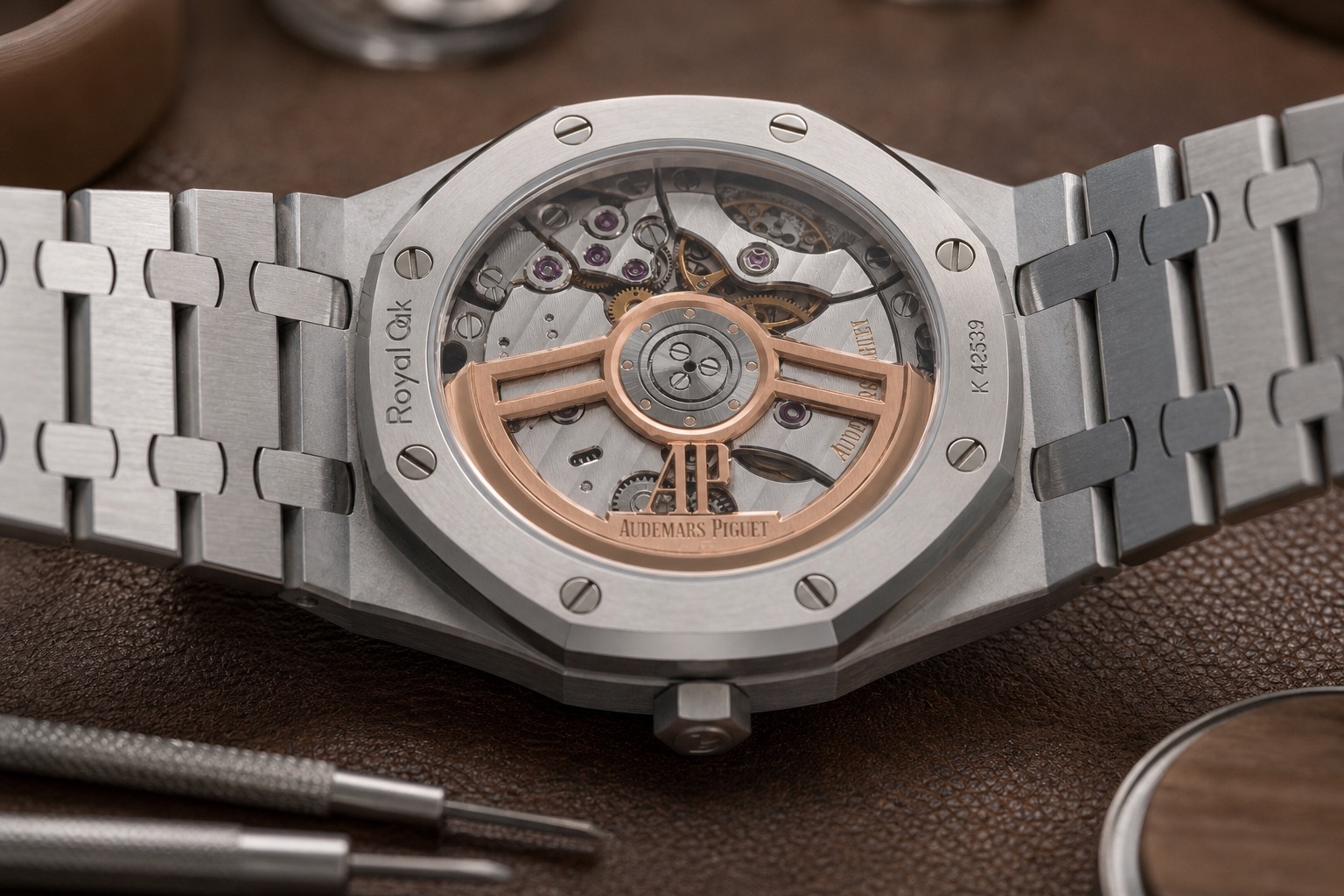
The movement is the reason the reference exists. Calibre 4302 arrived in 2019 with the Code 11.59; Revolution calls it the movement "found also in the time-only Audemars Piguet Code 11.59 launched in the same year" (Revolution). Set against the 3120 in the 15400, it's bigger (32 mm against 26.6 mm), faster (4 Hz against 3 Hz) and runs longer (70 hours against 60), with fewer parts (257 against 280) and fewer jewels (32 against 40), all by AP's own spec sheets. Through the back you see Geneva stripes on the bridges and what Monochrome describes as "a skeletonized gold rotor with superb sharp anglages". The movement now fills the caseback, which was half the point.
AI-generated illustration.
How it changed
The 15500 had a short life, so its story is mostly about what came before and after it.
| Years | Reference | Case | Calibre | What it brought |
|---|---|---|---|---|
| 1992 | 14790 | 36 mm | — | AP's "central model" for over a decade |
| 2005 | 15300 | 39 mm | 3120 | The 3120 and a centre seconds hand |
| 2012 | 15400 | 41 mm, 9.8 mm thick | 3120 | The 41 mm case |
| 2019 | 15500 | 41 mm, 10.4 mm thick | 4302 | A movement sized for the case, a reworked dial |
| 2022 | 15510 | 41 mm, 10.5 mm (AP) | 4302 | The 50th-anniversary case and bracelet |
Dates and sizes for the first four come from AP Chronicles and AP's product pages; the 14790's movement isn't stated in what I read, so I left it blank.
Inside the 15500's own run, the only change I could document is the dial line-up. Blue, grey and black came first in 2019. A silver-toned dial followed in 2020, which Monochrome introduced as "the latest iteration" at CHF 20,500 (Monochrome). No source records a change to the case, bracelet, dial printing or movement during the run.
The end came with the Royal Oak's 50th anniversary. AP framed the 2022 changes as something it had already tried on gold: "First introduced on Royal Oak models in gold a few years back, this evolved aesthetic appears for the first time on stainless steel and titanium references" (AP release, via La Cote des Montres). So the 15500 was, in a sense, living on borrowed time from the day it launched. AP's January 2022 release said "additional models in 41 and 34 mm will be available in the second half of 2022", and described the changes coming to the steel models: larger polished bevels on the case, a caseback "slightly more integrated into the case middle", bracelet links "thinner throughout", and first four links that "are now trapezoid in shape and no longer parallel" (AP release, via La Cote des Montres). The 41 mm reference that brought those changes is the 15510, which AP's page describes as combining "the collection's new ergonomic design" with a blue "Bleu Nuit, Nuage 50" dial (AP). It keeps calibre 4302.
That's the case for the 15500 as a reference in its own right. The 15510 kept the 15500's movement and changed the case, bracelet and dial, so the 15500 is the only steel 41 mm Royal Oak with calibre 4302 in the pre-2022 case and bracelet. Whether that's a virtue depends on how you feel about the old taper. I like it.
The variations that matter
Dials
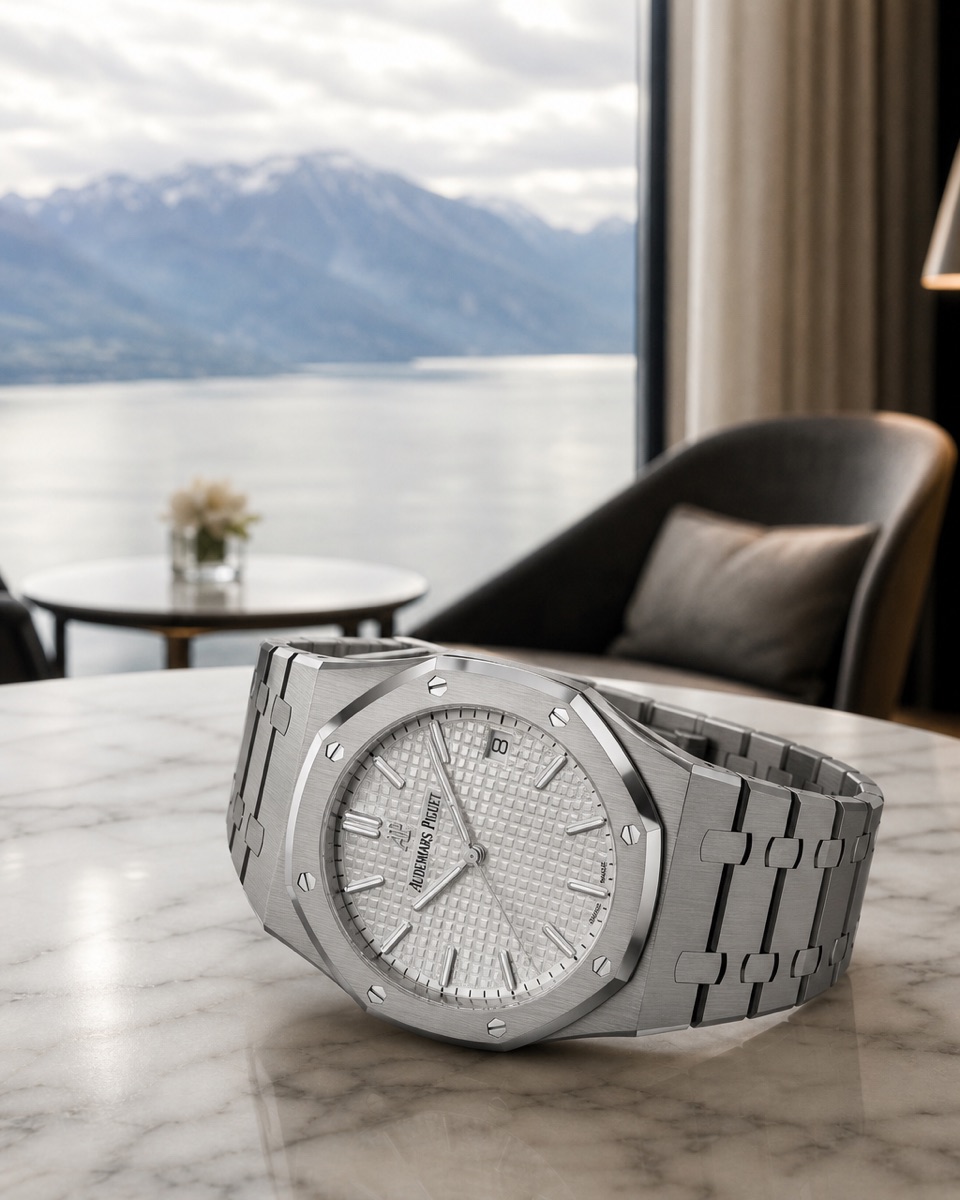
AP made four steel dials, all on the same "Grande Tapisserie" pattern with white gold applied markers. The suffix at the end of the reference tells you which one you're looking at:
| Reference | Dial, in AP's words | Introduced |
|---|---|---|
| 15500ST.OO.1220ST.01 | Blue | 2019 |
| 15500ST.OO.1220ST.02 | Grey | 2019 |
| 15500ST.OO.1220ST.03 | Black | 2019 |
| 15500ST.OO.1220ST.04 | Silver-toned | 2020 |
The colour names are from AP's pages for each suffix (.01, .02, .03, .04); the years come from Monochrome's two launch articles. Monochrome called the grey "slate grey" at launch, and you'll see dealers use other names. One market-data site lists .02 as "smoked grey" and .03 as "dark grey". AP calls the .03 black, so I'd trust the reference over the listing.
The blue had one distinction at launch. Monochrome's launch review reported that "the blue model photographed here is the only one to be a boutique exclusive, the four other editions will be available at official retailers too" (Monochrome). That's the only independent source I found for boutique-only blue, and dealers make the same claim for the blue 15400, so treat it as a launch-time detail.
AI-generated illustration.
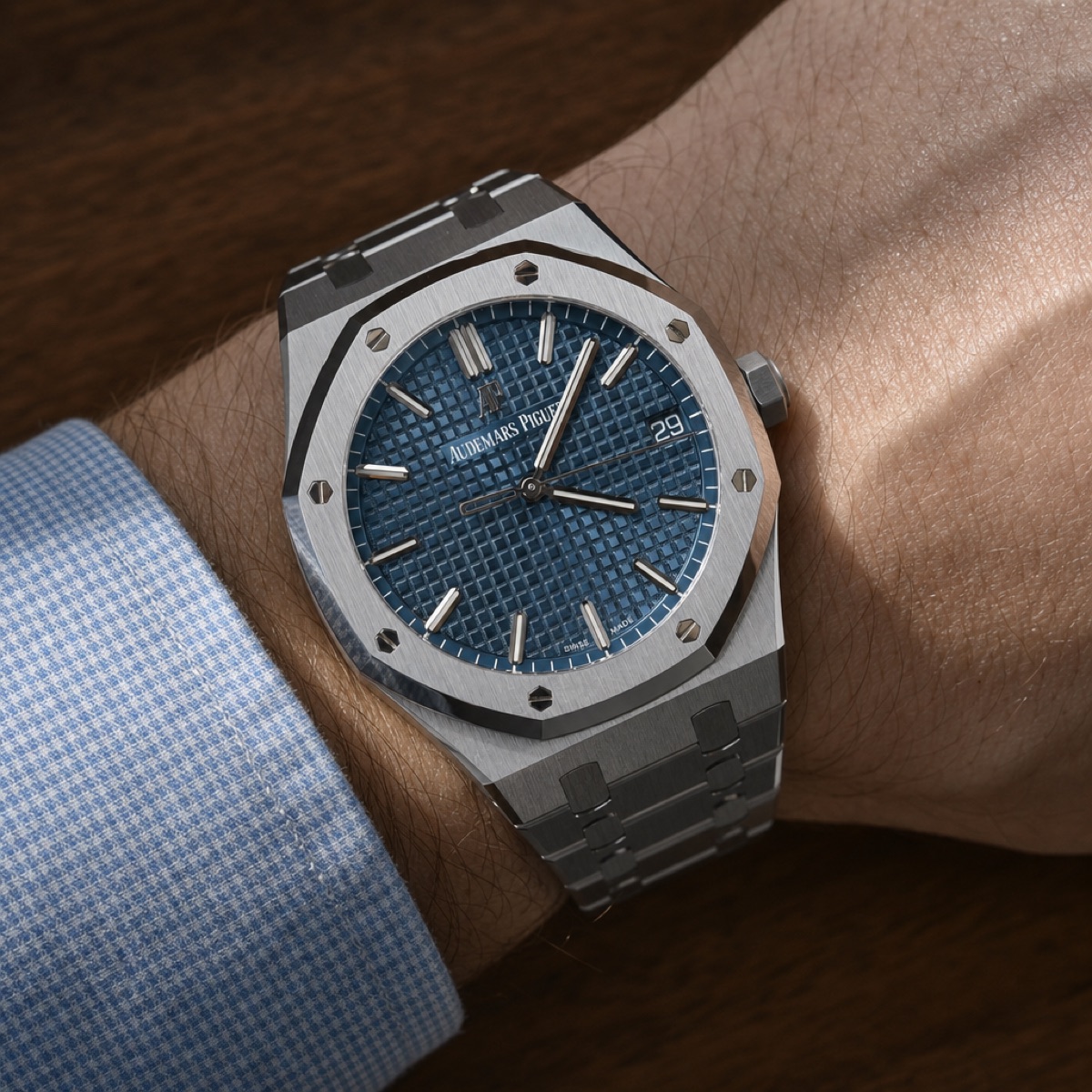
What makes a 15500 dial a 15500 is easiest to see beside a 15400. AP's own description is three items: "wider indexes, a minute train printed on the external area, and a date window further away from the centre" (AP). In practice that means:
- The date window sits out near the edge at three o'clock, with no small hour marker beside it. The 15400 has its date further in, with a short applied marker next to it.
- The hour markers are shorter and broader, and so are the hands, which Monochrome says carry more lume.
- The minute track sits on a smooth ring around the edge of the dial, with thin printed markers. On the 15400 the Tapisserie runs to the edge.
- The text loses the word "Automatic" at six o'clock, and the applied AP logo is slightly larger (Monochrome, Revolution).
That smooth minute ring is also the quickest way to tell a 15500 from a 15510, because the 2022 update moved the minute track back onto the Tapisserie (AP release).
Case and bracelet
The steel case and bracelet didn't change during the run. The middle of the reference reads 1220 on the 15500 and 1320 on the 15510, and the bracelets differ to match. If you're comparing a 15500 with a 15510 in person, the bracelet is the giveaway: the 15500's first links run parallel to each other, where the 15510's first four are trapezoids that taper sooner.
Pink gold
The 15500 also came in 18k pink gold, as 15500OR.OO.1220OR.01 on a gold bracelet and 15500OR.OO.D002CR.01 on an alligator strap, both with black dials at launch. Monochrome gave CHF 50,700 for the bracelet and CHF 32,100 for the strap (Monochrome), and AP still lists the strap version (AP).
Special dials
I couldn't find any. None of the research turned up a retailer-signed, commissioned, regional or misprinted 15500 dial, and Fratello was explicit that the reference "is not a limited edition" (Fratello). The 50th-anniversary pieces came in 2022, after the 15500, and the one aftermarket-customised Royal Oak I came across was a 15400. If someone offers you a "special edition" 15500, ask for AP's paperwork that says so.
AI-generated illustration.
Why it matters
The 15500 arrived just as steel sports watches stopped being things you could buy at retail. In September 2020 Watch Collecting Lifestyle tracked a new blue 15500ST reaching "the $38,575 USD mark" while "the retail price is only $20,400 USD" (WCL). Those are asking prices, but the gap is the point. Phillips sold a 2019 example for CHF 32,500 at its Geneva Watch Auction XI in June 2020 against an estimate of CHF 12,000–18,000 (Phillips), and a blue one for HK$355,600 in Hong Kong in May 2023 (Phillips). By early 2023, even after the market fell, a Morgan Stanley report built on WatchCharts data found the blue 15500 "still valued at more than double its retail price despite a -20% drop in the market value over the past year" (Time+Tide).
The obvious objection is that the 15500 is a three-year stopgap, overpriced in its moment and superseded by a better-finished watch. There's something in that. The 15510 has the more refined case and bracelet, and if you want the newest Royal Oak, that's the one to buy. But the 15500 is the reference where AP fixed the time-and-date Royal Oak's real problem, which was the movement, and it did it without touching the case and bracelet people already liked. The 15510 then changed the shape. If you prefer the older proportions with the newer engine, the 15500 is the only steel reference that gives you both.
I don't own one, but I'd like to. The blue is the obvious choice. I'd probably take the black, because I like the way the shorter markers and the white minute ring read against it.
What I'd check before buying one
- The reference and suffix on the papers against the dial in front of you, using the table above. A grey dial sold as "black" is worth sorting out before money moves.
- The dial details that separate it from a 15400: date near the edge with no marker beside it, smooth outer minute ring, no "Automatic". These are the fastest tells for a 15400 being passed off as the newer reference. Both have sapphire backs, so the caseback alone won't settle it, despite what one market-data site says; the movement behind it will (a 4302 fills the caseback; a 3120 doesn't).
- Box, warranty card and finishing. Fratello describes a new bracelet as brushed on most surfaces with polished angles on every link, so look for crisp lines between the two finishes on the case and links. Soft edges mean polishing, and a Royal Oak's value lives in those lines.
- Fakes. I didn't find an authentication guide from a source I'd trust, so I'd buy from a dealer who takes returns, or have AP look at it.
Sources
- AP Chronicles, "Birth of an Icon"
- AP Chronicles, "The Royal Oak 'Jumbo' Models"
- Audemars Piguet, Royal Oak Selfwinding 15500ST.OO.1220ST.01, and the same page as archived in March 2021
- Audemars Piguet, 15500ST .02, .03, .04 and 15500OR.OO.D002CR.01
- Audemars Piguet, 15400ST.OO.1220ST.01, archived March 2021
- Audemars Piguet, 15510ST.OO.1320ST.01
- Audemars Piguet 50th-anniversary press release, reproduced by La Cote des Montres (2022)
- Monochrome, Royal Oak Selfwinding 41mm 15500ST hands-on (January 2019)
- Monochrome, 15500ST silver dial (2020)
- Revolution, hands-on with the Royal Oak 15500
- Fratello, hands-on with the Royal Oak 15500ST (November 2020)
- Phillips, The Geneva Watch Auction: XI, lot 12
- Phillips, The Hong Kong Watch Auction: XVI, lot 805
- Watch Collecting Lifestyle, September 2020
- Time+Tide, secondary market report (March 2023)