A. Lange & Söhne Datograph Up/Down 405.035
- Make
- A. Lange & Söhne
- Reference
- 405.035
- Model
- Datograph Up/Down
- Variants
- 405.031, 405.034, 405.028
- Production
- 2012–present (in production)
- Case diameter
- 41 mm
- Calibre
- L951.6
- Case material
- Platinum
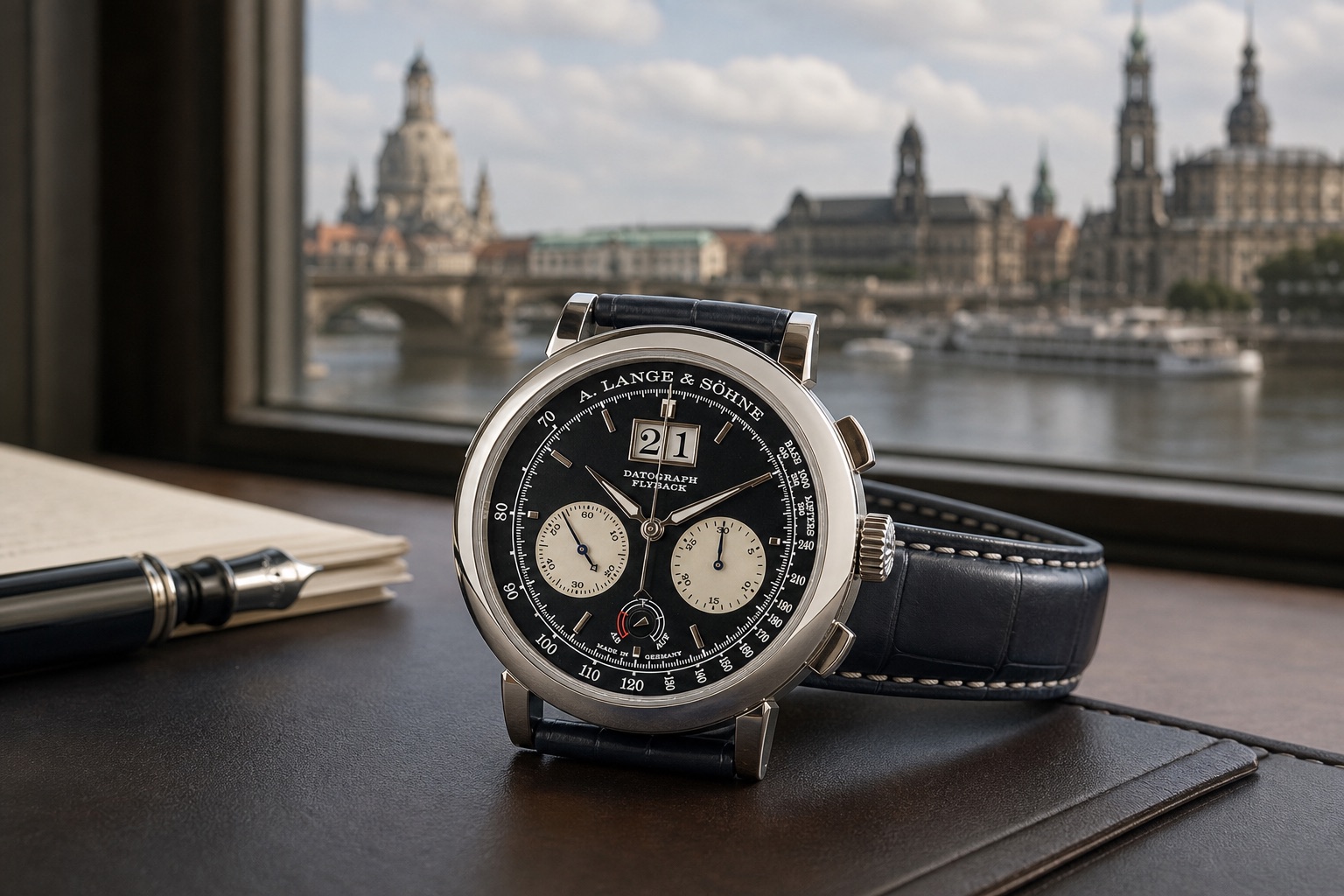
AI-generated illustration.
When Walter Lange and Günter Blümlein restarted A. Lange & Söhne in 1990, the name had nearly vanished. The company had been expropriated after the Second World War, and its first new collection didn't arrive until October 1994. Chronographs weren't new to the family: Ferdinand Adolph Lange, who founded Saxon watchmaking in Glashütte, introduced his first one in 1868. Lange's own account says a chronograph calibre was "right at the top" of the new manufacture's priority list after that. The answer came at Baselworld in 1999: the Datograph, the first chronograph calibre of the modern company, with a flyback, a precisely jumping minute counter, and the first use of Lange's outsize date in a chronograph movement.
Twenty-five years on, Lange's product development director Anthony de Haas still calls it "a reference for a consummate chronograph". In 2012 Lange replaced it. The A. Lange & Söhne Datograph Up/Down 405.035 is that replacement: the same layout and the same basic movement in a 41 mm platinum case, with a bigger mainspring, Lange's own balance spring, and a small power-reserve indicator at 6 o'clock that gives the watch its name. It is the platinum reference that carried the Datograph into its second generation, and it was still listed in 2025.
I don't own one. I want one, which is a fair warning about how I read the evidence below.
Where it came from
The Datograph needs its background explained, because it arrived from a company that was barely five years into making watches again. Blümlein and Walter Lange presented it together at Baselworld 1999. It was developed under Blümlein, who also ran IWC and Jaeger-LeCoultre and saw the demand for a chronograph coming. The calibre, the L951.1, combined a column wheel, a flyback and a precisely jumping minute counter. It was also the first Lange chronograph to carry the house's outsize date. Monochrome describes the clutch as lateral, the classic horizontal arrangement.
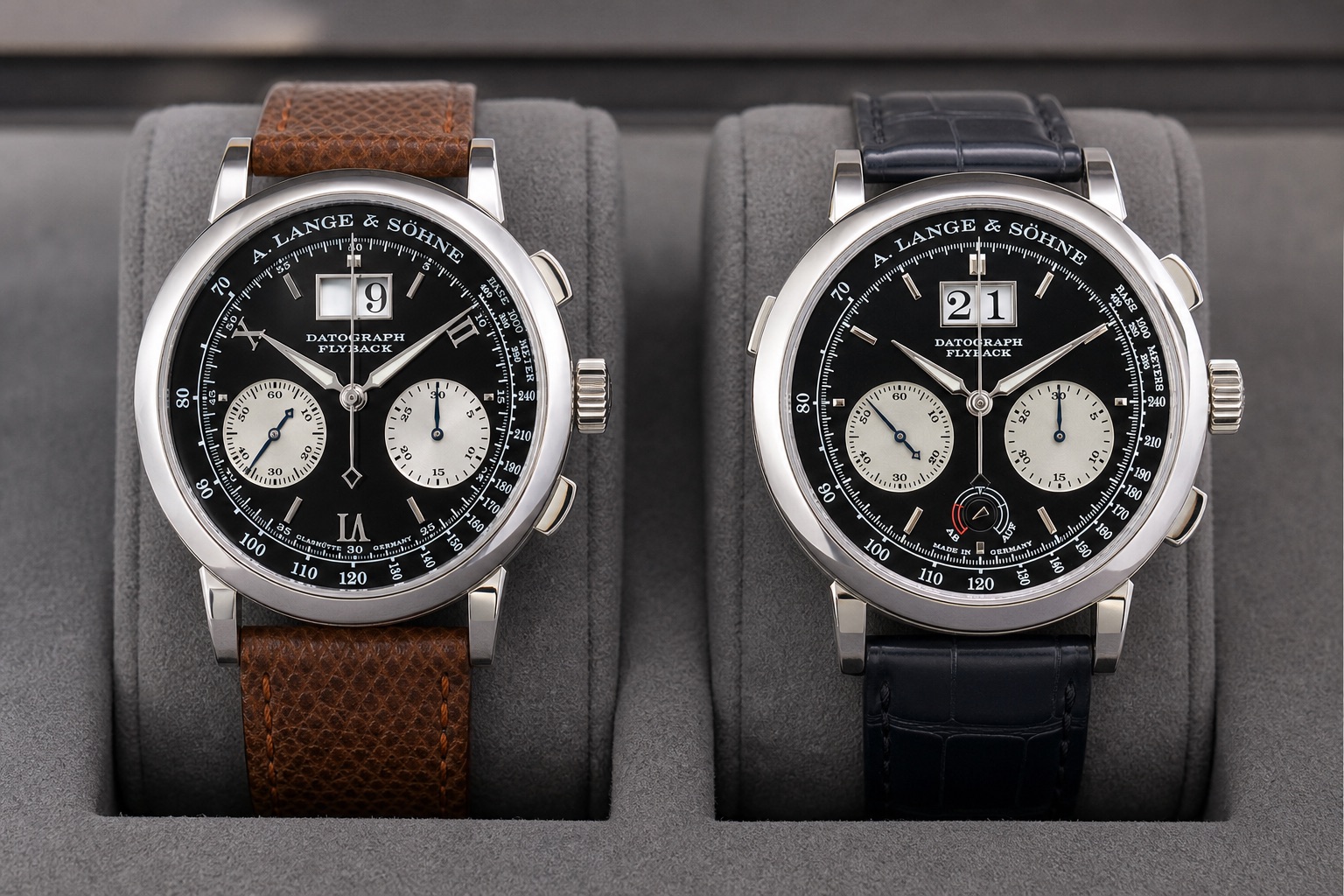
Monochrome's retrospective credits Annegret Fleischer, a movement designer who joined soon after the company restarted, with fitting the mechanism to the dial layout Lange wanted. Langepedia adds Reinhard Meis and Helmut Geyer to the development team, but I've found that only in one place. The dial itself, Lange says, was the work of unnamed "Lange engineers". They moved the two light subdials down slightly so they form an equilateral triangle with the outsize date, and that triangle is still the face of the watch.
Context explains the reaction. In 1999 Patek Philippe had no in-house chronograph: its 5070 of 1998 ran on a Lemania 2310 base, and Patek's own chronograph calibre didn't arrive until 2005. A German company only five years into production had built the more ambitious movement. Philippe Dufour, an independent watchmaker known for his attention to movement finishing, rated it highly enough to buy one, and Monochrome reports that it is the only watch he ever purchased. A line in which Dufour calls it the best chronograph movement ever made circulates in at least three different wordings, and I couldn't trace any of them to the original interview, so I'm leaving the quote out.
Phillips sums up the reception plainly: the original has "widely been regarded by collectors as one of the finest modern chronograph wristwatches produced by any firm". That's an auction house describing something it sells, but I haven't found a specialist who disagrees.
For its first few years the Datograph came only in platinum with a black dial. The family then grew in small steps. A pink gold version with a black dial and silver subdials, the 403.031, ran from about 2003 to 2005, and the more common pink gold 403.032 replaced it from 2005. SJX lists a single yellow gold reference, the 403.041 of 2008, which he estimates was made for a year or two at most and calls "possibly the only Lange model made in this metal with a black dial". Early platinum dials have their own collector detail: Phillips notes that pieces made before 2005 read "METER" on the tachymeter track instead of "meters". All of these are first-generation watches, and none of them carries over to the Up/Down.
The original reference, the platinum 403.035, stayed in the catalogue for about twelve years and was, in SJX's words, "the most common and longest lived" of the family. Sources split on its end date: a Phillips lot essay gives 1999 to 2011, while the Phillips collecting guide and SJX give 2012. The split is about where you draw the line, since the Up/Down was the replacement.
SJX showed the new watch on 20 December 2011, ahead of its public debut at SIHH in January 2012. Sotheby's and Bonhams both date the platinum 405.035 to that show. Lange's name for it is the Datograph Up/Down, "Auf/Ab" in German, after the power-reserve scale at 6 o'clock. Sotheby's credits the nickname to collectors.
I couldn't confirm a launch price. One trade report gives 69,000 euros and a dealer page gives 82,500, and I couldn't open the first or find a Lange price list to settle it. No source I read names a designer for the 2012 update, either. The record shows only what changed.
The watch
| Spec | Value |
|---|---|
| Reference | 405.035 |
| Case | Platinum, 41 mm diameter, 13.1 mm thick |
| Caseback | Sapphire crystal |
| Dial | Black, with silvered subdials and baton markers |
| Calibre | L951.6, manual winding |
| Jewels | 46 |
| Parts | 451 |
| Frequency | 18,000 vph |
| Power reserve | 60 hours |
| Functions | Hours, minutes, small seconds; flyback chronograph with precisely jumping minute counter; outsize date; power-reserve indicator |
| Strap | Black leather |
The dimensions come from Monochrome and aBlogtoWatch, and the jewel count from the Sotheby's catalogue, which matches the Phillips record for the pink gold 405.031. Neither source says whether the diameter includes the crown. I couldn't reach Lange's own specification page, so the water resistance, lug width and buckle of the 405.035 are missing from the table. Monochrome gives 30 metres for the 2024 white gold 405.028, but I wouldn't assume it carries over.
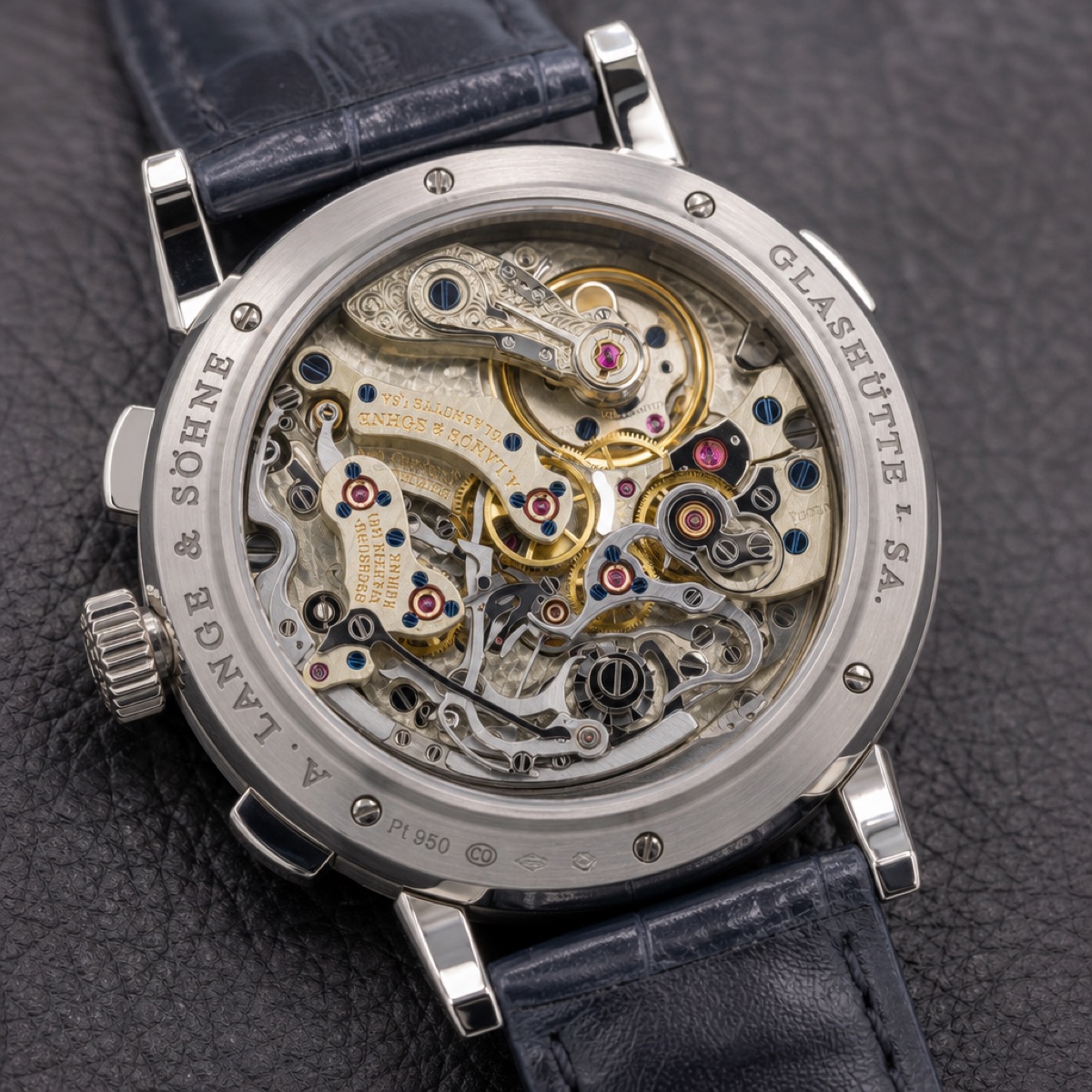
The movement is the reason to care about the rest of the table. SJX describes the L951.6 as fundamentally the L951.1 with two changes. The first is a larger mainspring, which raises the power reserve from 36 hours to 60. Sotheby's, Bonhams and Monochrome agree on the 36; Phillips' guide says 38, and I'm going with the majority. The second change is the regulating organ: a free-sprung balance with an overcoil hairspring made in-house, which Lange had first used in the Double Split. The Phillips guide notes that this replaced a bought-in Nivarox spring. Lange's own history lists it, as "an oscillation system developed in-house", alongside the power reserve as what the 2012 update added.
What carried over matters as much. The column wheel and the flyback stayed, and so did the jumping minute counter, which advances a full minute at a time instead of creeping. The parts count went from 405 to 451 according to Monochrome, and the frequency stayed at 18,000 vibrations per hour. The sapphire back is there because the movement is the point of the watch. De Haas describes the view through it as the place where "the micromechanical orchestration" of the chronograph shows itself.
At 41 by 13.1 mm in platinum this is a heavy, fairly thick watch for a manual-wind chronograph. aBlogtoWatch called the thickness "noticeable" at launch, and I'd expect that to be the first thing a buyer used to a vintage chronograph notices.
AI-generated illustration.
How it changed
The family is easier to follow as a table. The years come from the sources linked in each section and are approximate where they disagree.
| Years | Reference | Case | Dial | Calibre | Power reserve |
|---|---|---|---|---|---|
| 1999–2011/12 | 403.035 | Platinum, 39 mm | Black, silvered subdials, Roman numerals | L951.1 | 36 h |
| 2012– | 405.035 | Platinum, 41 mm | Black, silvered subdials, batons, power reserve at 6 | L951.6 | 60 h |
| 2015– | 405.031 | Pink gold, 41 mm | Black, as 405.035 | L951.6 | 60 h |
| 2018 | 405.034 Lumen, 200 pieces | 41 mm, 13.4 mm thick | Tinted sapphire, luminous | L951.7 | not confirmed |
| 2024 | 405.028, 25th anniversary | White gold | Blue | not confirmed | not confirmed |
The step from 403.035 to 405.035 is the only redesign of the standard watch. Within the 405.035's own run I found no documented change to the dial, hands, case or movement. A buyer can't date one by its details the way you'd date a vintage Rolex; the papers and the case and movement numbers do that job.
The siblings are variations on the same watch. Sotheby's says the pink gold version followed "at the same venue in 2015", and SJX says that aside from the case metal everything else stayed the same. A Phillips lot ties that pink gold watch to reference 405.031. The Lumen of 2018, reference 405.034, is a different object. It has a translucent, grey-tinted sapphire dial, and the hands, power-reserve pointer, date, registers and tracks glow green in the dark. The changes to the movement were enough for Lange to give it a new calibre number, the L951.7, and the case grew to 13.4 mm thick at the same 41 mm. It was limited to 200 pieces at €95,000 including German VAT, and SJX notes that it was the first limited Datograph since the ten Pisa pieces of 2004. The blue-dial white gold 405.028 marked the Datograph's 25th anniversary in 2024, at about €125,000 according to Monochrome. The 403.x generation had several more variants, in pink and yellow gold and retailer editions, and those belong to the original Datograph's story.
The variations that matter
Dials
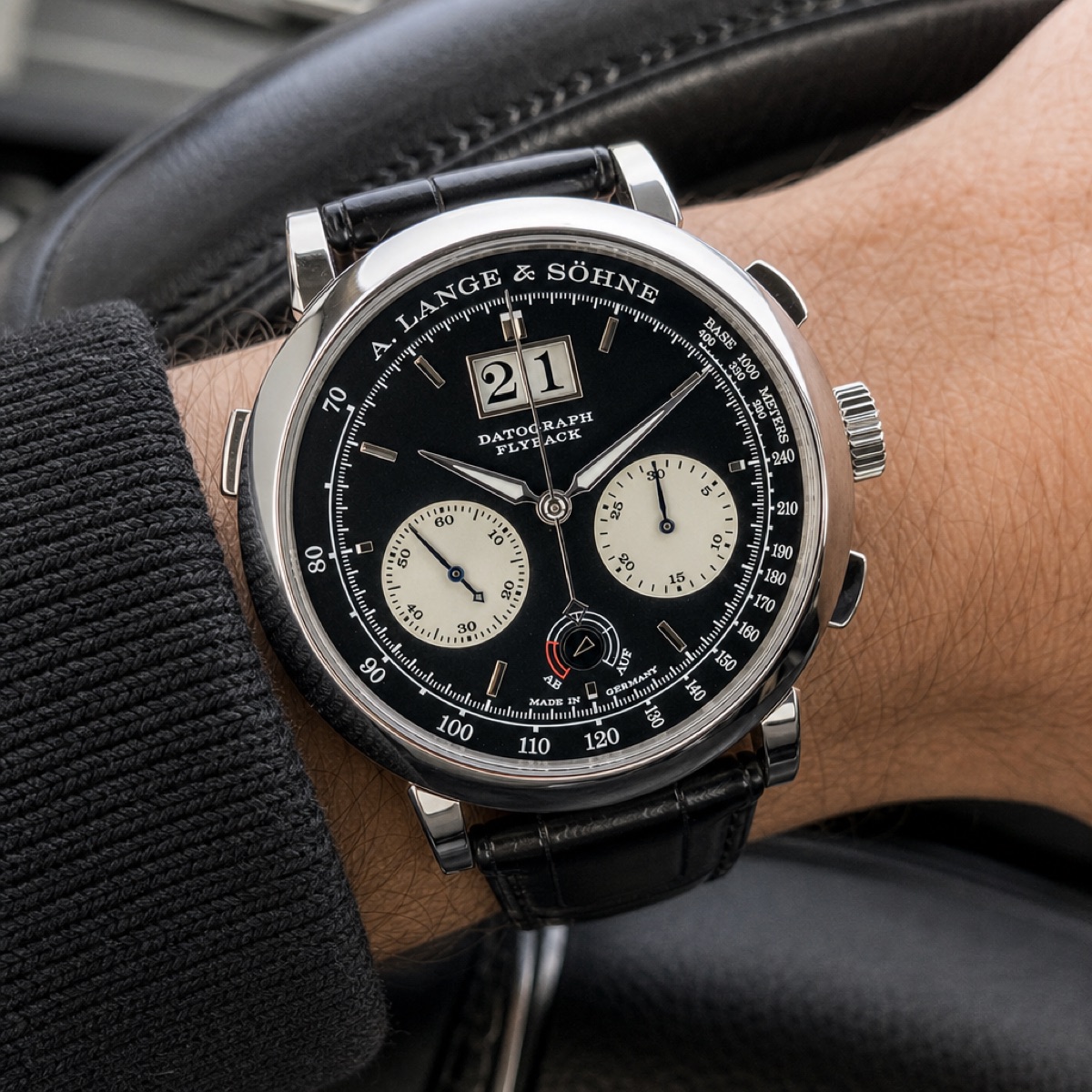
What separates a 405.035 from a 403.035 in a photo is the dial, and it changes in three places. The Roman numerals of the original became applied baton markers. A small power-reserve indicator, marked Auf and Ab, sits at 6 o'clock between the subdials. And Phillips notes the outsize date window grew by about 4% so it would keep its proportion on the larger dial. The black dial and silvered subdials stayed, and so did the triangle the subdials make with the date.
AI-generated illustration.
Not everyone liked the trade. SJX wrote at the launch that he preferred the Roman numerals and wasn't sure what to make of the all-baton dial, and he wondered whether the longer power reserve was needed at all or mainly gave the new model something to distinguish it. That's a fair objection, and I'll give it its due: the original is the better-known design, and its Roman dial is the one that made the reputation. My own read is that the batons suit the bigger case and the power-reserve indicator is useful on a manual-wind watch you'll leave in a drawer between wears. But it's a matter of taste, and plenty of collectors would take the 403.035 at the same money.
AI-generated illustration.
Case
Every 405.035 is platinum at 41 mm, two millimetres up on the original's 39, and 13.1 mm thick. The pink gold 405.031 shares the black dial, so the reference on the papers settles which metal you're looking at when a photo doesn't.
Co-branded, commissioned and unique dials
Searches of the auction houses and specialist guides turned up no retailer co-branded dial, service dial or named factory error on the 405.035. The famous one-offs and retailer editions, such as the ten "albino" pieces for Pisa Orologeria in 2004 and the unique dials made for Mannesmann VDO executives, are all from the 403.x generation according to SJX's reference guide. Dealer copy sometimes lets those stories drift onto the Up/Down.
The one special Up/Down I could document is the Hampton Court Edition, a unique piece in white gold with a grey dial and black subdials. It's a separate white gold piece. Lange sold it for charity through Phillips with Bacs & Russo in Geneva on 9 November 2024, with proceeds going to the King's Trust, and it made CHF 825,500 including premium. That figure says much more about a unique piece sold for charity than about the standard watch.
Why it matters
The 405.035 is where a watch the critics had already settled on got its one serious update. Lange kept the layout, the flyback and the jumping minute counter, and changed the regulating organ and the mainspring. My read is that this continuity is why the Up/Down has stayed in the catalogue for more than a decade. Langepedia, a dealer-run reference, listed it at $127,000 in the US in 2025.
The secondary market is far below that. Three dated auction results for the platinum Up/Down:
| Date | House | Lot | Watch | Result |
|---|---|---|---|---|
| 28 Apr 2019 | Antiquorum Hong Kong | 185 | 405.035 | HKD 400,000, premium basis not stated |
| 23 May 2025 | Bonhams Hong Kong | 902 | 405.035, c.2014 | HK$486,400 incl. premium |
| 25 Nov 2025 | Bonhams Hong Kong | 853Y | 405.035, c.2015 | HK$409,600 incl. premium |
Langepedia put platinum Datographs at roughly $75,000 to $85,000 on the used market in June 2025, which is a dealer's view and not a sale. Either way, a buyer pays well under list for a watch that is still made. That's the strongest argument for buying a used one, and the honest objection to buying it new.
What I'd check before buying one
- Papers and numbers: The case and movement numbers should match the certificate. The November 2025 Bonhams watch sold with box and manual but no papers listed, and that's worth pricing in.
- The dial: Batons, power reserve at 6 and a black dial with silvered subdials. Roman numerals mean a 403.x, whatever the listing says.
- Metal: Platinum for 405.035. If the seller's photos only show it under warm light, ask for the reference on the papers before arguing about the colour.
- The movement through the back: It should show the column wheel and the in-house balance. Lange's service policy and costs for the L951.6 are something I couldn't source, so ask the seller for the service history and ask Lange directly before you buy.
Sources
- A. Lange & Söhne press: Datograph: 25 years of chronograph history; Outstanding auction result for the Datograph Up/Down Hampton Court Edition
- Phillips: A. Lange & Söhne Datograph collecting guide; Datograph 403.035, lot 73; Datograph Up/Down 405.031, Hong Kong lot 810
- Sotheby's: Datograph Up/Down 405.035, Important Watches, 2021
- Bonhams: 405.035 c.2014, lot 902, May 2025; 405.035 c.2015, lot 853Y, November 2025
- Antiquorum, 405.035, lot 185, April 2019
- SJX: Introducing the Lange Datograph Up and Down, December 2011; Lange Datograph reference versions, dates and unique pieces, July 2013; Datograph Up/Down in pink gold; Datograph Lumen, October 2018
- Monochrome: The Datograph from 1999 until now; Datograph Up/Down review
- aBlogtoWatch, Datograph Up/Down hands-on, 2012
- Langepedia: Datograph encyclopedia entry; Datograph guide
- Research dossier:
~/Projects/notebook/personal/research/watches/2026-10-30-a-lange-sohne-datograph-up-down-405-035-dossier.md